Biology · Material Cycles
The Carbon Cycle
Carbon is in every molecule of every living thing, and the same carbon is used again and again. This lesson is for both Combined Science and separate Biology. It covers how materials cycle through an ecosystem, how carbon moves by photosynthesis, feeding, respiration, decay and combustion, the role of microorganisms as decomposers, and why the carbon cycle matters.
Learning Objectives
- 1Describe how materials cycle through the abiotic and biotic components of an ecosystem.
- 2Describe the processes in the carbon cycle: photosynthesis, respiration, feeding, decay and combustion.
- 3Explain the role of microorganisms as decomposers in returning carbon to the air.
- 4Explain why the carbon cycle is important, including the effect of burning fossil fuels on the carbon dioxide in the air.
Retrieval practice
-
1
Write the word equation for photosynthesis.
Show answerHide answer
carbon dioxide + water → glucose + oxygen, in the presence of light.
-
2
Write the word equation for aerobic respiration.
Show answerHide answer
glucose + oxygen → carbon dioxide + water.
-
3
What is a producer?
Show answerHide answer
An organism that makes its own food, usually by photosynthesis, such as a plant.
-
4
What do biotic and abiotic mean?
Show answerHide answer
Biotic means living and abiotic means non-living.
Nothing is wasted
An ecosystem receives a constant supply of energy from the Sun, but the Earth receives almost no new matter. The carbon, nitrogen and water in living things therefore have to be used again and again. They move between the abiotic parts of the environment, such as the air, water, soil and rock, and the biotic parts, the living organisms. A material cycle describes this journey. Some of the carbon atoms in your body have been in plants, animals and the air many times before.
Materials cycle through an ecosystem
A cycle takes a material out of the environment into living things and then back again.
-
Abiotic and biotic
The abiotic components are the non-living parts of an ecosystem, such as air, water, soil and rocks. The biotic components are all the living organisms, including plants, animals and microorganisms.
-
A limited supply
The Earth is almost a closed system for matter, so there is only a fixed supply of elements such as carbon, nitrogen and oxygen, and these have to be recycled.
-
Going in and coming out
Organisms take materials from the abiotic environment to build their bodies. The materials return to the environment through respiration, waste and when the organisms die and decay.
-
Three cycles
You need to know the carbon cycle, the water cycle and the nitrogen cycle, and how each one moves materials between the air, the soil or water and living things.
Carbon in the air and in living things
Carbon is the element that every molecule of life is built around.
-
Carbon dioxide in the air
The air contains about 0.04 percent carbon dioxide. This is the main source of carbon for plants and algae, which use it for photosynthesis.
-
Carbon in organisms
Carbohydrates, proteins, fats and DNA are all made from carbon compounds, so all of the carbon in an animal ultimately came from the carbon dioxide taken in by plants.
-
Long-term stores
Carbon is also stored for a very long time in fossil fuels, such as coal, oil and natural gas, which are made from the remains of living things.
The carbon cycle
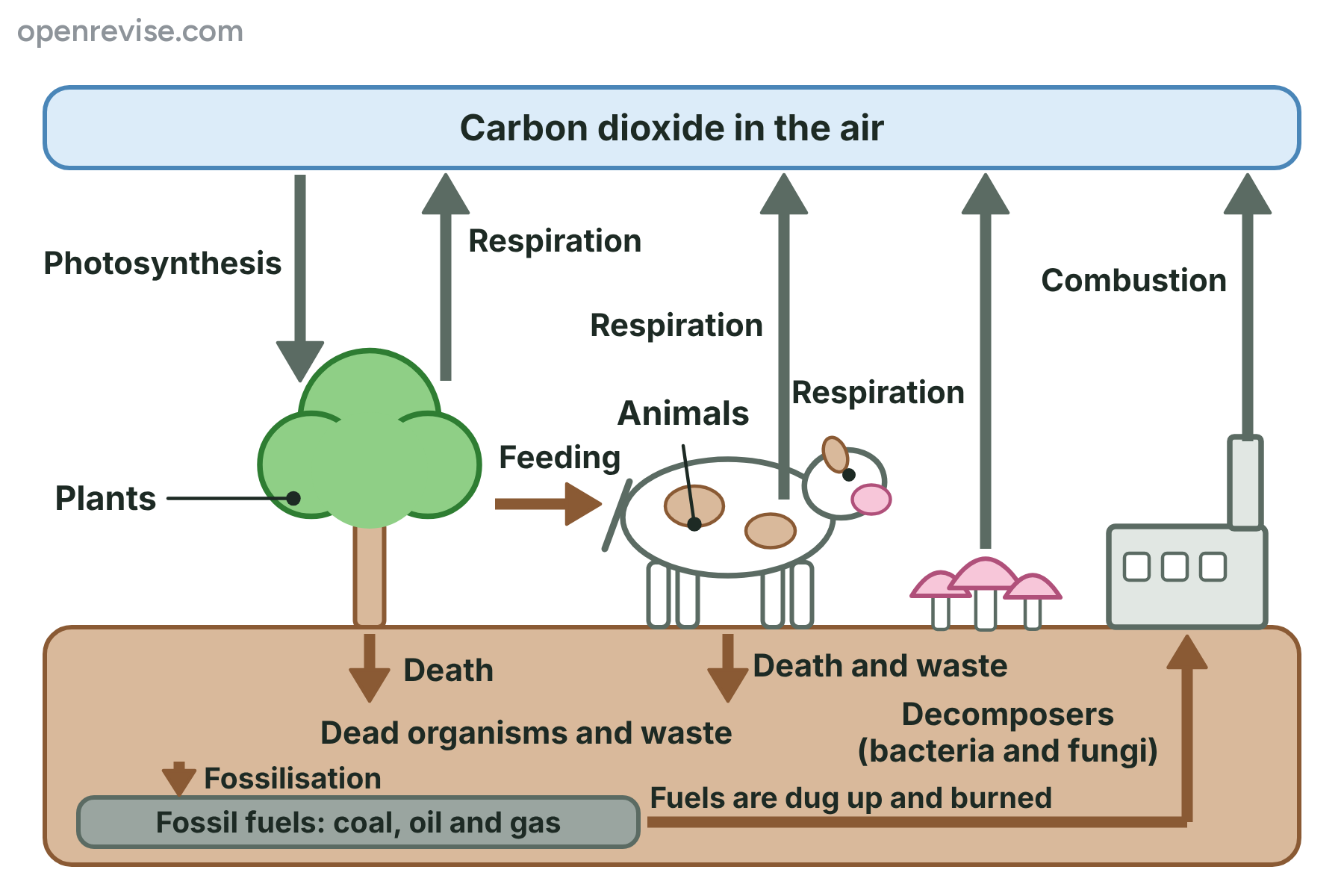
Grey arrows show carbon dioxide moving; brown arrows show carbon in compounds moving.
Following carbon around the cycle
Start with the carbon dioxide in the air and follow it through the processes in the order they happen.
-
1
Photosynthesis
Plants and algae take carbon dioxide from the air and use light energy to make glucose. The carbon becomes part of carbohydrates, proteins and fats in the plant.
-
2
Feeding
Animals eat the plants, so carbon compounds pass to the animals and then along the food chain to the animals that eat them.
-
3
Respiration
Plants, animals and microorganisms all respire, which releases carbon dioxide back into the air.
-
4
Death and decay
Dead organisms, faeces and other waste contain carbon compounds. Decomposers break them down and release carbon dioxide into the air by respiration.
-
5
Fossilisation
If dead remains are buried where there is no oxygen, they do not fully decay. Over millions of years they can form fossil fuels such as coal, oil and gas.
-
6
Combustion
Burning wood or fossil fuels releases the stored carbon as carbon dioxide into the air, much faster than it was stored.
Decomposers
Decomposers are the microorganisms that keep the carbon cycle turning by breaking down dead material.
-
Who they are
Decomposers are mainly bacteria and fungi. They feed on dead plants and animals, on faeces and on other waste.
-
How they feed
They release enzymes onto the dead material. The enzymes break large molecules into small soluble molecules, which the microorganisms absorb.
-
Respiration
The decomposers respire some of the nutrients they absorb. This releases carbon dioxide into the air, which plants can use again.
-
Why they matter
Without decomposers, dead material would pile up and its carbon and mineral ions would stay locked inside it. Plants would run short of nutrients and the cycle would stop.
Quick and slow routes for carbon
Quick cycling
- Photosynthesis takes the carbon out of the air
- Feeding passes it along food chains
- Respiration and decay return it to the air
- The carbon returns in days to years
Slow storage in fossil fuels
- Dead remains are buried without oxygen
- They form coal, oil and gas over millions of years
- The carbon is locked away for a very long time
- Burning releases it as carbon dioxide in a very short time
Why the carbon cycle is important
The cycle keeps carbon available for life and keeps the carbon dioxide in the air fairly steady, unless people upset the balance.
-
A constant supply
Because carbon is recycled, there is always carbon available to build the carbohydrates, proteins and fats of new organisms.
-
A balance
Photosynthesis removes carbon dioxide from the air and respiration, decay and combustion put it back. Normally these processes balance, so the carbon dioxide level stays fairly steady.
-
Human activity
Burning fossil fuels and cutting down forests add carbon dioxide to the air and reduce photosynthesis. This has raised the carbon dioxide level, and carbon dioxide is a greenhouse gas that contributes to global warming.
-
Nutrients returned
Decay returns carbon and mineral ions to the soil and air, which keeps the soil fertile for plants.
Case study
Carbon dioxide measured over the years
Scientists at an observatory on Mauna Loa in Hawaii have measured the carbon dioxide in the air every year since 1958. The level was about 315 parts per million in 1958 and has risen to over 420 parts per million. Each year the level dips slightly in the northern summer, when plants photosynthesise most, and then rises again. The steady rise is mostly caused by burning fossil fuels and by deforestation, which add carbon dioxide faster than photosynthesis and the oceans can remove it.
Percentage increase in carbon dioxide
The carbon dioxide in the air was 315 parts per million in 1958 and 420 parts per million in 2023. Calculate the percentage increase.
Show the solutionHide the solution
- 1 Find the increase \(420 - 315 = 105\) parts per million
- 2 Divide by the starting value \(105 \div 315 = 0.333\)
- 3 Multiply by 100 \(0.333 \times 100 = 33\%\)
AnswerThe carbon dioxide level increased by 33%.
The big idea
Carbon is cycled between the air and living things by photosynthesis, feeding, respiration, decay and combustion, and decomposers keep the cycle turning.
The carbon cycle
The carbon cycle
-
Out of the air
- photosynthesis in plants and algae
-
Through living things
- feeding along food chains
- carbon compounds
-
Back to the air
- respiration
- decay
- combustion
-
Decomposers
- bacteria and fungi
- enzymes
- respiration
-
Importance
- supply of carbon
- balance of carbon dioxide
- global warming
Summary and exam focus
- Materials such as carbon cycle between the abiotic environment and living things, because the Earth has only a limited supply.
- Photosynthesis removes carbon dioxide from the air, and respiration, decay and combustion return it.
- Carbon passes along food chains in carbon compounds by feeding.
- Decomposers, bacteria and fungi, break down dead material and release carbon dioxide by respiration.
- Burning fossil fuels and deforestation raise the carbon dioxide level in the air and contribute to global warming.
Exam focus
Describe how carbon in the carbon dioxide of the air becomes part of a fox, and how it returns to the air. (6 marks) (6 marks)
Follow the carbon in order, using the names of the processes. Start with photosynthesis in the grass, then feeding along the food chain to the fox, then give the ways it returns: respiration, and death and decay by decomposers. Name each process and say what happens to the carbon in it, rather than just listing the words.
Key terms
The words this lesson expects you to use. Each one is linked from the first place it appears above.
- Abiotic
- The non-living parts of an ecosystem, such as air, water, soil and rock.
- Biotic
- The living parts of an ecosystem, such as plants, animals and microorganisms.
- Carbon cycle
- The movement of carbon between the air, living things, the soil and fossil fuels.
- Decomposer
- A microorganism, such as a bacterium or fungus, that breaks down dead material and waste.
- Decay
- The breakdown of dead plants and animals and waste by decomposers.
- Combustion
- The burning of a fuel such as wood or coal, which releases carbon dioxide.
- Fossil fuel
- A fuel such as coal, oil or natural gas that formed over millions of years from the remains of living things.
- Deforestation
- The cutting down of forests, which reduces photosynthesis and often releases carbon dioxide.
- Greenhouse gas
- A gas such as carbon dioxide that traps heat in the atmosphere and contributes to global warming.
- Carbon compound
- A substance such as a carbohydrate, protein or fat that contains carbon, which is passed along food chains.
You've finished the notes
Check your understanding
Test yourself while it is fresh. Start with the flashcards, then try the exam questions.
Something here looks wrong?
Tell us what and we will go and look. It goes to whoever writes these pages, nobody else, and we do not ask who you are — so there is nothing to sign and nothing comes back to you.