Biology · Material Cycles
The Water Cycle and Potable Water
Every living thing needs water, and the water on Earth is used again and again. This lesson is for both Combined Science and separate Biology. It covers the processes of the water cycle, why the cycle is important, how potable water is made, and how areas of drought make it by desalination.
Learning Objectives
- 1Describe the processes in the water cycle: evaporation, transpiration, condensation, precipitation and run-off.
- 2Explain why the water cycle is important to living things and to ecosystems.
- 3Describe how potable water is produced from fresh water, and explain why potable water is not the same as pure water.
- 4Explain how potable water is produced in areas of drought, including desalination by distillation and by reverse osmosis, and evaluate it.
Retrieval practice
-
1
What is the change of state from a liquid to a gas called?
Show answerHide answer
Evaporation.
-
2
What do plant roots take up from the soil?
Show answerHide answer
Water and mineral ions.
-
3
What do the stomata in a leaf do?
Show answerHide answer
They let gases, including water vapour, move in and out of the leaf.
-
4
What is the main source of energy for an ecosystem?
Show answerHide answer
The Sun.
Water on the move
Cells are mostly water, and the chemical reactions of life take place in solution, so every organism needs a supply of water. The water on Earth is the same water that has been moving between the sea, the air, the land and living things for billions of years. The water cycle is powered by energy from the Sun, and it moves water between the abiotic parts of the environment and the biotic parts, the living organisms.
The processes in the water cycle
Five processes move water between the sea, the air, the land and living things.
-
Evaporation
Energy from the Sun turns liquid water from the sea, rivers, lakes and wet soil into water vapour, which rises into the air.
-
Transpiration
Plants take water up through their roots, and most of it evaporates from the leaves through the stomata. A large tree can transpire hundreds of litres of water on a hot day.
-
Condensation
The rising water vapour cools in the colder air higher up and condenses into tiny droplets of liquid water, which form clouds.
-
Precipitation
When the droplets in a cloud join into drops that are heavy enough, they fall as rain, snow, sleet or hail.
-
Run-off
Water that falls on land runs over the surface and through the soil into streams and rivers and back to the sea. Some soaks into the ground and collects as groundwater.
The water cycle
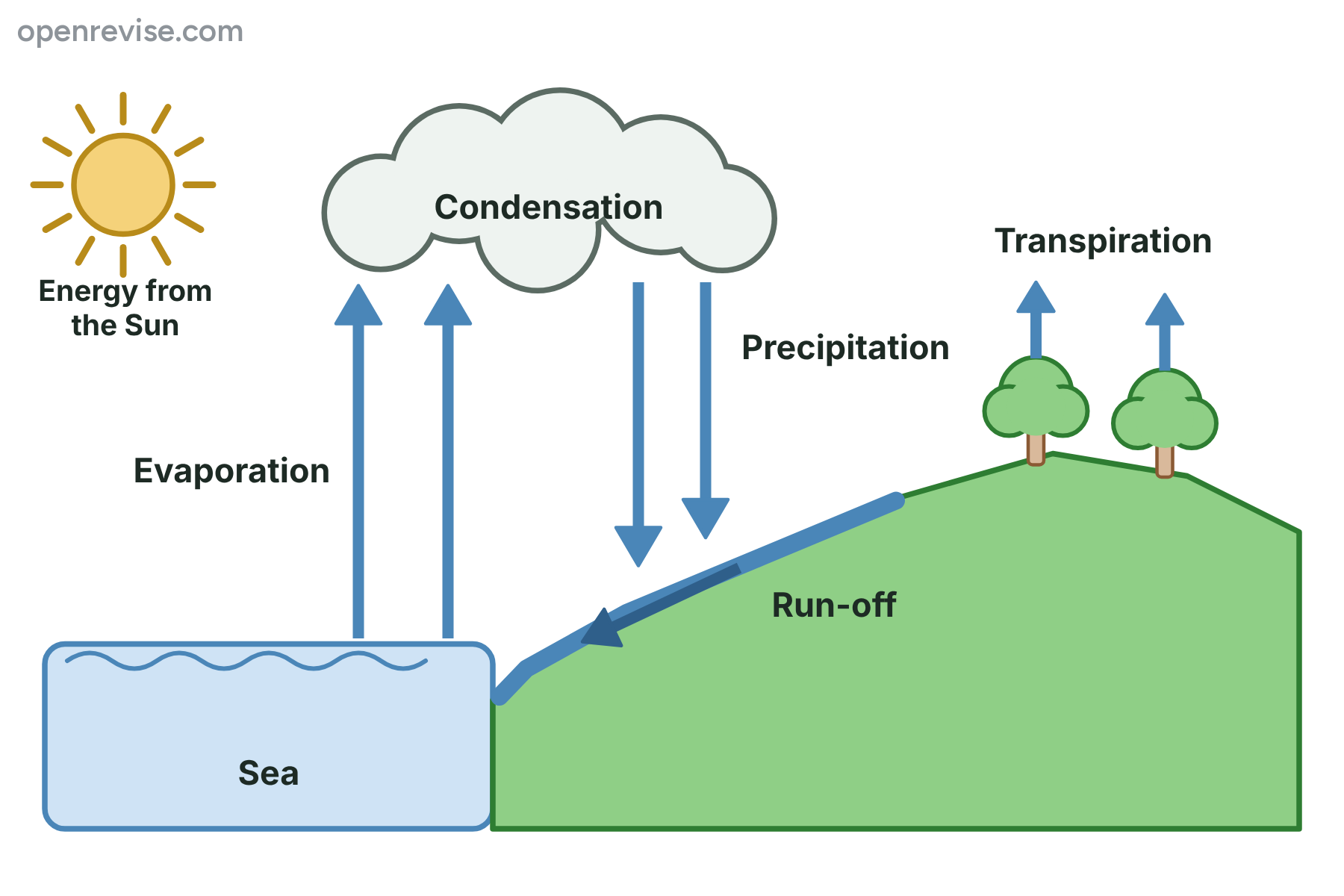
The Sun's energy drives the cycle: water evaporates, condenses, falls and runs back to the sea.
Why the water cycle is important
Without the water cycle, life on land would run out of fresh water.
-
A supply of fresh water
Evaporation leaves salts behind, so the rain that falls is fresh water. This is what land plants and animals drink and what fills rivers, lakes and reservoirs.
-
Needed for life
Water is a solvent for the reactions in cells, it carries substances around organisms, it is a raw material for photosynthesis and it supports plant cells so that they stay firm.
-
Moving materials
Run-off and rivers carry dissolved mineral ions from the land to the sea, which moves materials between the abiotic and biotic parts of ecosystems.
-
Shaping ecosystems
Where and how much rain falls decides whether an area becomes a rainforest, a grassland or a desert, so the cycle shapes which organisms can live where.
Potable water
Potable water is water that is safe to drink, which is not the same as pure water.
-
Potable is not pure
Pure water contains only water molecules. Potable water can contain dissolved substances, such as small amounts of salts, as long as the levels of dissolved substances and microorganisms are low enough to be safe.
-
Sources in the UK
Most of the potable water in the UK starts as rain collected in reservoirs, rivers and underground rocks, where it contains low levels of dissolved substances.
-
Why it is treated
Untreated water may contain microorganisms, such as the bacteria that cause cholera and typhoid, so it has to be treated before it is supplied.
Making potable water from fresh water
The treatment steps are the same in most water works.
-
1
Choose a source
Water is taken from a reservoir, river or borehole where the levels of dissolved substances are low.
-
2
Filter it
A screen removes large objects, then beds of sand and gravel filter out smaller solid particles.
-
3
Sterilise it
Chlorine, ozone or ultraviolet light kills the microorganisms that remain.
-
4
Supply it
The treated water is stored and sent to homes through pipes.
Making potable water in areas of drought
In a drought there is too little rain for the reservoirs and rivers to supply the people who live there.
-
Desalination
Where the sea is nearby, sea water can be turned into potable water by removing the dissolved salts. This is desalination.
-
Distillation
Sea water is heated until it boils. The steam leaves the salt behind and is cooled in a condenser, where it turns back into pure water. It needs a large amount of energy to heat the water.
-
Reverse osmosis
Sea water is forced at high pressure through a partially permeable membrane. Water molecules pass through but the salt ions do not.
-
Other ways
Areas of drought can also store rainwater, recycle waste water, pipe in water from elsewhere or pump groundwater from deep boreholes.
Two ways to remove the salt from sea water
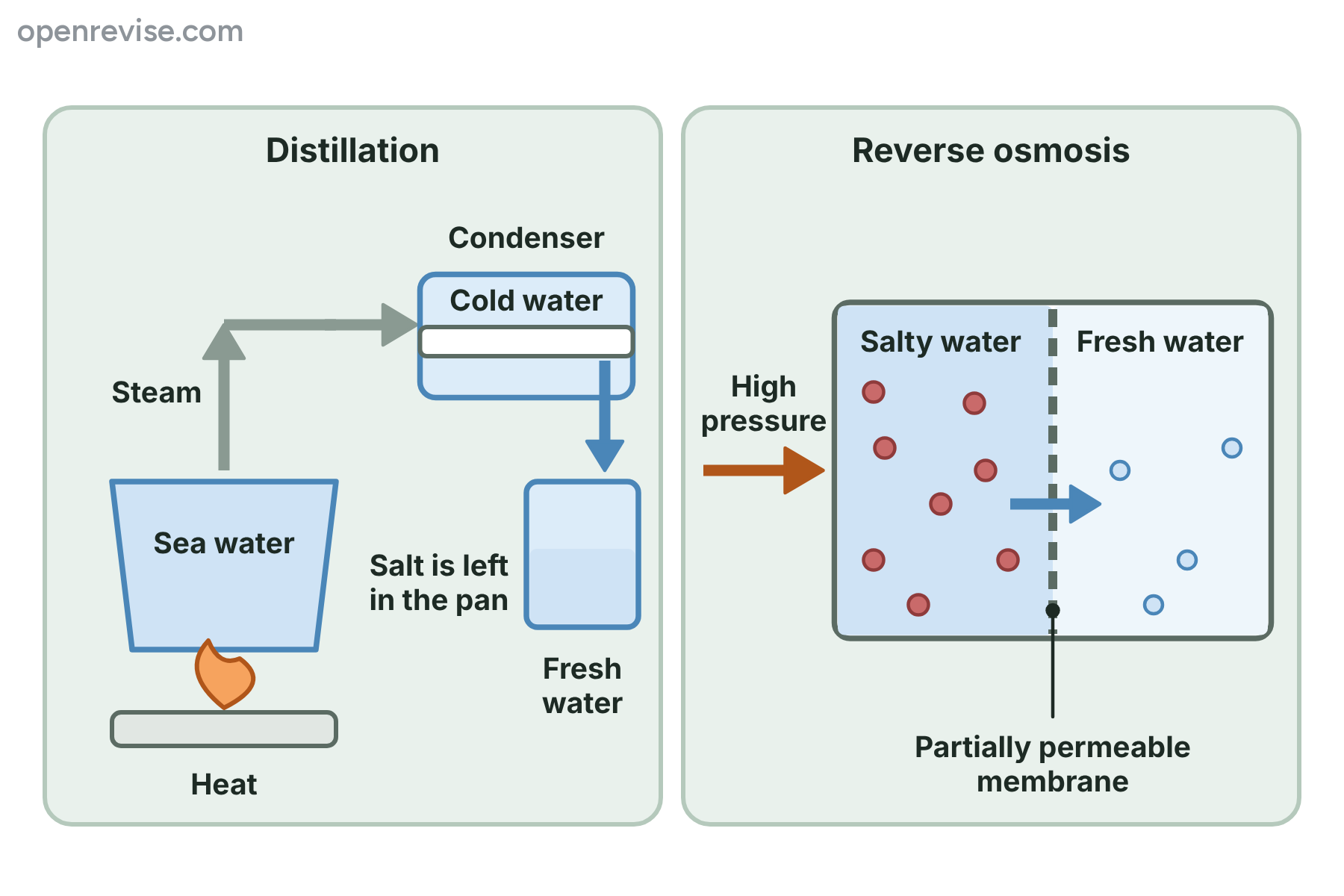
Both methods leave the salt behind, but both need a lot of energy.
Distillation and reverse osmosis compared
Distillation
- The sea water is boiled and the steam is condensed
- Salt and other solids are left behind
- Uses a lot of energy for heating
- Gives very pure water
Reverse osmosis
- The sea water is pushed through a partially permeable membrane
- Salt ions cannot pass through the membrane
- Uses energy to create a high pressure, usually less than heating
- The membranes are expensive and must be replaced
Evaluating desalination
Desalination solves one problem but creates others, so an evaluation gives both sides.
-
Advantages
It gives a reliable supply of potable water that does not depend on the rain, and the sea is a supply that will not run out.
-
Energy cost
It needs a large amount of energy, which makes the water expensive. If the energy comes from burning fossil fuels, it adds carbon dioxide to the air.
-
Waste brine
The very salty water that is left behind has to be got rid of, and it can harm sea life if it is pumped back into the sea.
-
Where it makes sense
It is most useful in dry coastal areas that can afford the energy, and often used as a back-up in a drought.
How much fresh water is recovered
A reverse osmosis plant treats 100 000 litres of sea water and produces 40 000 litres of potable water. Calculate the percentage of the sea water that becomes potable water.
Show the solutionHide the solution
- 1 Divide the potable water by the sea water \(40\,000 \div 100\,000 = 0.4\)
- 2 Multiply by 100 \(0.4 \times 100 = 40\%\)
Answer40% of the sea water becomes potable water.
Case study
A desalination plant for London
The UK is not a dry country, but the south east gets less rain than many people expect. Thames Water built a reverse osmosis plant at Beckton in east London, which opened in 2010. It treats slightly salty water from the River Thames estuary and was designed to supply up to about 150 million litres of potable water a day. Because it uses a lot of energy, it is kept for times of drought rather than used all the time.
The big idea
Water cycles between the sea, the air, the land and living things, and in areas of drought potable water can be made by removing the salt from sea water.
The water cycle
The water cycle
-
Processes
- evaporation
- transpiration
- condensation
- precipitation
- run-off
-
Importance
- fresh water supply
- needed for life
- shapes ecosystems
-
Potable water
- safe to drink
- not the same as pure water
- filtered and sterilised
-
Drought
- desalination
- distillation
- reverse osmosis
-
Evaluation
- reliable supply
- high energy cost
- waste brine
Summary and exam focus
- The water cycle moves water by evaporation, transpiration, condensation, precipitation and run-off, using energy from the Sun.
- It matters because it supplies fresh water, and living things, ecosystems and the movement of materials depend on it.
- Potable water is safe to drink, but it is not pure water, because it can contain low levels of dissolved substances.
- Potable water is made by choosing a source, filtering it and sterilising it with chlorine, ozone or ultraviolet light.
- In areas of drought, desalination by distillation or reverse osmosis can make potable water from sea water, but it needs a lot of energy.
Exam focus
Evaluate the use of desalination to provide potable water in a country that has very little rain. (6 marks) (6 marks)
Give a balanced answer with at least two advantages and two disadvantages, and then a judgement. Name how the process works, either distillation or reverse osmosis, and link the energy cost to the money and to the carbon dioxide released. Finish by saying when desalination is worth using, for example in a dry coastal country, rather than only listing points.
Key terms
The words this lesson expects you to use. Each one is linked from the first place it appears above.
- Evaporation
- The change of liquid water into water vapour, driven by energy from the Sun.
- Transpiration
- The loss of water vapour from a plant, mainly through the stomata of its leaves.
- Condensation
- The change of water vapour into liquid water droplets as it cools, which forms clouds.
- Precipitation
- Water falling from clouds to the ground as rain, snow, sleet or hail.
- Run-off
- Water flowing over the land surface into streams and rivers and back to the sea.
- Potable water
- Water that is safe to drink, with low levels of dissolved substances and microorganisms.
- Desalination
- Removing the dissolved salts from sea water to make potable water.
- Distillation
- Boiling a liquid and condensing the vapour to separate it from the substances dissolved in it.
- Reverse osmosis
- Forcing salty water at high pressure through a partially permeable membrane that lets water through but not the salt.
- Drought
- A long period with much less rain than normal, so that water supplies run short.
You've finished the notes
Check your understanding
Test yourself while it is fresh. Start with the flashcards, then try the exam questions.
Something here looks wrong?
Tell us what and we will go and look. It goes to whoever writes these pages, nobody else, and we do not ask who you are — so there is nothing to sign and nothing comes back to you.