Biology · Material Cycles
The Nitrogen Cycle
Nearly four fifths of the air is nitrogen, yet plants cannot use it and often run short of nitrogen compounds in the soil. This lesson is for both Combined Science and separate Biology. It covers how nitrates are made available for plants to take up: the roles of the four groups of bacteria, lightning, fertilisers and crop rotation with legumes.
Learning Objectives
- 1Explain why plants need nitrates and why the nitrogen in the air cannot be used directly.
- 2Describe the roles of nitrogen-fixing bacteria, decomposers, nitrifying bacteria and denitrifying bacteria in the nitrogen cycle.
- 3Explain how lightning, fertilisers and crop rotation with legumes make nitrates available for plant uptake.
- 4Describe how nitrogen is passed through the biotic and abiotic parts of an ecosystem.
Retrieval practice
-
1
What are proteins made from?
Show answerHide answer
Amino acids joined in chains.
-
2
Which part of a plant takes in mineral ions from the soil?
Show answerHide answer
The root hair cells, by active transport.
-
3
What is a decomposer?
Show answerHide answer
A microorganism, such as a bacterium or fungus, that breaks down dead material and waste.
-
4
What is the name for a relationship in which both organisms benefit?
Show answerHide answer
Plenty of nitrogen, but not for plants
About 78 percent of the air is nitrogen gas, which is very unreactive. Plants and animals cannot use it directly, so they depend on nitrogen in compounds. Plants take in nitrates from the soil and use them to make amino acids and proteins for growth. Animals get their nitrogen compounds by eating plants or other animals. The nitrogen cycle shows how nitrogen moves between the air, the soil and living things, and which bacteria make it available.
Why plants need nitrates
Nitrate ions in the soil water are the main source of nitrogen for plants.
-
Making proteins
Plants combine the nitrates they take up with sugars from photosynthesis to make amino acids. The amino acids are joined to make the proteins needed for growth, for enzymes and for new cells.
-
Taken up by the roots
The root hair cells take in nitrate ions from the soil by active transport, which uses energy from respiration.
-
A shortage of nitrates
A plant that has too few nitrates grows slowly and has pale yellow leaves, because it cannot make enough protein or chlorophyll.
-
Passed on
Animals cannot take nitrates from the soil. They get their nitrogen in the proteins of the plants and animals that they eat.
The nitrogen cycle
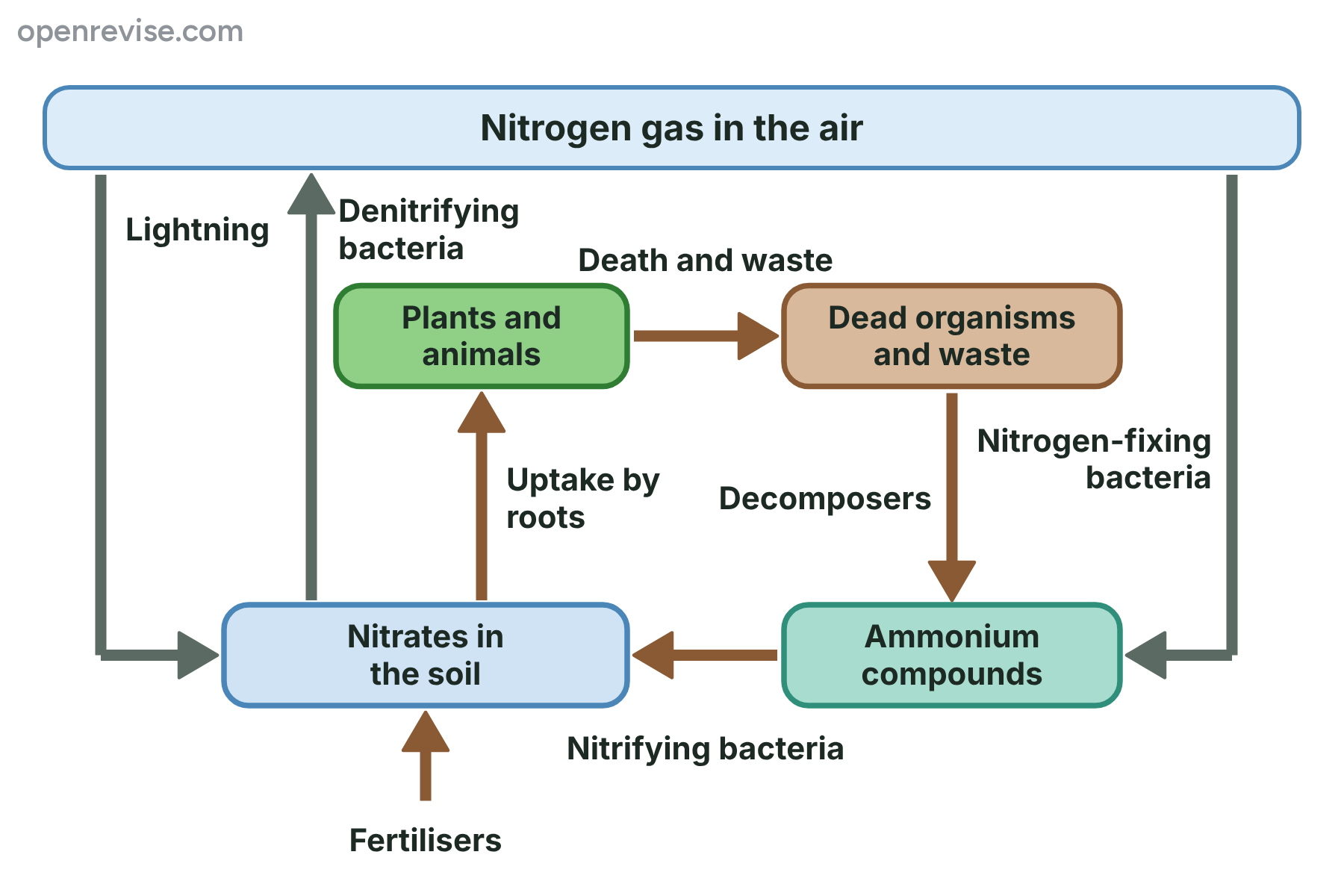
Grey arrows show nitrogen gas moving; brown arrows show nitrogen compounds moving.
The four roles of bacteria
Four groups of microorganisms carry out the changes in the nitrogen cycle, and the exam expects you to know each one.
-
Nitrogen-fixing bacteria
These change nitrogen gas from the air into ammonia and other nitrogen compounds that plants can use. Some live free in the soil. Others live in nodules on the roots of legumes such as peas, beans and clover.
-
Decomposers
Bacteria and fungi break down the proteins and urea in dead organisms, faeces and urine. This releases the nitrogen as ammonia and ammonium compounds in the soil.
-
Nitrifying bacteria
They change ammonium compounds into nitrates, which plant roots can take up. They need oxygen, so they work best in well aerated soil.
-
Denitrifying bacteria
They change nitrates back into nitrogen gas, which returns to the air. They work best in waterlogged soil with little oxygen, and they make the soil less fertile.
Following nitrogen around the cycle
Start with the nitrogen gas in the air and follow it round until it returns.
-
1
Fixing
Nitrogen-fixing bacteria in the soil and in root nodules change nitrogen gas into ammonium compounds. Lightning also converts it into nitrates.
-
2
Nitrification
Nitrifying bacteria in the soil change the ammonium compounds into nitrates.
-
3
Uptake
Plant roots take up nitrates by active transport and use them to make amino acids and proteins.
-
4
Feeding
Animals eat the plants, and the nitrogen in the proteins passes along the food chain.
-
5
Death and decay
When plants and animals die, and in the urea and faeces they produce, decomposers break down the proteins and release ammonium compounds.
-
6
Denitrification
In waterlogged soil, denitrifying bacteria change some nitrates back into nitrogen gas, which returns to the air.
Lightning and fertilisers
Besides the bacteria, two other things add nitrates to the soil.
-
Lightning
The energy of a lightning flash makes nitrogen and oxygen in the air combine to form nitrogen oxides. They dissolve in rain and fall to the ground as nitrates, which plants can take up.
-
Fertilisers
Fertilisers contain nitrates or ammonium compounds. They are made in factories and spread on fields to replace the nitrates that crops take out of the soil.
-
Why they are needed
When a crop is harvested, the nitrogen in its proteins is taken away from the field instead of returning to the soil by decay, so the soil gradually runs short of nitrates.
-
The problem with too much
Fertiliser that is not taken up by crops is washed by rain into rivers and lakes, where it can cause eutrophication.
Crop rotation
Crop rotation means growing a different crop in a field each year, so that the same crop is not grown on the same land year after year.
-
The legume crop
Legumes, such as peas, beans and clover, have nitrogen-fixing bacteria in their root nodules. The bacteria get sugars from the plant and the plant gets nitrogen compounds from the bacteria, which is mutualism.
-
Adding nitrates
When the legumes are ploughed in or their roots decay, the nitrogen compounds in them are released as nitrates in the soil for the next crop.
-
Less fertiliser
A rotation that includes a legume means farmers need to buy and spread less nitrate fertiliser, which saves money and reduces pollution.
-
Other benefits
Different crops use different amounts of nutrients and attract different pests, so a rotation also stops pests and diseases of one crop building up.
Fertilisers and crop rotation compared
Nitrate fertilisers
- Made in factories and spread on the soil
- Give a quick supply of nitrates for the crop
- Cost money and use energy to make
- Excess is washed into rivers and can cause eutrophication
Crop rotation with legumes
- Legumes are grown in turn with other crops
- Nitrogen-fixing bacteria in the root nodules make nitrogen compounds
- Cheap and natural, but a field is not always growing a cash crop
- Reduces pests and disease and cuts the fertiliser needed
Case study
The Norfolk four-course rotation
In the eighteenth century, farmers in Norfolk grew wheat, then turnips, then barley and then clover in a four year cycle. The clover was a legume. Its root nodules held nitrogen-fixing bacteria that added nitrogen compounds to the soil, and the animals that grazed it added manure. The land stayed fertile without any fertilisers made in factories, and yields rose so much that the system spread across Britain.
The big idea
Plants cannot use nitrogen gas, so bacteria, lightning and fertilisers must turn it into the nitrates that the roots take up.
The nitrogen cycle
The nitrogen cycle
-
Plants need
- nitrates
- amino acids
- proteins
- active transport
-
Bacteria
- fixing
- decomposers
- nitrifying
- denitrifying
-
Other sources
- lightning
- fertilisers
-
Crop rotation
- legumes
- root nodules
- less fertiliser
-
Losses
- harvest
- denitrification in waterlogged soil
- washed into rivers
Summary and exam focus
- Plants take up nitrates by active transport and use them to make amino acids and proteins.
- Nitrogen-fixing bacteria change nitrogen gas into ammonium compounds, and decomposers release ammonium compounds from dead material and waste.
- Nitrifying bacteria change ammonium compounds into nitrates, and denitrifying bacteria change nitrates into nitrogen gas.
- Lightning and fertilisers add nitrates to the soil.
- Crop rotation with legumes uses nitrogen-fixing bacteria in root nodules to add nitrates and reduces the need for fertiliser.
Exam focus
Explain how nitrates become available to a crop plant growing in a field, and how a farmer can increase the nitrate in the soil. (6 marks) (6 marks)
Name the type of bacterium at each step and say what it changes, for example nitrifying bacteria change ammonium compounds into nitrates. Then link the farmer's actions to the cycle: fertilisers add nitrates directly and a legume in the rotation adds them through nitrogen-fixing bacteria. Do not mix up nitrifying bacteria, which make nitrates, and denitrifying bacteria, which remove them.
Key terms
The words this lesson expects you to use. Each one is linked from the first place it appears above.
- Nitrate
- An ion containing nitrogen that plants take up from the soil to make amino acids and proteins.
- Nitrogen-fixing bacteria
- Bacteria that change nitrogen gas from the air into nitrogen compounds such as ammonia.
- Nitrifying bacteria
- Bacteria that change ammonium compounds into nitrates in the soil.
- Denitrifying bacteria
- Bacteria that change nitrates into nitrogen gas, mostly in waterlogged soil.
- Decomposer
- A microorganism that breaks down dead material and waste, releasing ammonium compounds.
- Legume
- A plant such as a pea, bean or clover that has nitrogen-fixing bacteria in nodules on its roots.
- Root nodule
- A swelling on the root of a legume that contains nitrogen-fixing bacteria.
- Fertiliser
- A substance added to soil to supply the mineral ions, such as nitrates, that plants need.
- Crop rotation
- Growing a different crop in a field each year in a repeating order.
- Mutualism
- A relationship between two species in which both benefit.
You've finished the notes
Check your understanding
Test yourself while it is fresh. Start with the flashcards, then try the exam questions.
Something here looks wrong?
Tell us what and we will go and look. It goes to whoever writes these pages, nobody else, and we do not ask who you are — so there is nothing to sign and nothing comes back to you.