Biology · Material Cycles
Decomposition, Food Preservation and Composting
Decay is a nuisance in a fridge and a gift in a garden, and the same three factors control it in both places. This lesson is for separate Biology only: Combined Science students do not need it. It covers how temperature, water content and oxygen availability affect the rate of decomposition in food preservation and in composting, and how to calculate rate changes in decay.
Learning Objectives
- 1Explain the effects of temperature, water content and oxygen availability on the rate of decomposition.
- 2Explain how these three factors are used to slow decay in food preservation.
- 3Explain how the same factors are controlled to speed up decay in composting.
- 4Calculate rate changes in the decay of biological material, and interpret graphs of decay.
Retrieval practice
-
1
What are decomposers?
Show answerHide answer
Microorganisms, mainly bacteria and fungi, that break down dead material and waste.
-
2
What happens to an enzyme at a temperature that is too high?
Show answerHide answer
It is denatured, so its shape changes and it stops working.
-
3
What is osmosis?
Show answerHide answer
The movement of water from a dilute solution to a more concentrated solution through a partially permeable membrane.
-
4
Which process in the decomposers releases carbon dioxide and heat?
Show answerHide answer
Respiration.
Decay: unwanted and wanted
Decomposition returns nutrients to the soil, but it also ruins food in the kitchen. Either way it is carried out by bacteria and fungi, and how fast it happens depends on how well those microorganisms can grow. They need a suitable temperature, water and, for most of them, oxygen. Food preservation takes away one or more of these so that decay slows down or stops. Composting does the opposite, giving the decomposers everything they need so that the garden waste rots as fast as possible.
What decomposers need
The rate of decay is how quickly the mass of dead material falls, and three factors control it.
-
Temperature
The enzymes of the decomposers work faster as the temperature rises, up to an optimum of about 25 to 45 degrees Celsius for many bacteria and fungi. Near 0 degrees Celsius they work very slowly, and at around 60 degrees Celsius and above most of them are killed because their enzymes are denatured.
-
Water content
Decomposers release enzymes onto their food, which needs water to work, and they absorb their nutrients in solution. Very dry material decays very slowly, because the microorganisms cannot grow.
-
Oxygen availability
Most decomposers respire aerobically, which releases the most energy, so they grow and decay material faster when oxygen is available. Without oxygen only anaerobic microorganisms can work, and they are slower.
-
Measuring the rate
The rate of decay can be found from how quickly the mass of the material falls, or from how fast carbon dioxide is released.
Food preservation
Food is preserved by taking away one of the things that the microorganisms need, so they cannot grow and spoil it.
-
Low temperature
In a fridge, at about 1 to 5 degrees Celsius, the enzymes of bacteria and fungi work slowly, so food lasts for days. In a freezer, at minus 18 degrees Celsius, the water is ice and the microorganisms cannot grow at all, so food lasts for months. Freezing does not kill them, so thawed food soon spoils.
-
Heating
Heating food in a sealed can or jar kills the microorganisms, because their enzymes are denatured. Because the container is sealed, no new microorganisms and little oxygen can get in.
-
Removing water
Drying removes the water, as in dried fruit and dried milk. Adding a lot of salt or sugar, as in bacon, salted fish and jam, makes water leave the microorganisms by osmosis, so they dry out and cannot grow.
-
Removing oxygen
Vacuum packing, or sealing food in oil, keeps air away, so aerobic microorganisms cannot respire. Some packs are filled with nitrogen instead of air for the same reason.
Preserving food and making compost
Food preservation: slow the decay
- Cool or freeze it, so the enzymes work slowly or the water is ice
- Dry, salt or sweeten it, so the microorganisms lose water
- Exclude oxygen with vacuum packs, cans or oil
- Aim: decomposers stop growing, and the food lasts longer
Composting: speed up the decay
- Keep the heap warm, so the enzymes work faster
- Keep it damp, so the microorganisms can grow
- Let air in, so the decomposers respire aerobically
- Aim: decomposers grow fast, and the waste rots quickly
Composting
Compost is rotted plant waste that gardeners and farmers add to soil. It is made in a heap or bin by decomposers, and the three factors are controlled to make it quickly.
-
Warmth
The decomposers respire and release heat, and a large heap with a lid keeps this heat in. The centre can reach 50 to 60 degrees Celsius, which makes the enzymes work fast. A small cold heap rots very slowly in winter.
-
Moisture
The heap should be as damp as a squeezed sponge. If it is too dry the microorganisms stop growing, and if it is too wet the water fills the air spaces and drives out the oxygen.
-
Oxygen
Turning the heap with a fork, mixing in coarse material such as twigs and putting air holes in the bin all let air in. A waterlogged, compacted heap runs out of oxygen, then slowly rots by anaerobic respiration and smells unpleasant.
-
A good mixture
A mixture of green waste, such as grass cuttings and vegetable peelings, and brown waste, such as dry leaves and cardboard, gives the decomposers the food they need. Chopping it up gives the decomposers a larger surface area to work on.
Inside a compost heap
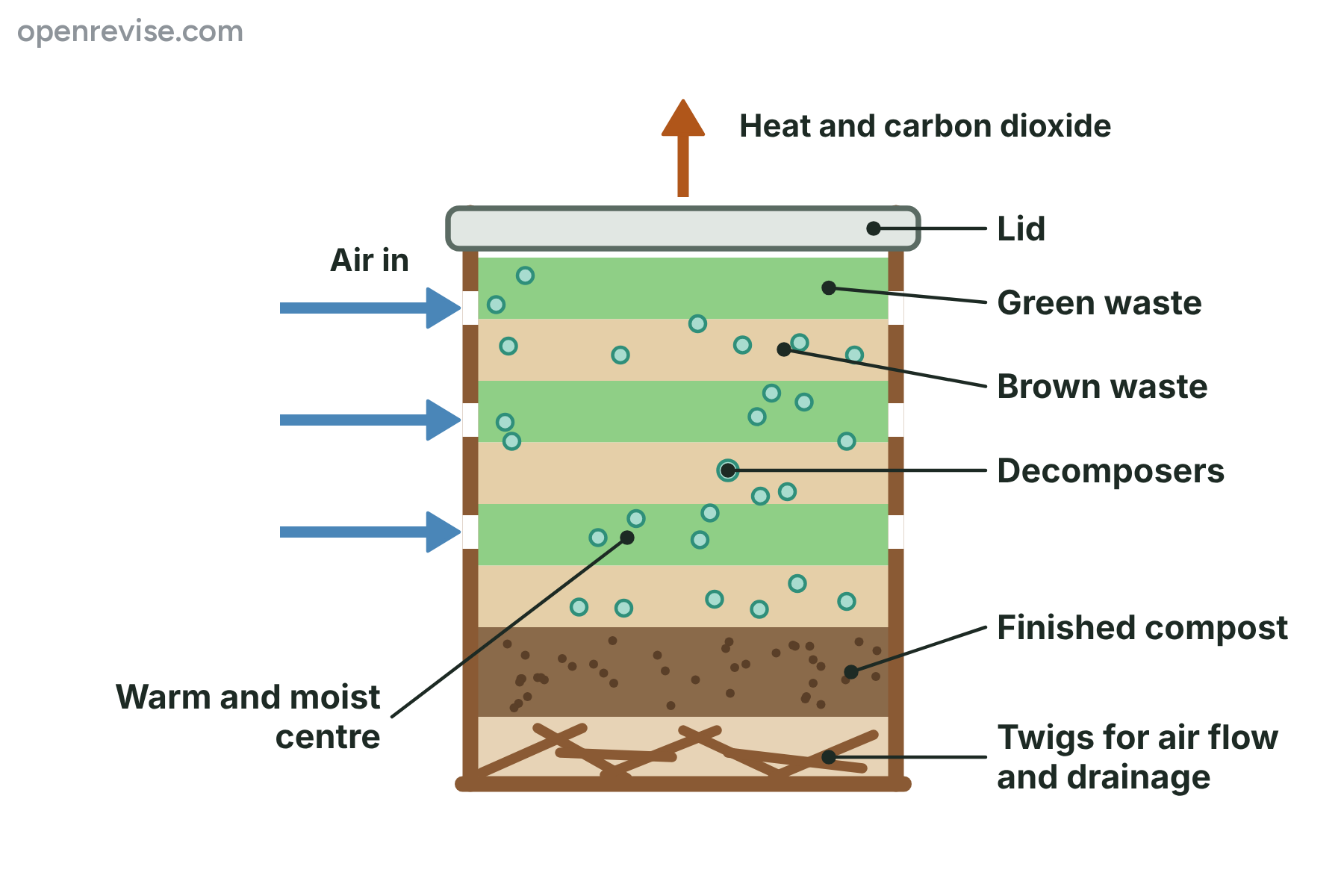
Air, moisture and warmth let the decomposers work fast.
Making good compost
Each step controls one of the factors, so that the decomposers can work at their fastest rate.
-
1
Chop it up
Cut or shred the waste into small pieces, which gives the decomposers a larger surface area.
-
2
Mix the layers
Alternate green and brown waste, with some coarse twigs at the bottom for air and drainage.
-
3
Keep it damp
Water the heap in dry weather and cover it in heavy rain, so that it is damp like a squeezed sponge.
-
4
Let air in
Turn the heap every few weeks, so that the decomposers always have oxygen.
-
5
Keep it warm
Put on a lid, so that the heat from respiration stays in the heap and keeps the enzymes working fast.
-
6
Wait
After some weeks or months the waste has become dark, crumbly compost that smells earthy, ready to spread on the soil.
Measuring and calculating decay
Biologists compare conditions by finding out how fast the mass of material falls.
-
Measuring decay
Weigh a sample of dead material, such as grass cuttings or leaves in a mesh bag, at regular times as it decays. Its mass falls as the decomposers respire it and release carbon dioxide and water.
-
Rate of decay
Rate of decay = change in mass divided by the time taken, in grams per day.
-
Percentage change
Percentage loss of mass = (starting mass minus final mass) divided by starting mass, then multiplied by 100.
-
Comparing rates
To compare two conditions, divide one rate by the other to see how many times faster it is, or find the percentage change in the rate.
Decay of grass cuttings at three temperatures
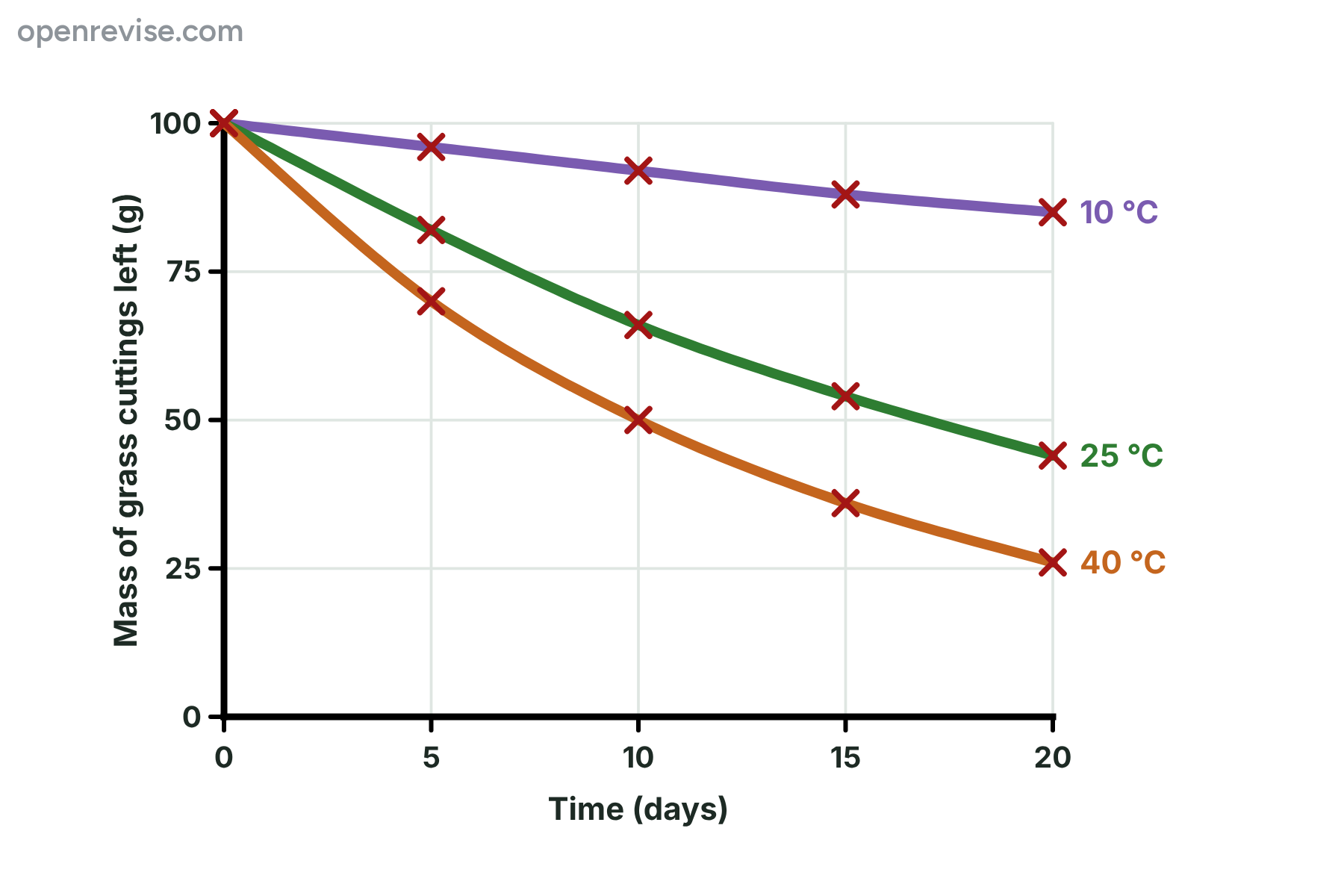
The steeper the curve, the faster the decay.
Rate of decay and percentage loss
At 25 degrees Celsius the mass of grass cuttings fell from 100 g to 66 g in 10 days. Calculate (a) the mean rate of decay in g per day and (b) the percentage loss of mass.
Show the solutionHide the solution
- 1 Find the change in mass \(100 - 66 = 34\) g
- 2 Divide by the time \(34 \div 10 = 3.4\) g per day
- 3 Percentage loss \(34 \div 100 \times 100 = 34\%\)
Answer(a) 3.4 g per day. (b) 34%.
Comparing two rates of decay
At 10 degrees Celsius the mean rate of decay over the first 10 days was 0.8 g per day, and at 25 degrees Celsius it was 3.4 g per day. How many times faster is the decay at 25 degrees Celsius, and what is the percentage increase in the rate?
Show the solutionHide the solution
- 1 Divide the faster rate by the slower rate \(3.4 \div 0.8 = 4.25\), so about 4.3 times faster
- 2 Find the increase in the rate \(3.4 - 0.8 = 2.6\) g per day
- 3 Percentage increase \(2.6 \div 0.8 \times 100 = 325\%\)
AnswerThe decay is about 4.3 times faster, which is a 325% increase in the rate.
Case study
Why jam keeps for years
Jam is made by boiling fruit with a very large amount of sugar and sealing it in a jar while it is hot. The boiling kills the microorganisms already in the fruit, and the sealed jar keeps out oxygen and new microorganisms. The sugar solution is so concentrated that water leaves any microorganism that does land on the jam by osmosis, so it dries out. A jar of jam therefore stays safe to eat for months or years until it is opened.
The big idea
Decomposers need warmth, water and oxygen, so food is preserved by taking these away and compost is made by providing them.
Rate of decay
Rate of decay
-
Temperature
- enzymes faster when warm
- slow in a fridge
- stopped by freezing
- killed by heat
-
Water
- needed to grow
- drying, salting and sugar remove it
-
Oxygen
- aerobic decomposers
- vacuum packing
- turning compost
-
Food preservation
- cool
- dry
- sealed
- vacuum packed
-
Composting
- warm, damp, aerated
- mix of green and brown waste
Summary and exam focus
- Decomposers work faster when it is warmer, up to an optimum, because their enzymes work faster, and they are killed by high temperatures.
- They need water to grow, and most need oxygen for aerobic respiration, so decay is slower when material is dry or has no oxygen.
- Food is preserved by cooling or freezing it, heating it in sealed containers, drying, salting or sweetening it, and excluding oxygen.
- Compost is made quickly by keeping the heap warm, damp and aerated, with a mixture of green and brown waste.
- The rate of decay is the change in mass divided by the time, and the percentage loss is the change divided by the starting mass, times 100.
Exam focus
A gardener's compost heap is cold, very wet and smells unpleasant, and the waste is rotting slowly. Explain how the gardener could speed up decomposition. (6 marks) (6 marks)
Deal with each factor in turn: oxygen, water and temperature. For each, say what the gardener should do and why it helps the decomposers, using the correct words such as aerobic respiration, enzymes and anaerobic. The smell is a clue that oxygen is missing.
Key terms
The words this lesson expects you to use. Each one is linked from the first place it appears above.
- Decomposition
- The breakdown of dead plants, animals and waste by decomposers such as bacteria and fungi.
- Rate of decay
- How quickly dead material breaks down, found from the change in mass divided by the time taken.
- Food preservation
- Treating food so that microorganisms cannot grow and spoil it, by removing warmth, water or oxygen.
- Compost
- Rotted plant waste, made by decomposers, that is added to soil to return nutrients and improve its structure.
- Aerobic
- Using oxygen, as in aerobic respiration by most decomposers.
- Anaerobic
- Without oxygen, as in a waterlogged compost heap where decay is slower.
- Osmosis
- The movement of water from a dilute solution to a concentrated solution across a partially permeable membrane.
- Waterlogged
- So full of water that the air spaces are filled and there is little oxygen.
- Vacuum packing
- Removing the air from a pack of food so that aerobic microorganisms cannot grow.
- Percentage loss of mass
- The change in mass divided by the starting mass, multiplied by 100.
You've finished the notes
Check your understanding
Test yourself while it is fresh. Start with the flashcards, then try the exam questions.
Something here looks wrong?
Tell us what and we will go and look. It goes to whoever writes these pages, nobody else, and we do not ask who you are — so there is nothing to sign and nothing comes back to you.