Biology · Exchange and Transport in Animals
Blood Vessels
Blood travels round the body in three kinds of vessel. This lesson explains how the structure of arteries, veins and capillaries fits their jobs, and how to calculate the rate of blood flow.
Learning Objectives
- 1Name the three types of blood vessel and say what each one does.
- 2Explain how the structure of arteries, veins and capillaries is related to their functions.
- 3Describe the path of blood from an artery through capillaries to a vein.
- 4Calculate the rate of blood flow using volume and time.
Retrieval practice
-
1
Which chamber pumps blood into the aorta?
Show answerHide answer
The left ventricle.
-
2
What is the job of a capillary?
Show answerHide answer
To let substances be exchanged between the blood and the cells.
-
3
What is diffusion?
Show answerHide answer
The net movement of particles from a higher to a lower concentration.
-
4
Which side of the heart has the thicker wall?
Show answerHide answer
The left side.
Three kinds of vessel
The blood is carried in a network of tubes called blood vessels. If they were laid end to end, the blood vessels in one adult would reach round the world more than twice. The vessels are not all the same. Each of the three types has a different structure because each has a different job to do.
Arteries, veins and capillaries
The direction of flow is what separates arteries from veins, not whether the blood is oxygenated.
-
Arteries
Carry blood away from the heart. The blood is at high pressure, so artery walls are thick and strong, with muscle and elastic fibres.
-
Veins
Carry blood back to the heart. The blood is at low pressure, so vein walls are thinner and the lumen is wider. Veins have valves.
-
Capillaries
Tiny vessels that run between the cells of every tissue. Substances pass between the blood and the cells through their walls.
Comparing the three blood vessels
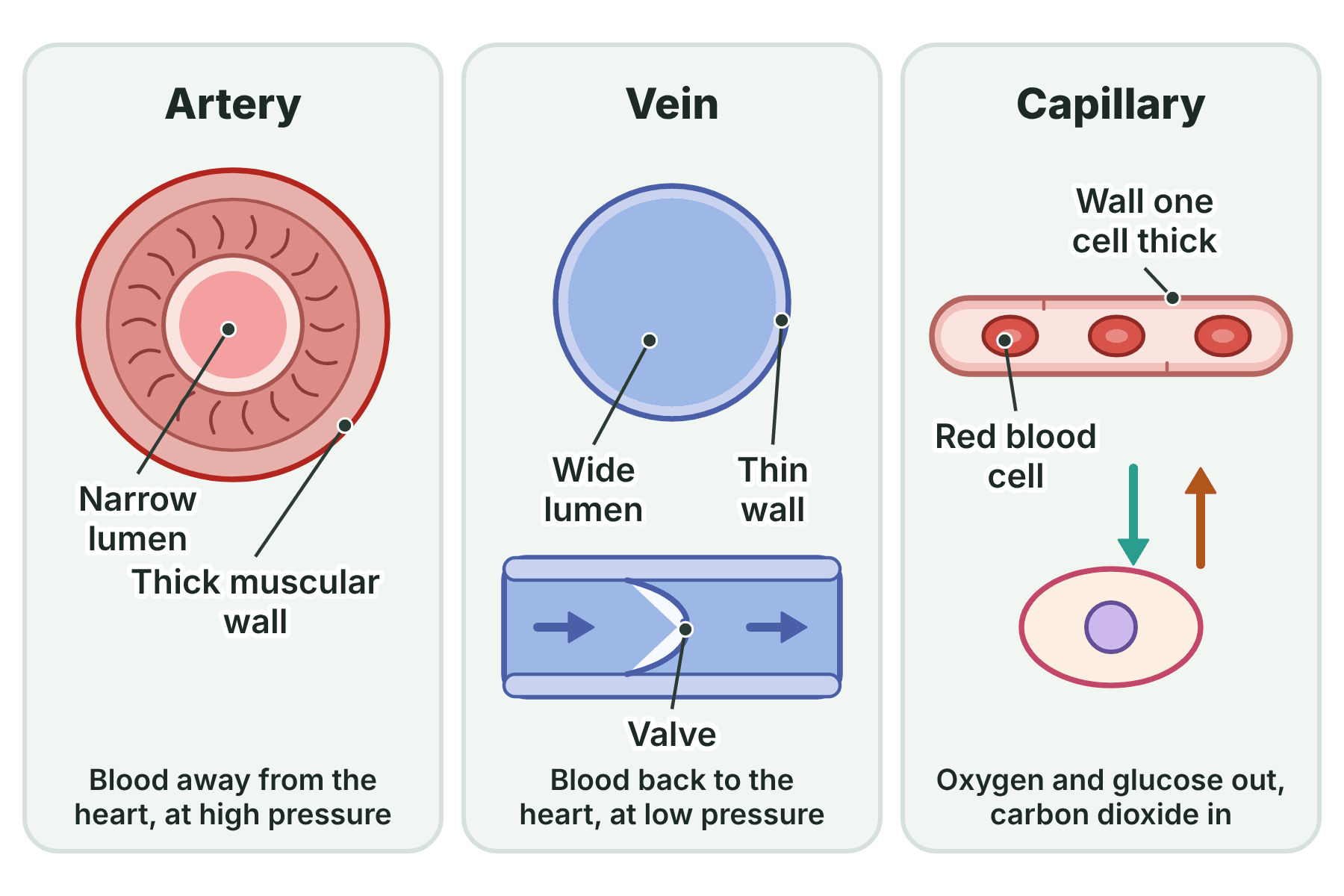
The structure of each vessel suits its job.
Artery and vein compared
Artery
- Carries blood away from the heart
- High blood pressure
- Thick wall with muscle and elastic fibres
- Narrow lumen compared with the wall
Vein
- Carries blood towards the heart
- Low blood pressure
- Thinner wall
- Wider lumen, and valves to stop backflow
Why the structures fit the jobs
In the exam you must link each feature to its function.
-
Thick wall of an artery
The blood leaves the heart at high pressure. A thick wall of muscle and elastic fibres can stretch and recoil without bursting.
-
Valves in veins
The blood is at such low pressure that it could flow backwards. The valves close to stop it, so it can only flow towards the heart.
-
Wide lumen of a vein
A wider lumen gives less resistance, so blood at low pressure can still flow easily.
-
Thin wall of a capillary
The wall is only one cell thick, so the diffusion path is short. Oxygen and glucose pass out to the cells and carbon dioxide passes in.
-
Capillary networks
Huge numbers of capillaries give a large surface area for exchange, and the blood moves slowly through them, which gives time for diffusion.
Blood flowing through the vessels
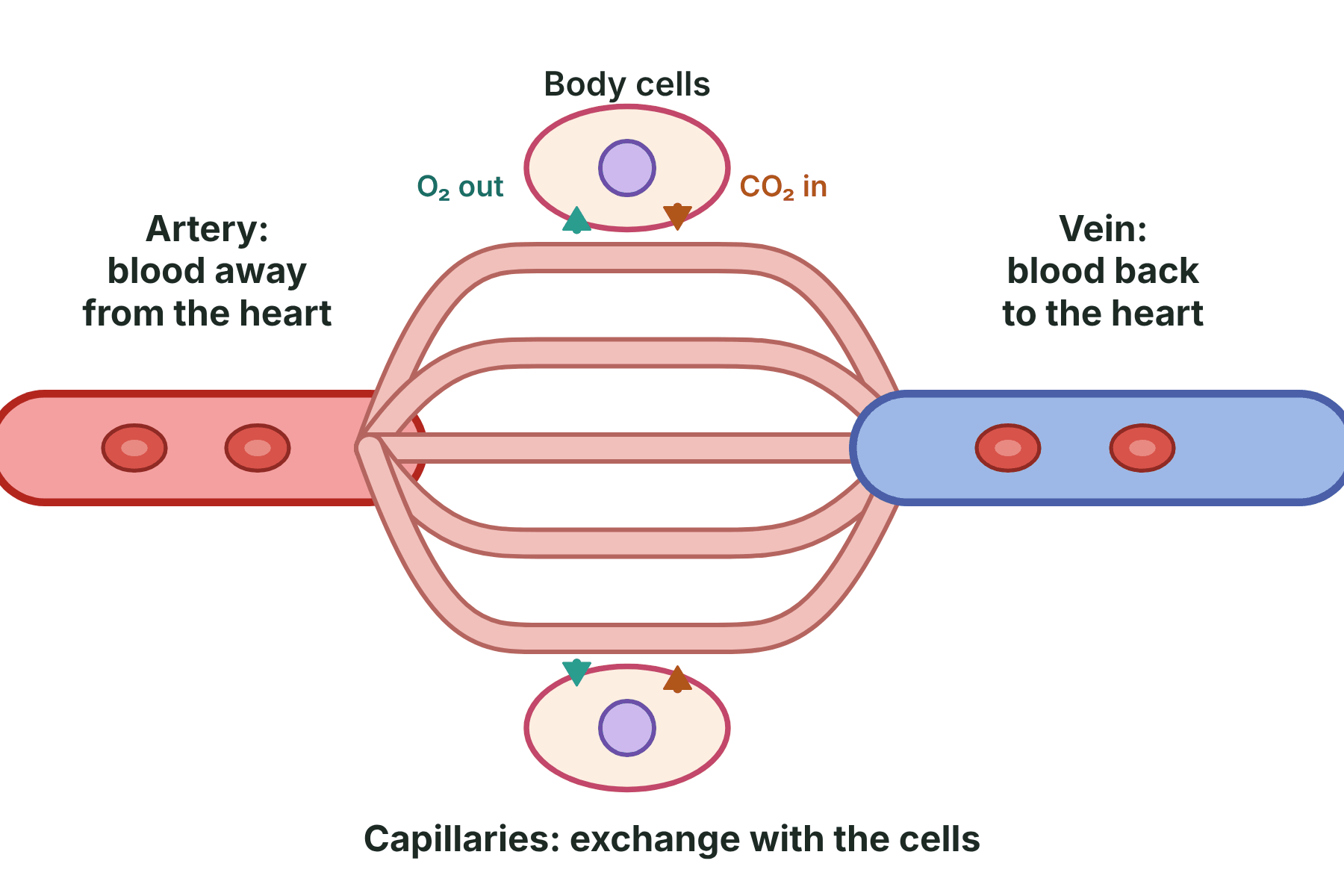
Capillaries connect the arteries to the veins, and exchange happens in them.
Calculating the rate of blood flow
In 3 minutes, 360 cm³ of blood flows through an artery in a muscle. Calculate the rate of blood flow in cm³ per minute.
Show the solutionHide the solution
- 1 Write the formula Rate of blood flow = volume of blood ÷ time
- 2 Substitute the values \(360\text{ cm}^3 \div 3\text{ min}\)
- 3 Calculate and give the unit \(= 120\text{ cm}^3\text{ per minute}\)
AnswerThe rate of blood flow is 120 cm³ per minute.
Case study
Pulse and blood pressure
Each time the left ventricle contracts it forces a surge of blood into the arteries, and the elastic walls stretch. You can feel this surge as a pulse where an artery runs close to the skin, such as at the wrist or neck. You cannot feel a pulse in a vein, because by the time the blood reaches the veins the pressure has dropped and the surges have smoothed out.
The key difference
Arteries carry blood away from the heart. Veins carry blood to the heart. Capillaries link the two.
Blood vessels
Blood vessels
-
Arteries
- away from the heart
- thick wall
- high pressure
-
Veins
- to the heart
- thin wall
- wide lumen
- valves
-
Capillaries
- wall one cell thick
- exchange with cells
-
Flow
- artery to capillary to vein
-
Calculation
- rate = volume ÷ time
Summary and exam focus
- Arteries carry blood away from the heart at high pressure and have thick, strong walls.
- Veins carry blood to the heart at low pressure and have thinner walls, wide lumens and valves.
- Capillaries have walls one cell thick, so substances diffuse across them quickly.
- Rate of blood flow is the volume of blood divided by the time.
- Oxygenated or not, the vessel type depends on the direction of flow.
Exam focus
Explain how the structure of an artery is related to its function. (3 marks) (3 marks)
Pair each structure with its reason. "Thick wall" must be followed by "because blood is at high pressure". Mention the elastic fibres and muscle in the wall.
Key terms
The words this lesson expects you to use. Each one is linked from the first place it appears above.
- Artery
- A blood vessel that carries blood away from the heart at high pressure.
- Vein
- A blood vessel that carries blood to the heart at low pressure.
- Capillary
- A tiny blood vessel with a wall one cell thick, where substances are exchanged with the cells.
- Lumen
- The space inside a blood vessel through which the blood flows.
- Valve
- A flap inside a vein that stops blood flowing backwards.
- Elastic fibres
- Stretchy fibres in the walls of arteries that let them stretch and recoil.
- Rate of blood flow
- The volume of blood that passes a point in a given time.
- Pulse
- The surge felt in an artery each time the heart pumps blood into it.
You've finished the notes
Check your understanding
Test yourself while it is fresh. Start with the flashcards, then try the exam questions.
Something here looks wrong?
Tell us what and we will go and look. It goes to whoever writes these pages, nobody else, and we do not ask who you are — so there is nothing to sign and nothing comes back to you.