Biology · Exchange and Transport in Animals
The Heart and Double Circulation
The heart is a muscular pump that sends blood to the lungs and then round the body. This lesson names the chambers and blood vessels of the heart, follows the double circulation and explains how the heartbeat is kept steady.
Learning Objectives
- 1Describe the structure and function of the human heart.
- 2Name the blood vessels associated with the heart and say what each one carries.
- 3Describe the double circulatory system and explain why it is needed.
- 4Describe how the pacemaker controls the heart rate, and what an artificial pacemaker does.
Retrieval practice
-
1
What is an organ?
Show answerHide answer
A group of different tissues that work together to do a particular job.
-
2
Why do cells need a supply of oxygen?
Show answerHide answer
For aerobic respiration, which releases the energy the cell needs.
-
3
Which gases are exchanged in the lungs?
Show answerHide answer
Oxygen goes into the blood and carbon dioxide comes out of it.
-
4
What is an organ system?
Show answerHide answer
A group of organs working together to do a job, such as the circulatory system.
A pump that never rests
The heart is an organ made mostly of cardiac muscle, the muscle that contracts to squeeze blood out of the heart. It beats about 100 000 times a day without ever resting. Blood carries oxygen and dissolved food to every cell and takes carbon dioxide and other wastes away. Because the heart pumps blood to the lungs and also to the rest of the body, humans have what is called a double circulatory system.
The four chambers of the heart
The heart is divided into a right side and a left side by a wall of muscle, so the blood on one side never mixes with the blood on the other.
-
Right atrium
Receives deoxygenated blood from the body. It contracts to push the blood down into the right ventricle.
-
Right ventricle
Pumps deoxygenated blood to the lungs, where gas exchange takes place.
-
Left atrium
Receives oxygenated blood from the lungs. It contracts to push the blood down into the left ventricle.
-
Left ventricle
Pumps oxygenated blood around the rest of the body. Its wall is much thicker than the right ventricle's because it has to push blood much further.
The human heart
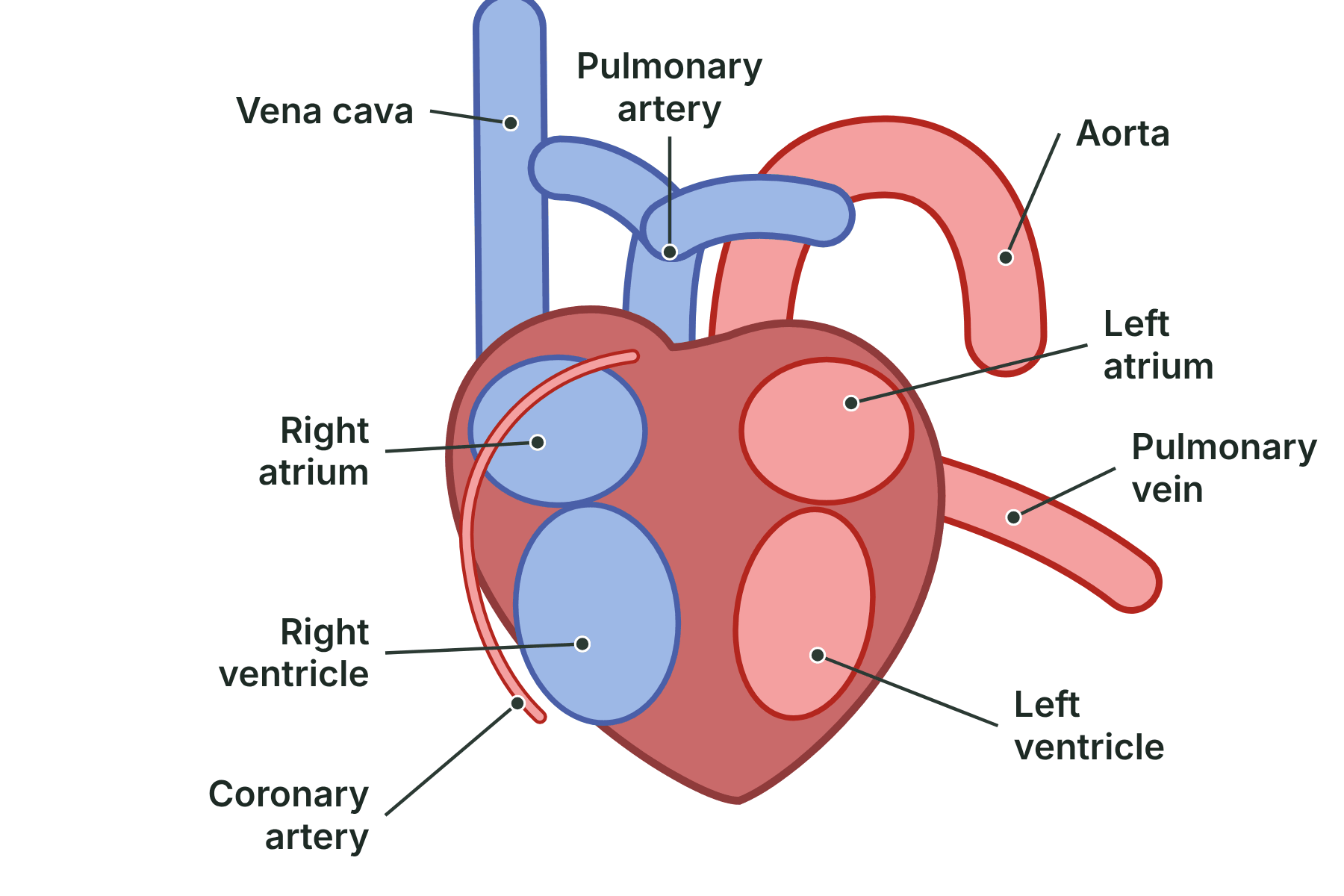
Blue shows deoxygenated blood and red shows oxygenated blood. The right side of the body is on the left of the picture.
The blood vessels of the heart
Five sets of blood vessels are linked with the heart. The names of the heart's valves are not needed.
-
Vena cava
Brings deoxygenated blood from the body to the right atrium.
-
Pulmonary artery
Carries deoxygenated blood from the right ventricle to the lungs.
-
Pulmonary vein
Brings oxygenated blood from the lungs to the left atrium.
-
Aorta
Carries oxygenated blood from the left ventricle to the body.
-
Coronary arteries
Run over the surface of the heart and supply the heart muscle itself with oxygenated blood.
Following the blood round the double circulation
Blood goes through the heart twice on every complete trip round the body.
-
1
Body to heart
Deoxygenated blood returns from the body in the vena cava and enters the right atrium.
-
2
Heart to lungs
The right ventricle pumps the blood along the pulmonary artery to the lungs.
-
3
Gas exchange
In the lungs the blood picks up oxygen and gives up carbon dioxide.
-
4
Lungs to heart
Oxygenated blood returns along the pulmonary vein to the left atrium.
-
5
Heart to body
The left ventricle pumps the blood into the aorta, which carries it to all the organs of the body.
The double circulatory system
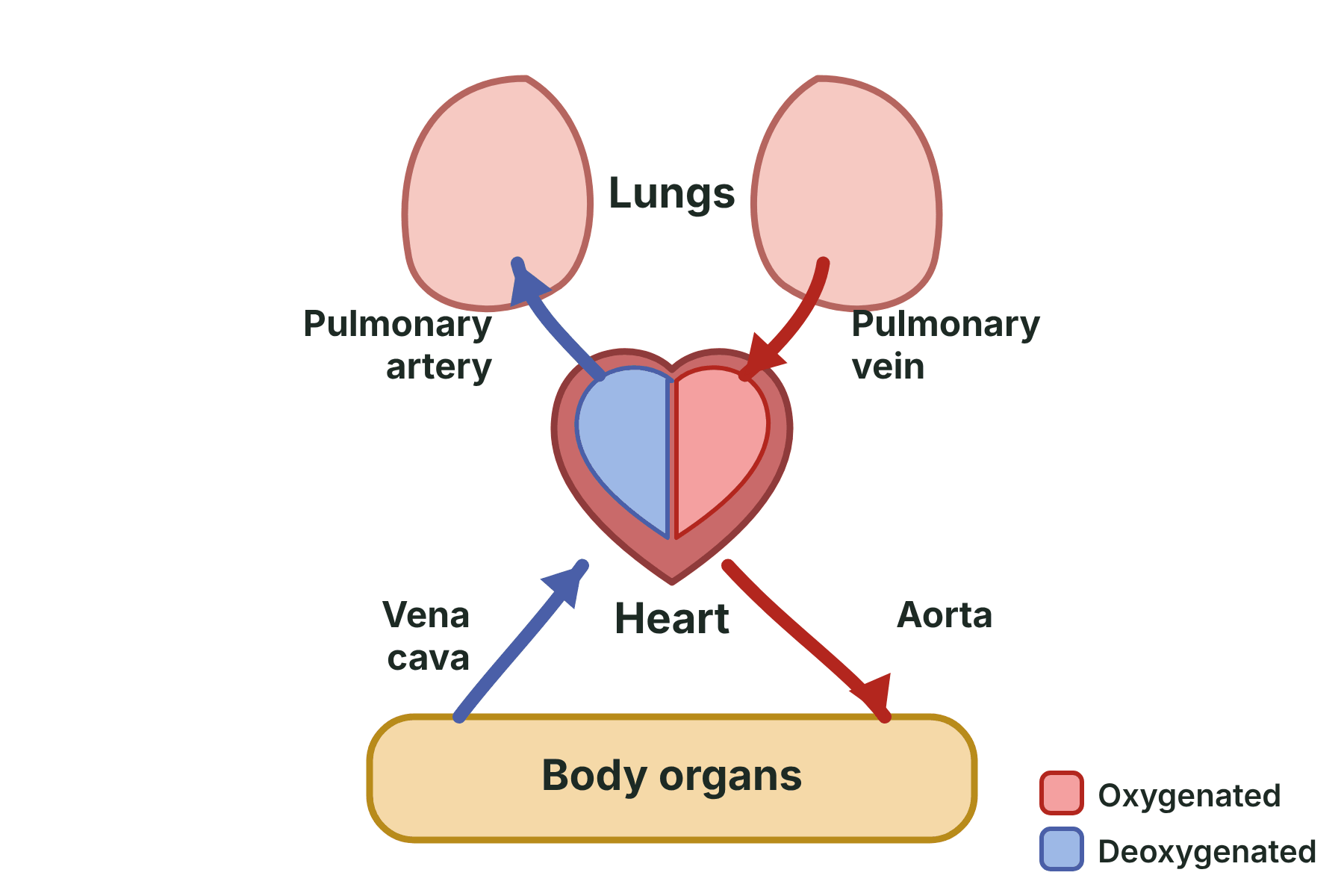
Blood passes through the heart twice on every trip round the body.
The two sides of the heart
Right side
- Receives deoxygenated blood from the body
- Pumps blood a short distance to the lungs
- Thinner muscle wall
- Pumps at lower pressure
Left side
- Receives oxygenated blood from the lungs
- Pumps blood to every organ of the body
- Thicker muscle wall
- Pumps at higher pressure
Why a double circulatory system is needed
A single loop would work badly, because the lungs are full of tiny, delicate capillaries.
-
Pressure drops in the lungs
Blood loses pressure as it squeezes through the narrow capillaries of the lungs. Returning it to the heart gives it a fresh push to the body.
-
Gas exchange is protected
The blood going to the lungs can be pumped at a lower pressure, which does not damage the thin walls of the alveoli.
-
Fast delivery
The blood going to the body is pumped at high pressure, so oxygen and glucose reach the cells quickly.
Keeping the heartbeat steady
The heart beats without being told to by the brain.
-
The natural pacemaker
A group of cells in the wall of the right atrium sets the natural resting heart rate. Each one sends out an electrical signal that makes the heart muscle contract.
-
Artificial pacemakers
An artificial pacemaker is a small electrical device fitted under the skin. It sends regular electrical pulses to the heart to correct an irregular heartbeat.
Working out a heart rate
A student counts 21 pulses in 15 seconds. Calculate their heart rate in beats per minute.
Show the solutionHide the solution
- 1 Find how many 15-second periods are in a minute \(60 \div 15 = 4\)
- 2 Multiply the count by 4 \(21 \times 4 = 84\)
- 3 Write the answer with its unit 84 beats per minute
AnswerThe heart rate is 84 beats per minute.
Case study
The artificial pacemaker
In some people the natural pacemaker cells do not work properly, so the heart beats too slowly or unevenly. A surgeon can fit an artificial pacemaker, a device about the size of a matchbox, under the skin near the collarbone. A wire runs to the heart and delivers tiny electrical pulses that keep the beat regular. The battery lasts for several years before it has to be replaced.
Do not mix them up
The right ventricle pumps blood to the lungs. The left ventricle pumps blood to the rest of the body.
The heart
The heart
-
Chambers
- right atrium
- right ventricle
- left atrium
- left ventricle
-
Vessels
- vena cava
- pulmonary artery
- pulmonary vein
- aorta
- coronary arteries
-
Double circulation
- heart to lungs
- heart to body
-
Two sides
- right pumps to lungs
- left pumps to body
- left wall thicker
-
Pacemaker
- cells in right atrium
- artificial pacemaker corrects irregular beat
Summary and exam focus
- The heart is a muscular organ with four chambers: two atria and two ventricles.
- The right ventricle pumps blood to the lungs and the left ventricle pumps blood to the body.
- The vena cava, pulmonary artery, pulmonary vein and aorta carry blood to and from the heart.
- The coronary arteries supply the heart muscle with oxygen.
- A group of cells in the right atrium acts as the natural pacemaker.
Exam focus
Describe the path taken by blood from the vena cava until it enters the aorta. (4 marks) (4 marks)
Name every chamber and vessel in order, and say what happens to the blood on the way: it is pumped to the lungs and picks up oxygen. Follow the order exactly and do not skip the lungs.
Key terms
The words this lesson expects you to use. Each one is linked from the first place it appears above.
- Double circulatory system
- A circulation in which blood passes through the heart twice on each trip round the body, once to the lungs and once to the body.
- Atrium
- An upper chamber of the heart that receives blood.
- Ventricle
- A lower chamber of the heart that pumps blood out.
- Vena cava
- The vein that brings deoxygenated blood from the body to the right atrium.
- Aorta
- The artery that carries oxygenated blood from the left ventricle to the body.
- Pulmonary artery
- The artery that carries deoxygenated blood from the right ventricle to the lungs.
- Pulmonary vein
- The vein that brings oxygenated blood from the lungs to the left atrium.
- Coronary artery
- An artery that supplies the heart muscle with oxygenated blood.
- Pacemaker
- A group of cells in the right atrium that controls the resting heart rate.
You've finished the notes
Check your understanding
Test yourself while it is fresh. Start with the flashcards, then try the exam questions.
Something here looks wrong?
Tell us what and we will go and look. It goes to whoever writes these pages, nobody else, and we do not ask who you are — so there is nothing to sign and nothing comes back to you.