Exam questions · Biology · Exchange and Transport in Animals
The Heart and Double Circulation
- 7 exam questions
- 17 marks
- 8 quick checks
-
1 State [1 mark]
Name the blood vessel that carries blood from the heart to the lungs.
Show answerHide answer
Model answer
The pulmonary artery.
Mark scheme
- Pulmonary artery — 1 mark
-
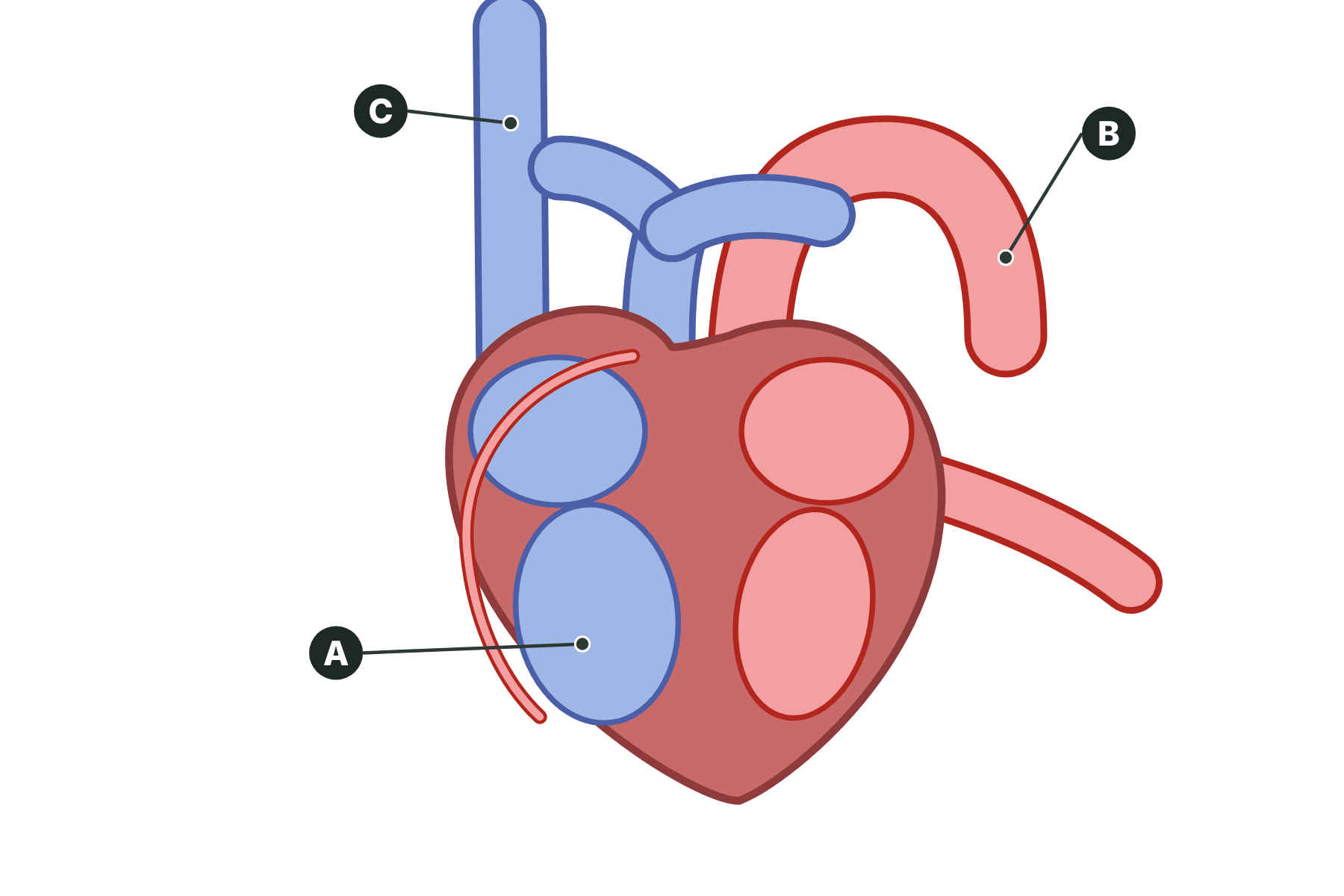
2 Name [3 marks]
Figure 1 shows the human heart. Name the parts labelled A, B and C.
Show answerHide answer
Model answer
A is the right ventricle. B is the aorta. C is the vena cava.
Mark scheme
- A: right ventricle — 1 mark
- B: aorta — 1 mark
- C: vena cava — 1 mark
-
3 Describe [2 marks]
Describe the function of the coronary arteries.
Show answerHide answer
Model answer
They supply the heart muscle with oxygenated blood. This gives the muscle the oxygen it needs for respiration to release energy for contraction.
Mark scheme
- Supply the heart (muscle) with blood — 1 mark
- Oxygen for respiration — 1 mark
-
4 Explain [2 marks]
Explain why the wall of the left ventricle is thicker than the wall of the right ventricle.
Show answerHide answer
Model answer
The left ventricle pumps blood around the whole body, which is a long way, so it needs to generate a higher pressure. A thicker muscle wall contracts with more force.
Mark scheme
- Pumps blood to the whole body / further — 1 mark
- Thicker muscle gives a greater force / higher pressure — 1 mark
-
5 Calculate [2 marks]
A student counts 18 pulses in 15 seconds. Calculate the heart rate in beats per minute.
Show answerHide answer
Model answer
There are four 15-second periods in a minute. 18 × 4 = 72 beats per minute.
Mark scheme
- Multiplies by 4 — 1 mark
- 72 beats per minute — 1 mark
-
6 Explain [3 marks]
Explain why humans have a double circulatory system.
Show answerHide answer
Model answer
Blood loses pressure as it passes through the capillaries in the lungs. Returning it to the heart increases the pressure again before it is sent to the body. This means the blood reaches the body quickly, while the pressure in the lungs can stay low enough not to damage the thin alveoli.
Mark scheme
- Blood loses pressure in the lung capillaries — 1 mark
- The heart increases the pressure again — 1 mark
- Low pressure in the lungs protects them / higher pressure for the body — 1 mark
-
7 Describe [4 marks]
Describe how the natural pacemaker and an artificial pacemaker control the heart rate.
Show answerHide answer
Model answer
The natural pacemaker is a group of cells in the right atrium. These cells send out electrical signals that make the heart muscle contract, which sets the natural resting heart rate. An artificial pacemaker is an electrical device. It sends regular electrical pulses to the heart to correct an irregular heartbeat.
Mark scheme
- Natural pacemaker in the right atrium — 1 mark
- Cells send electrical signals that make the heart contract — 1 mark
- Artificial pacemaker is an electrical device — 1 mark
- It corrects irregularities in the heart rate — 1 mark
Quick check
-
1
Which chamber of the heart pumps blood to the body?
Show answerHide answer
D: Left ventricle
The left ventricle pumps oxygenated blood into the aorta, which carries it round the body.
-
2
Which vessel brings oxygenated blood from the lungs to the heart?
Show answerHide answer
B: Pulmonary vein
The pulmonary vein carries oxygenated blood from the lungs to the left atrium.
-
3
What do the coronary arteries supply?
Show answerHide answer
C: The heart muscle with blood
The coronary arteries run over the surface of the heart and bring oxygenated blood to the heart muscle.
-
4
Why is the wall of the left ventricle thicker than that of the right?
Show answerHide answer
A: It pumps blood further
It has to pump blood to the whole body, so it needs to contract with more force.
-
5
Where is the natural pacemaker of the heart?
Show answerHide answer
D: The right atrium
A group of cells in the right atrium sets the natural resting heart rate.
-
6
A pulse is counted as 20 beats in 15 seconds. What is the heart rate?
Show answerHide answer
C: 80 beats per minute
20 × 4 = 80 beats per minute.
-
7
Why do humans have a double circulatory system?
Show answerHide answer
B: To keep the pressure high round the body
The blood loses pressure in the lungs, so it returns to the heart to be pumped again to the body.
-
8
What does an artificial pacemaker do?
Show answerHide answer
A: Corrects an irregular heart rate
It sends electrical pulses to correct an irregular heartbeat.