Biology · Homeostasis
Blood Glucose and Diabetes
Every cell needs a steady supply of glucose, so the concentration of glucose in the blood is carefully controlled. This lesson explains how insulin controls blood glucose, how glucagon works with it in Higher tier, and how type 1 and type 2 diabetes compare.
Learning Objectives
- 1Explain how insulin controls the concentration of glucose in the blood.
- 2(Higher tier) Explain how glucagon interacts with insulin in a negative feedback system.
- 3Compare type 1 and type 2 diabetes, and explain how each is treated.
- 4Interpret graphs of blood glucose concentration.
Retrieval practice
-
1
Which gland releases insulin?
Show answerHide answer
The pancreas.
-
2
What is negative feedback?
Show answerHide answer
A response that reverses a change and returns a condition to normal.
-
3
What is glycogen?
Show answerHide answer
The carbohydrate in which animals store glucose, in the liver and muscles.
-
4
What is a target organ?
Show answerHide answer
An organ with receptors for a particular hormone.
Sugar in the blood
After a meal, glucose from the food is absorbed into your blood. If nothing happened, the glucose concentration would rise very high, then fall again as cells used it up. Instead, the blood glucose concentration stays within narrow limits. Two hormones from the pancreas, insulin and glucagon, keep it there by negative feedback, and the liver acts as the store.
Insulin lowers blood glucose
When the blood glucose concentration is too high, the pancreas releases insulin.
-
Detection
The pancreas detects that the blood glucose concentration is too high, for example after a meal.
-
Insulin
The pancreas releases the hormone insulin into the blood.
-
The target organs
Insulin makes the liver and the muscle cells take up glucose from the blood.
-
Storage
In the liver, the glucose is converted into glycogen, which is stored. Cells also use more glucose.
-
Result
The blood glucose concentration falls back to normal.
Glucagon raises blood glucose (Higher tier)
When the blood glucose concentration is too low, the pancreas releases glucagon.
-
Detection
The pancreas detects that the blood glucose concentration is too low, for example between meals or during exercise.
-
Glucagon
The pancreas releases the hormone glucagon into the blood.
-
The target organ
Glucagon makes the liver convert glycogen back into glucose, which is released into the blood.
-
Result
The blood glucose concentration rises back to normal.
-
Interaction
Insulin and glucagon have opposite effects and work together. This is a negative feedback system that keeps the concentration steady.
Controlling blood glucose
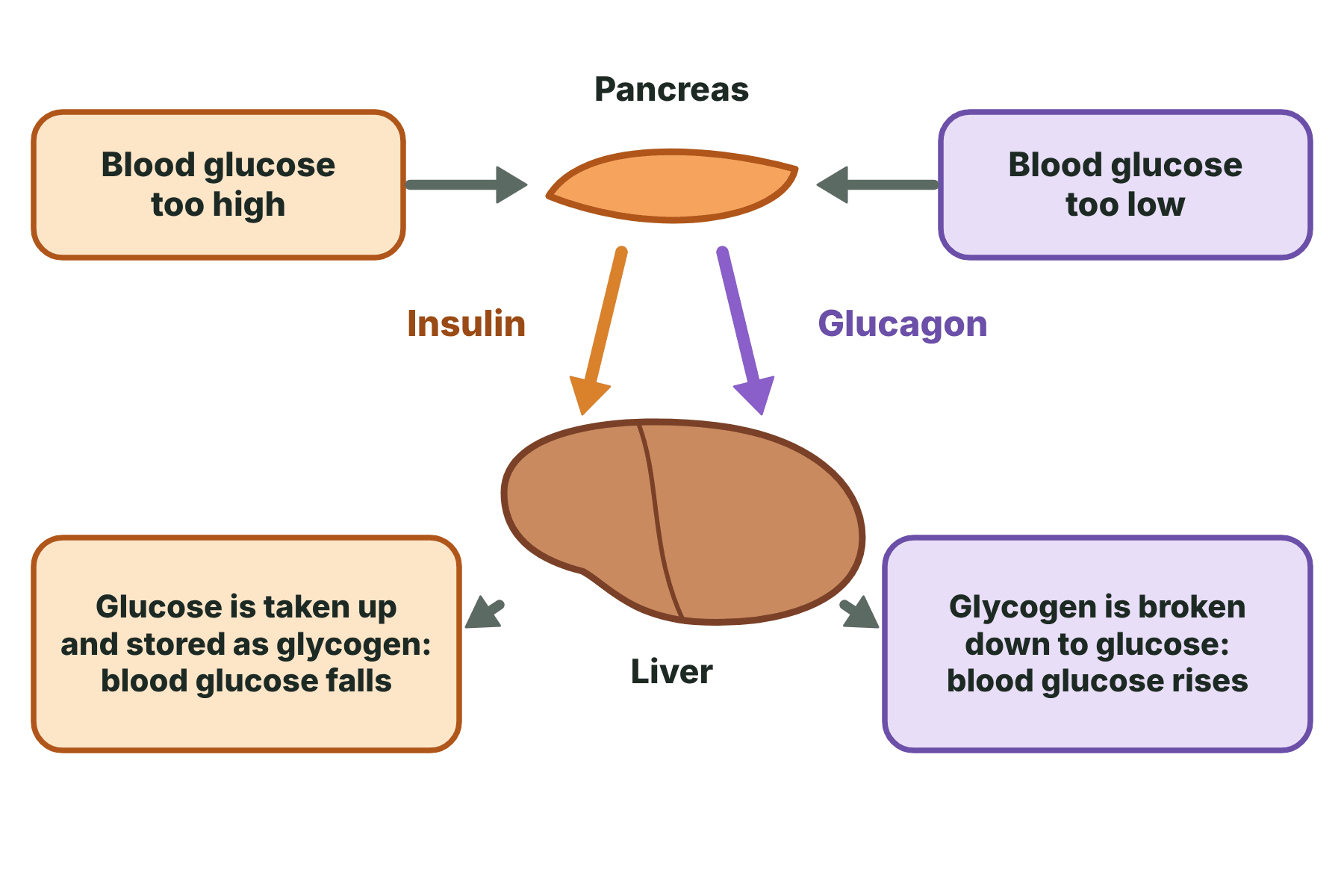
Insulin lowers the blood glucose concentration and glucagon raises it.
Insulin and glucagon
Insulin
- Released when blood glucose is too high
- Released by the pancreas
- Liver converts glucose to glycogen
- Blood glucose falls
Glucagon (Higher tier)
- Released when blood glucose is too low
- Released by the pancreas
- Liver converts glycogen to glucose
- Blood glucose rises
Diabetes
In diabetes the blood glucose concentration is not controlled properly and can rise too high.
-
Type 1 diabetes
The pancreas does not produce enough insulin. It usually starts in childhood, because the cells that make insulin are destroyed by the body's own immune system.
-
Type 2 diabetes
The body cells stop responding to insulin. It is more common in adults and is linked to obesity, a poor diet and lack of exercise.
-
Symptoms
Very high blood glucose, excess urine, thirst and tiredness.
-
Danger
Without treatment, high blood glucose damages blood vessels, nerves, the eyes and the kidneys.
Treating diabetes
The treatment depends on the type of diabetes.
-
Type 1
The person monitors their blood glucose and injects insulin, usually before meals. The insulin lets the liver and muscles take up glucose. Eating a controlled amount of carbohydrate helps.
-
Type 2
The person controls their diet, takes more exercise and loses weight. These changes help cells respond to insulin again. Some people also take medicines or insulin.
-
Why diet matters
Eating less sugar and less starch means less glucose enters the blood after a meal.
-
Prevention
Type 2 diabetes can often be prevented by a healthy diet, exercise and keeping a healthy body mass.
Blood glucose after a meal
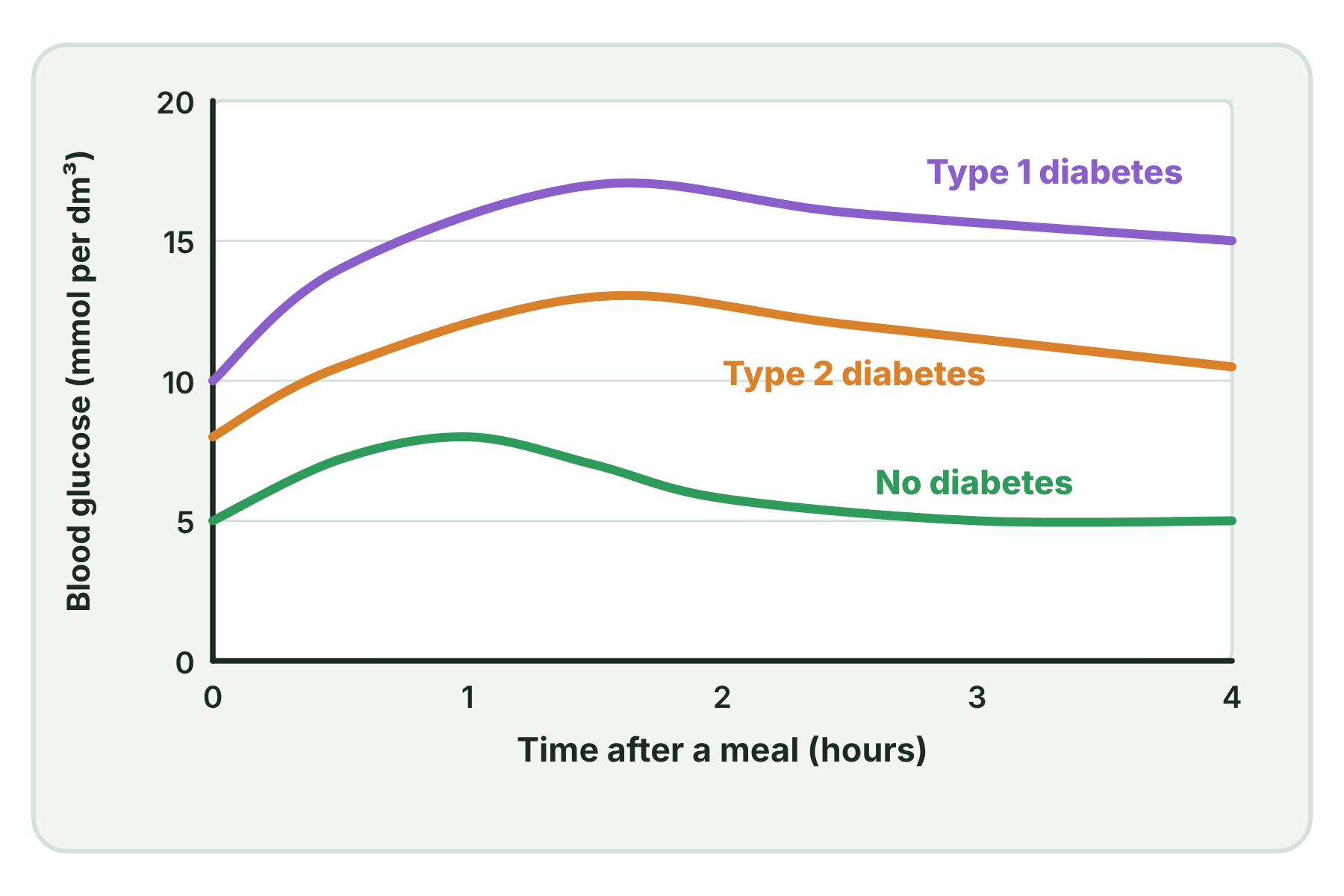
In diabetes the blood glucose stays high after a meal.
Type 1 and type 2 diabetes
Type 1
- The pancreas does not make enough insulin
- Usually starts in childhood
- Not caused by lifestyle
- Treated with insulin injections
Type 2
- Body cells stop responding to insulin
- More common in adults
- Linked to obesity and lack of exercise
- Treated with diet, exercise and sometimes medicine
Case study
Eating a sugary snack
A student drinks a sugary drink. The glucose is absorbed and the blood glucose concentration rises. The pancreas detects this and releases insulin. The insulin makes the liver and muscles take in glucose and store it as glycogen, and the concentration falls back to normal within a couple of hours. A person with type 1 diabetes cannot make insulin, so their blood glucose would stay high unless they inject some.
The big idea
Insulin lowers the blood glucose concentration by making the liver store glucose as glycogen, and for Higher tier glucagon raises it by making the liver release glucose, and in diabetes this control fails.
Blood glucose
Blood glucose
-
Insulin
- released when glucose is high
- liver stores glycogen
-
Glucagon (Higher tier)
- released when glucose is low
- liver releases glucose
-
Type 1 diabetes
- pancreas makes too little insulin
-
Type 2 diabetes
- cells stop responding to insulin
-
Treatment
- injections or diet and exercise
Summary and exam focus
- The pancreas releases insulin when the blood glucose is too high.
- Insulin makes the liver and muscles take up glucose, and the liver stores it as glycogen.
- (Higher tier) Glucagon makes the liver release glucose when the blood glucose is too low.
- In type 1 diabetes the pancreas does not make enough insulin, and it is treated with insulin injections.
- In type 2 diabetes the cells stop responding to insulin, and it is treated with diet and exercise, and sometimes medicine.
Exam focus
Explain how insulin controls the blood glucose concentration after a meal. (4 marks) (4 marks)
Write in order: the glucose concentration rises, the pancreas detects it, the pancreas releases insulin, insulin makes the liver take up glucose and convert it to glycogen, so the concentration falls.
Key terms
The words this lesson expects you to use. Each one is linked from the first place it appears above.
- Blood glucose concentration
- The amount of glucose in the blood.
- Insulin
- The hormone that lowers the blood glucose concentration.
- Glucagon
- The hormone that raises the blood glucose concentration (Higher tier).
- Pancreas
- The organ that releases insulin and glucagon.
- Glycogen
- The carbohydrate in which the liver stores glucose.
- Diabetes
- A disease in which the blood glucose concentration is not controlled properly.
- Type 1 diabetes
- Diabetes in which the pancreas does not make enough insulin.
- Type 2 diabetes
- Diabetes in which the body cells stop responding to insulin.
You've finished the notes
Check your understanding
Test yourself while it is fresh. Start with the flashcards, then try the exam questions.
Something here looks wrong?
Tell us what and we will go and look. It goes to whoever writes these pages, nobody else, and we do not ask who you are — so there is nothing to sign and nothing comes back to you.