Biology · Homeostasis
The Kidneys and Water Balance
The kidneys clean the blood and control the amount of water and salts in the body. This lesson is for separate Biology. It covers why water balance matters, the structure of the kidney and nephron, how urine is made, and for Higher tier students how ADH controls the water in the blood and how the body responds to challenges.
Learning Objectives
- 1Explain the effect on cells of osmotic changes in body fluids.
- 2Describe the function of the kidneys in homeostasis, including the removal of urea.
- 3Describe the gross structure of the urinary system and the structure of a nephron, and how urine is made.
- 4(Higher tier) Describe the effect of ADH on the amount of water reabsorbed and explain how this is controlled by negative feedback.
- 5(Higher tier) Explain how the body responds to challenges such as exercise, heat and a salty diet.
Retrieval practice
-
1
What is osmosis?
Show answerHide answer
The movement of water from a dilute solution to a concentrated solution through a partially permeable membrane.
-
2
What is urea?
Show answerHide answer
A waste substance made from the breakdown of excess protein.
-
3
What is negative feedback?
Show answerHide answer
A response that reverses a change and returns a condition to normal.
-
4
What does the pituitary gland do?
Show answerHide answer
It releases hormones that control other glands.
Cleaning and balancing the blood
Every minute about a litre of blood flows through your kidneys. They remove waste, including urea, and they adjust the amount of water and salts that leave the body. Without the kidneys, waste would build up and the water content of the blood would swing too far. Kidney failure is life-threatening, which is why a patient may need dialysis or a transplant.
Why the water content matters
The water content of the blood affects the cells because of osmosis.
-
Too much water
If the blood becomes too dilute, water enters the body cells by osmosis. Animal cells have no cell wall, so they swell and may burst.
-
Too little water
If the blood becomes too concentrated, water leaves the cells by osmosis, and they shrink and cannot work properly.
-
Balance
The kidneys keep the water content of the blood constant, so the cells stay normal.
A red blood cell in three solutions
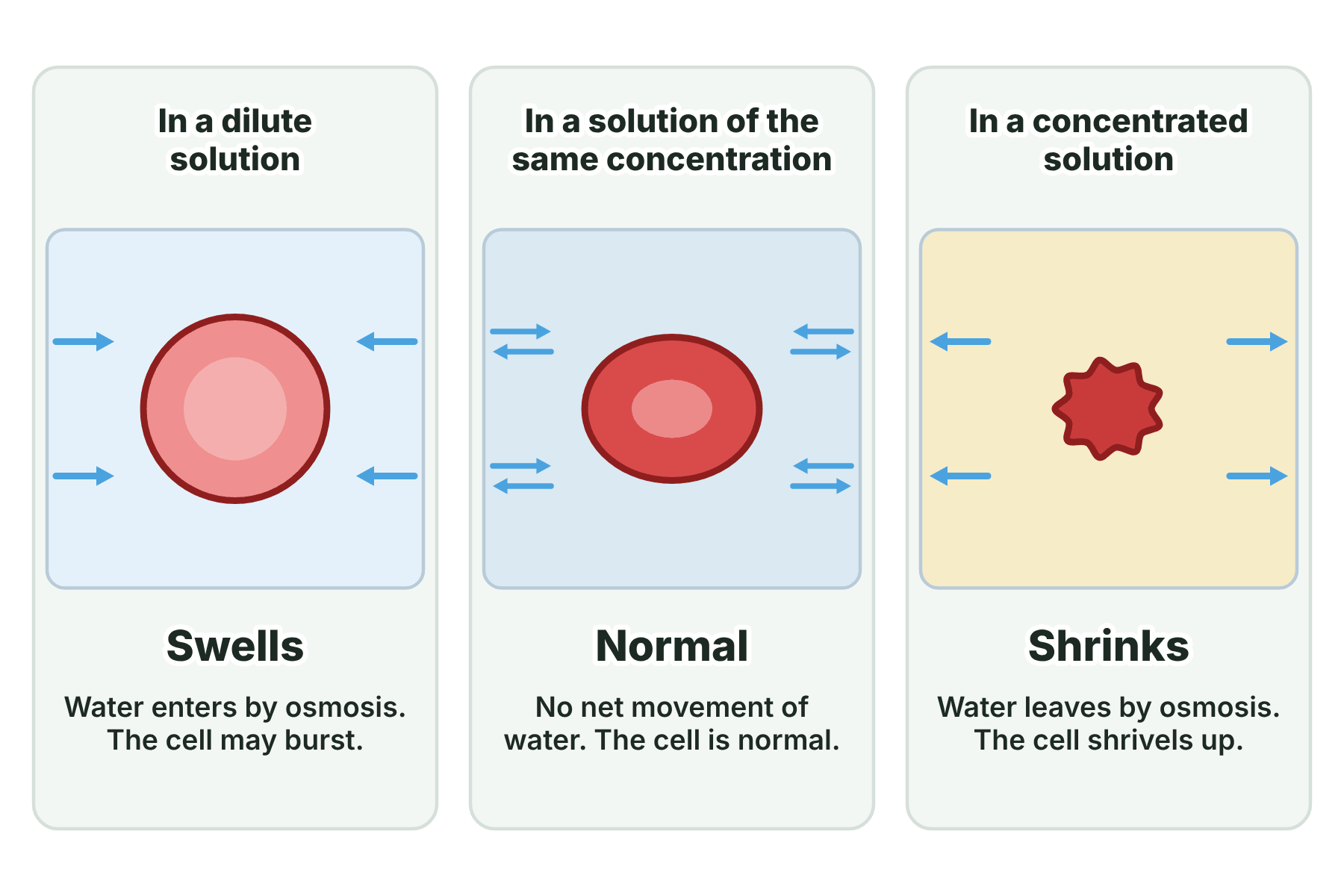
With no cell wall, an animal cell can burst in a dilute solution.
What the kidneys do
The kidneys are organs of excretion and of water balance.
-
Remove urea
Urea is made in the liver when excess amino acids are broken down. It is poisonous, and the kidneys remove it from the blood.
-
Remove excess water
The kidneys control how much water is lost in the urine.
-
Remove excess mineral ions
Salts that are not needed are removed, in the urine.
-
Urine
The urine contains urea, excess water and excess ions. It travels from the kidneys along the ureters to the bladder, and leaves the body through the urethra.
The urinary system
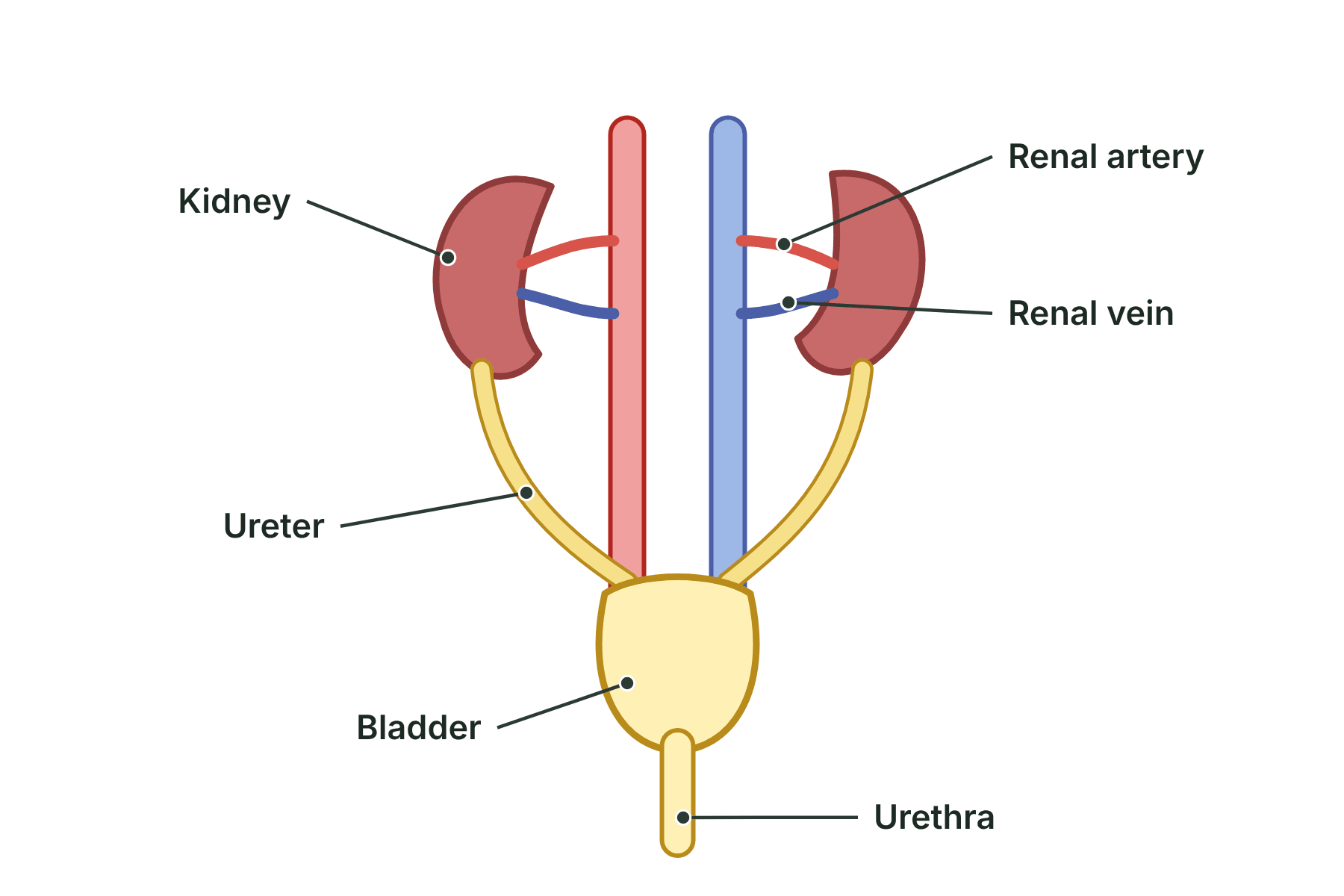
The kidneys make urine, which passes down the ureters to the bladder.
The nephron
Each kidney contains about a million tiny filtering units called nephrons.
-
Bowman's capsule
A cup-shaped structure that surrounds a knot of capillaries called the glomerulus.
-
Proximal convoluted tubule
The first coiled tube after the capsule.
-
Loop of Henle
A long hairpin loop that goes down into the middle of the kidney and back.
-
Distal convoluted tubule
A second coiled tube.
-
Collecting duct
The tube that collects the urine from many nephrons and carries it towards the ureter.
How urine is made
Urine is made in three stages as the blood flows through the nephrons.
-
Filtration
Blood in the glomerulus is at high pressure. This pushes small molecules, such as water, glucose, urea and mineral ions, out of the blood into the Bowman's capsule. Blood cells and proteins are too big, so they stay in the blood.
-
Selective reabsorption
As the filtrate flows along the tubule, all of the glucose is reabsorbed into the blood, using active transport. Some of the water and some of the mineral ions are also reabsorbed.
-
Release of waste
The urea, the excess water and the excess ions stay in the tubule, and flow out as urine.
-
Adjusting the water
The amount of water that is reabsorbed in the collecting duct depends on the body's needs.
A nephron
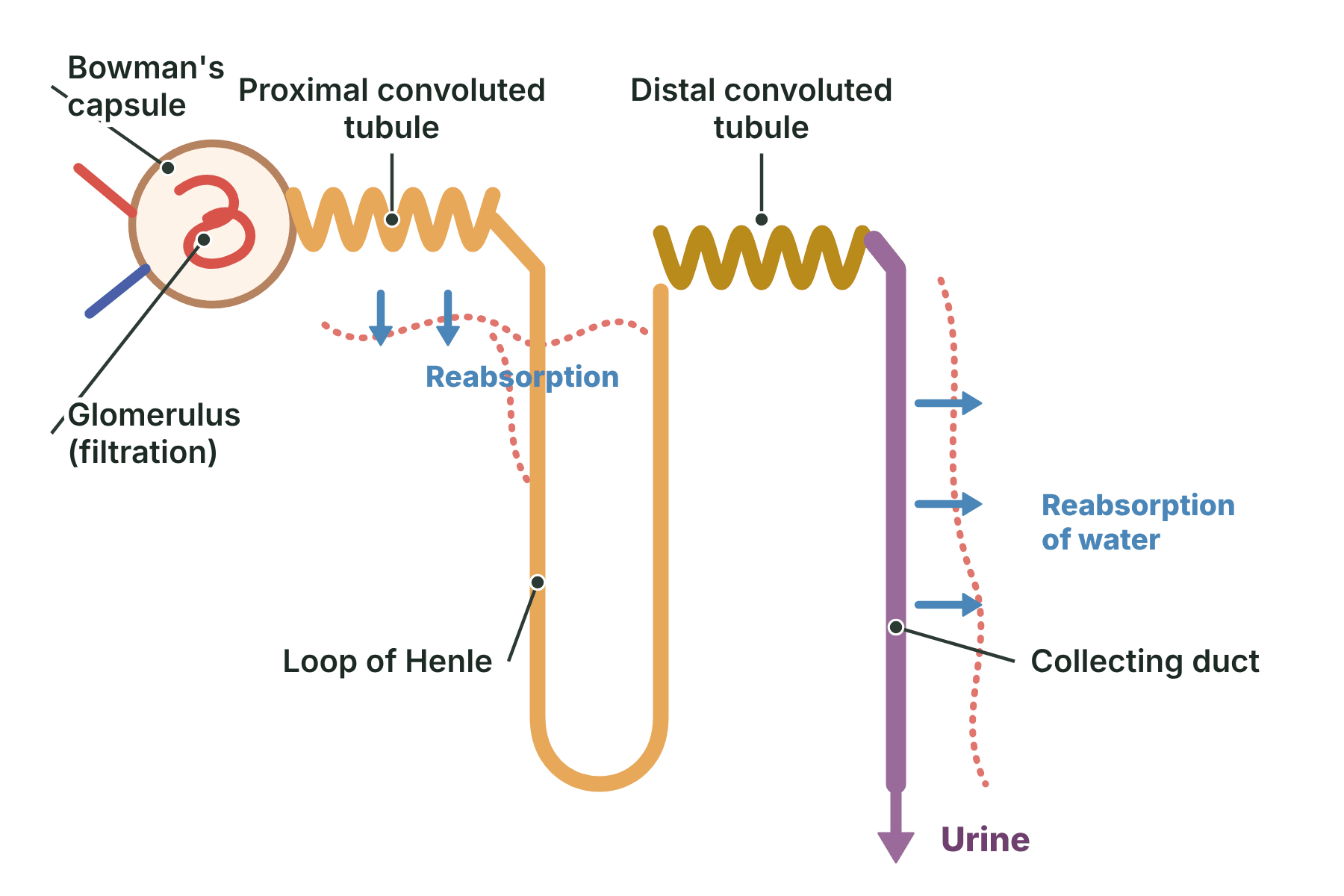
Filtration happens in the glomerulus and the capsule, and reabsorption in the tubules.
ADH and water balance (Higher tier)
The amount of water reabsorbed is controlled by the hormone ADH, antidiuretic hormone.
-
Too little water
If the blood is too concentrated, the hypothalamus detects this and the pituitary gland releases more ADH.
-
The effect of ADH
ADH makes the walls of the collecting duct more permeable to water, so more water is reabsorbed into the blood. The urine is a small volume and concentrated.
-
Too much water
If the blood is too dilute, the pituitary releases less ADH. The collecting duct is less permeable, less water is reabsorbed, and the urine is a large volume and dilute.
-
Negative feedback
Each change in the water content causes a response that reverses it.
Controlling water balance with ADH (Higher tier)
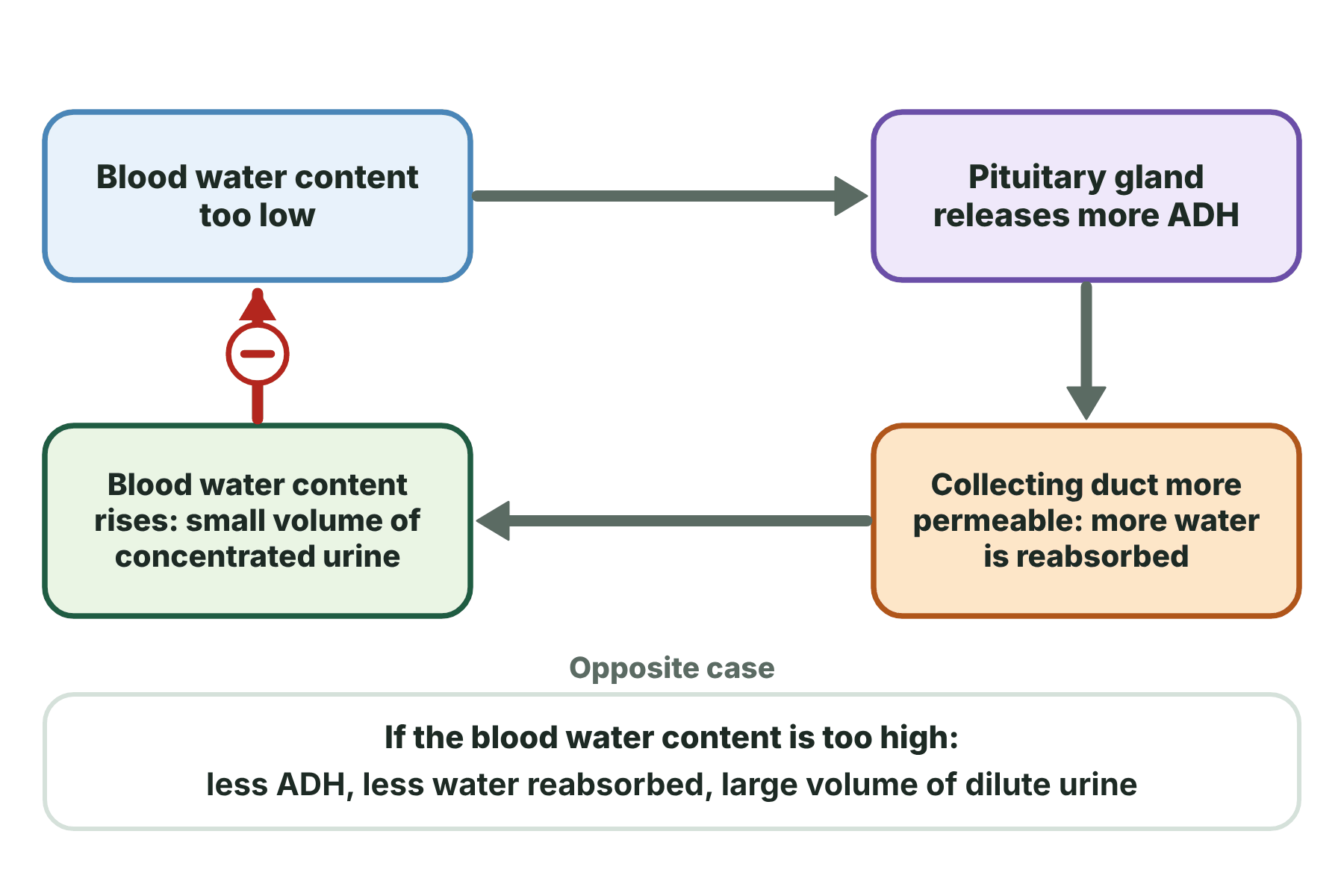
ADH makes the kidneys reabsorb more water when the blood is too concentrated.
Responding to challenges (Higher tier)
Exercise, hot weather and food all change the water and salt content of the body.
-
Exercise or heat
You lose water and salts in sweat. The blood becomes more concentrated, more ADH is released, and the kidneys produce less, darker, concentrated urine.
-
Drinking a lot of water
The blood becomes more dilute, less ADH is released, and the kidneys produce more, pale, dilute urine.
-
A salty meal
The blood becomes more concentrated. More ADH is released, the urine is concentrated, and you feel thirsty and drink more.
-
Heavy exercise
Sports drinks that contain water and salts help to replace what is lost in sweat.
Dilute urine and concentrated urine
Too much water in the body
- Less ADH is released
- Collecting duct less permeable
- Less water is reabsorbed
- Large volume of pale, dilute urine
Too little water in the body
- More ADH is released
- Collecting duct more permeable
- More water is reabsorbed
- Small volume of dark, concentrated urine
Case study
A long run on a hot day
A runner loses a lot of water and salts in sweat during a marathon on a hot day. Her blood becomes more concentrated. The hypothalamus detects this and the pituitary gland releases more ADH. The collecting ducts in her kidneys become more permeable, so more water is reabsorbed into her blood and she produces only a little dark urine. If she drinks plenty of water and a sports drink, the blood water content returns to normal and the ADH level falls.
The big idea
The kidneys filter the blood, reabsorb what is needed and remove urea and excess water and ions, and for Higher tier ADH adjusts the water reabsorbed so that the water content of the blood stays constant.
The kidneys
The kidneys
-
Functions
- remove urea
- excess water and ions
-
Nephron
- Bowman's capsule
- tubules
- loop of Henle
- collecting duct
-
Stages
- filtration
- selective reabsorption
- urine
-
ADH (Higher tier)
- controls water reabsorbed in the collecting duct
-
Challenges (Higher tier)
- exercise
- heat
- salty food
Summary and exam focus
- If the water content of the blood is wrong, cells gain or lose water by osmosis.
- The kidneys remove urea, excess water and excess mineral ions from the blood.
- Blood is filtered under pressure, then glucose, some water and some ions are reabsorbed.
- (Higher tier) ADH makes the collecting duct more permeable, so more water is reabsorbed.
- (Higher tier) Exercise, heat and a salty diet make the blood more concentrated, so more ADH is released.
Exam focus
Describe how urine is made in the kidney. (4 marks) (4 marks)
Describe the stages in order: filtration under high pressure in the glomerulus, selective reabsorption of all the glucose and some water and ions in the tubule, and then the urea and the excess water and ions leave as urine.
Key terms
The words this lesson expects you to use. Each one is linked from the first place it appears above.
- Kidney
- An organ that filters the blood and makes urine.
- Nephron
- The filtering unit of the kidney.
- Urea
- A poisonous waste substance made from excess amino acids and removed by the kidneys.
- Filtration
- The forcing of small molecules out of the blood into the Bowman's capsule.
- Selective reabsorption
- The taking back into the blood of useful substances such as glucose.
- ADH
- The hormone that controls the amount of water the kidneys reabsorb (Higher tier).
- Urine
- The liquid that contains urea, excess water and excess ions.
- Collecting duct
- The tube that carries urine from the nephrons.
You've finished the notes
Check your understanding
Test yourself while it is fresh. Start with the flashcards, then try the exam questions.
Something here looks wrong?
Tell us what and we will go and look. It goes to whoever writes these pages, nobody else, and we do not ask who you are — so there is nothing to sign and nothing comes back to you.