Biology · Homeostasis
Temperature Control and the Skin
Humans keep their body temperature at about 37 °C however hot or cold it is outside. This lesson is for separate Biology. It covers how the skin detects temperature, how the brain coordinates the response, and how sweating, blood vessels, shivering and hairs help the body to warm up or cool down.
Learning Objectives
- 1Describe the function of the skin in detecting external temperature and in controlling body temperature.
- 2Explain how the brain acts as a coordination centre for temperature control.
- 3Describe the responses of the body when it gets too hot and when it gets too cold.
- 4Explain how these responses are examples of negative feedback.
Retrieval practice
-
1
What is homeostasis?
Show answerHide answer
The regulation of the internal conditions of the body to keep them constant.
-
2
What does the hypothalamus control?
Show answerHide answer
Body temperature and water balance.
-
3
What is negative feedback?
Show answerHide answer
A response that reverses a change and returns a condition to normal.
-
4
What is an effector?
Show answerHide answer
A muscle or gland that carries out a response.
Hot days and cold days
On a hot day you sweat and your face goes red. On a cold day you shiver and your skin goes pale. These are not accidents. They are responses that keep your core body temperature at about 37 °C, the best temperature for your enzymes. The skin has the receptors that detect the temperature outside, and it also contains the effectors that help to warm up or cool down the body.
Detecting temperature
Temperature receptors detect changes, and the brain coordinates the response.
-
In the skin
Temperature receptors detect the temperature of the surroundings and send impulses along sensory neurones to the brain.
-
In the brain
The hypothalamus contains receptors that monitor the temperature of the blood flowing through it.
-
Coordination centre
The hypothalamus compares the temperature with the normal level and sends impulses to effectors in the skin and muscles.
-
Effectors
Sweat glands, muscles in the walls of blood vessels, the muscles attached to the hairs, and the skeletal muscles that shiver.
The structure of the skin
The skin has layers and structures that are involved in temperature control.
-
Epidermis
The thin outer layer of skin.
-
Hair and erector muscle
Each hair grows from a follicle, and a tiny hair erector muscle can pull the hair upright.
-
Sweat gland
Makes sweat, which travels along a sweat duct to a pore on the surface of the skin.
-
Blood vessels
Small arteries in the dermis carry blood close to the skin surface.
-
Fat layer
A layer of fat below the skin that insulates the body.
-
Temperature receptor
Detects the temperature of the surroundings.
A section through the skin
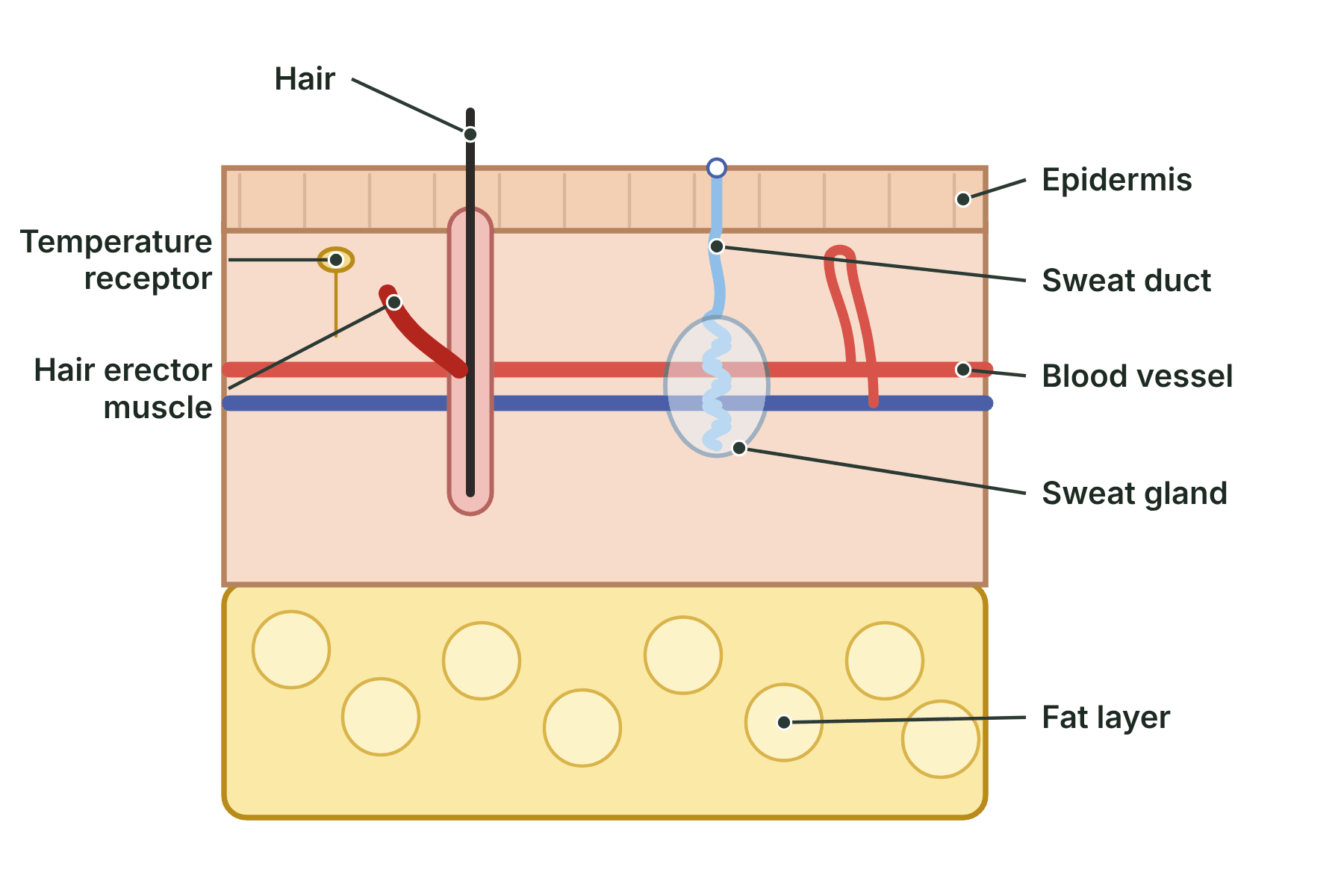
The skin contains the receptors and the effectors for temperature control.
When the body gets too hot
The responses lose heat to the surroundings.
-
Sweating
The sweat glands release more sweat. As the sweat evaporates from the skin it takes heat from the body, which cools it down.
-
Vasodilation
The blood vessels near the surface of the skin widen, so more blood flows close to the surface and more heat is transferred to the surroundings. The skin looks red.
-
Hairs lie flat
The hair erector muscles relax, so the hairs lie flat and do not trap an insulating layer of air.
-
Result
The body temperature falls back towards 37 °C.
When the body gets too cold
The responses save heat and make more of it.
-
Shivering
The skeletal muscles contract and relax rapidly. Respiration in the muscles releases heat, which warms the body.
-
Vasoconstriction
The blood vessels near the surface of the skin narrow, so less blood flows near the surface and less heat is lost. The skin looks pale.
-
Hairs stand up
The hair erector muscles contract and the hairs stand on end. This traps a layer of air that insulates the skin, but it is not very effective in humans because we have little body hair.
-
No sweating
The sweat glands release little or no sweat.
-
Result
The body temperature rises back towards 37 °C.
Responses to heat and cold
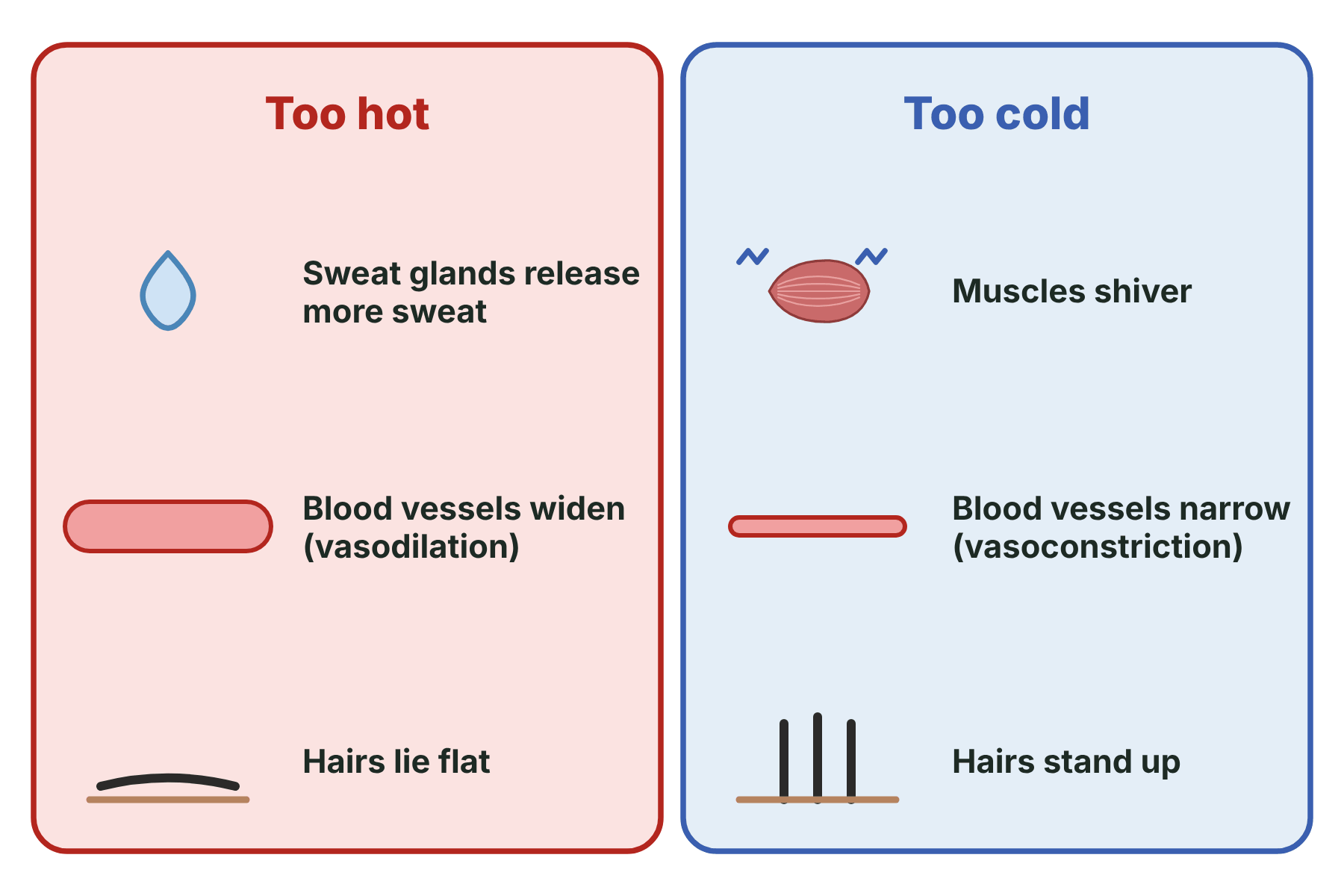
The body cools by sweating and vasodilation, and warms by shivering and vasoconstriction.
Too hot and too cold
Too hot
- Sweating increases
- Blood vessels widen
- Hairs lie flat
- Heat is lost
Too cold
- Shivering
- Blood vessels narrow
- Hairs stand up
- Heat is kept and made
Case study
Why do we go red when we exercise?
When you run hard, the muscles release a lot of heat from respiration, and your blood temperature rises. The hypothalamus detects this and sends impulses to the skin. The blood vessels near the surface widen, which is why your face looks red, and the sweat glands release sweat. The blood carries the heat to the skin, where it is lost to the air, and the evaporation of sweat cools you down.
The big idea
The hypothalamus coordinates temperature control by negative feedback: sweating and vasodilation cool the body, and shivering and vasoconstriction warm it.
Temperature control
Temperature control
-
Receptors
- in the skin and in the hypothalamus
-
Coordination centre
- the hypothalamus in the brain
-
Too hot
- sweating
- vasodilation
- hairs flat
-
Too cold
- shivering
- vasoconstriction
- hairs stand up
-
Normal
- about 37 °C
Summary and exam focus
- Temperature receptors in the skin and the hypothalamus detect changes in temperature.
- The hypothalamus is the coordination centre.
- When the body is too hot, sweating and vasodilation lose heat.
- When the body is too cold, shivering and vasoconstriction save and release heat, and the hairs stand up.
- These are examples of negative feedback.
Exam focus
Describe how the body responds when the blood temperature rises above 37 °C. (4 marks) (4 marks)
Start with the detection: the hypothalamus detects the temperature. Then give the effectors and what they do: more sweat which evaporates, and vasodilation, so more heat is lost.
Key terms
The words this lesson expects you to use. Each one is linked from the first place it appears above.
- Thermoregulation
- The control of body temperature.
- Hypothalamus
- The part of the brain that monitors and controls body temperature.
- Sweat gland
- A gland in the skin that releases sweat.
- Vasodilation
- The widening of blood vessels near the skin surface, so that more heat is lost.
- Vasoconstriction
- The narrowing of blood vessels near the skin surface, so that less heat is lost.
- Shivering
- Rapid muscle contractions that release heat.
- Evaporation
- The change from liquid to gas, which takes heat from the surface.
- Hair erector muscle
- A muscle that pulls a hair upright.
You've finished the notes
Check your understanding
Test yourself while it is fresh. Start with the flashcards, then try the exam questions.
Something here looks wrong?
Tell us what and we will go and look. It goes to whoever writes these pages, nobody else, and we do not ask who you are — so there is nothing to sign and nothing comes back to you.