Biology · The Endocrine System
Hormones and the Endocrine System
Hormones are chemical messengers that coordinate the body more slowly than nerves, but with longer-lasting effects. This lesson covers the principles of hormonal control, the main endocrine glands, how hormonal and nervous control compare, and for Higher tier students the roles of thyroxine and adrenaline.
Learning Objectives
- 1Describe the principles of hormonal coordination and control by the human endocrine system.
- 2Name the main endocrine glands and the hormones they release.
- 3Compare nervous control and hormonal control.
- 4(Higher tier) Explain the roles of thyroxine and adrenaline in the body.
- 5(Higher tier) Explain how thyroxine is an example of a negative feedback system.
Retrieval practice
-
1
What carries substances around the body?
Show answerHide answer
The blood.
-
2
What is a gland?
Show answerHide answer
An organ that makes and releases a chemical, such as a hormone.
-
3
What is the nervous system made of?
Show answerHide answer
The brain, the spinal cord and the nerves.
-
4
What is an effector?
Show answerHide answer
A muscle or gland that carries out a response.
A second communication system
The nervous system is very fast, but it is not the only way the body coordinates itself. The endocrine system uses chemical messengers called hormones, which are carried in the blood. They take longer to arrive, but they can control processes that go on for hours, days or even years, such as growth, reproduction and the use of energy.
How hormones work
The endocrine system is made of glands that release hormones directly into the blood.
-
Hormone
A chemical messenger made in an endocrine gland and carried in the blood.
-
Endocrine gland
A gland that releases its hormone straight into the blood, not along a tube.
-
Transport
The blood carries the hormone to every part of the body.
-
Target organs
A hormone only affects its target organs, which have receptors that fit that hormone. Other cells ignore it.
-
The effect
The target organ responds, for example by releasing another chemical, growing or releasing energy.
The main endocrine glands
Each gland releases different hormones with different jobs.
-
Pituitary gland
The master gland, in the head. It releases hormones that control other glands, as well as growth hormone, FSH, LH and ADH.
-
Thyroid gland
In the neck. It releases thyroxine, which controls the rate of metabolism.
-
Pancreas
Below the stomach. It releases insulin and glucagon, which control blood glucose.
-
Adrenal glands
Above the kidneys. They release adrenaline, which prepares the body for action.
-
Ovaries
In females. They release oestrogen and progesterone.
-
Testes
In males. They release testosterone.
The endocrine glands
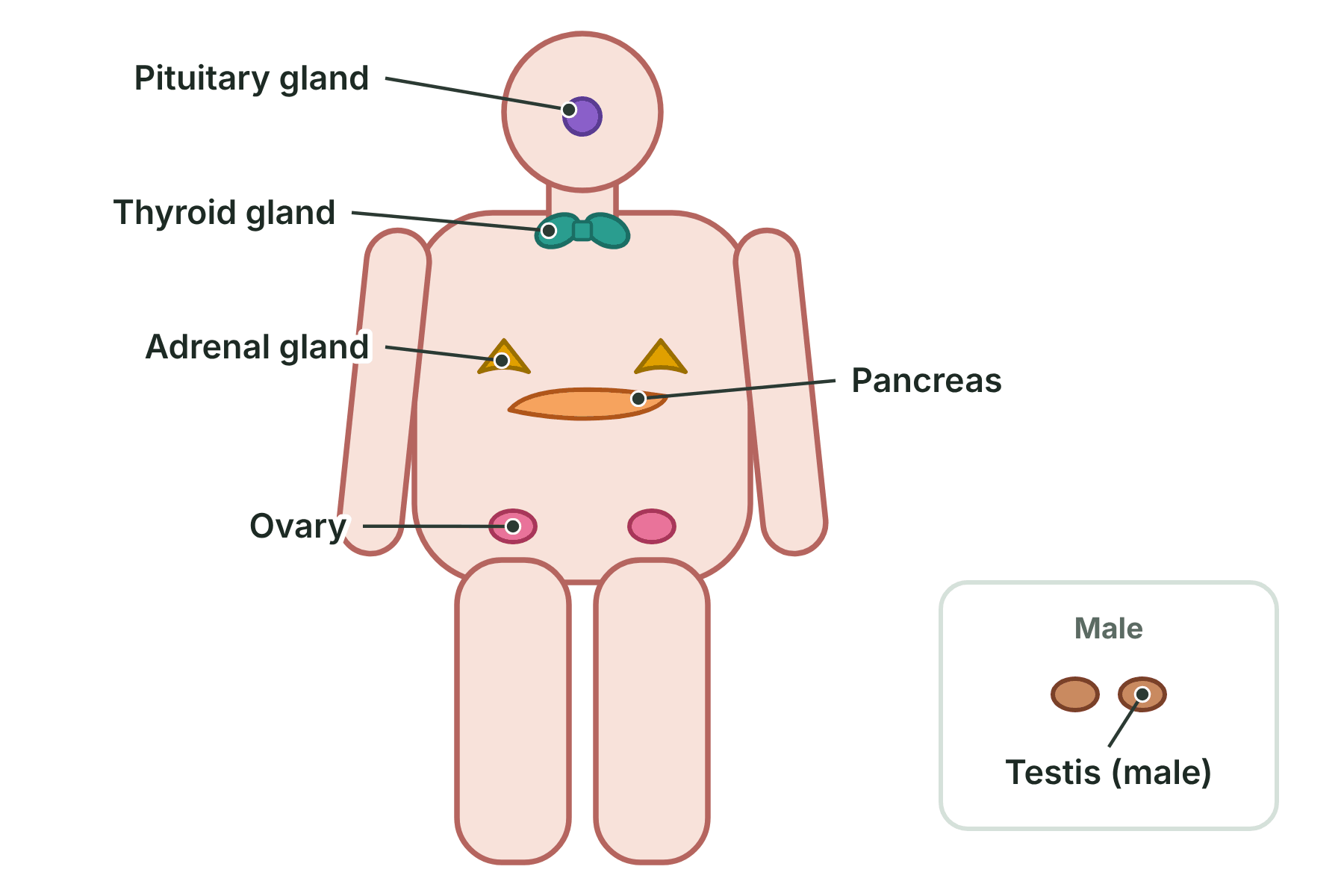
The endocrine glands release hormones into the blood.
Nervous control and hormonal control
Nervous system
- Electrical impulses along neurones
- Very fast response
- Short-lived effect
- Acts on a precise place, such as one muscle
Endocrine system
- Chemical hormones in the blood
- Slower response
- Longer-lasting effect
- Acts on target organs that can be anywhere in the body
Thyroxine (Higher tier)
Thyroxine controls how fast the body's chemical reactions happen, and it is controlled by negative feedback.
-
The source
The thyroid gland releases thyroxine.
-
The role
Thyroxine controls the basal metabolic rate, which is the rate of the body's chemical reactions at rest. It is also important for growth and development.
-
Too little thyroxine
The pituitary gland releases more of a hormone that tells the thyroid gland to make thyroxine, so the level rises.
-
Too much thyroxine
High levels of thyroxine stop the pituitary releasing that hormone, so the thyroid gland makes less, and the level falls. This is negative feedback: a change causes a response that reverses the change.
Negative feedback with thyroxine (Higher tier)
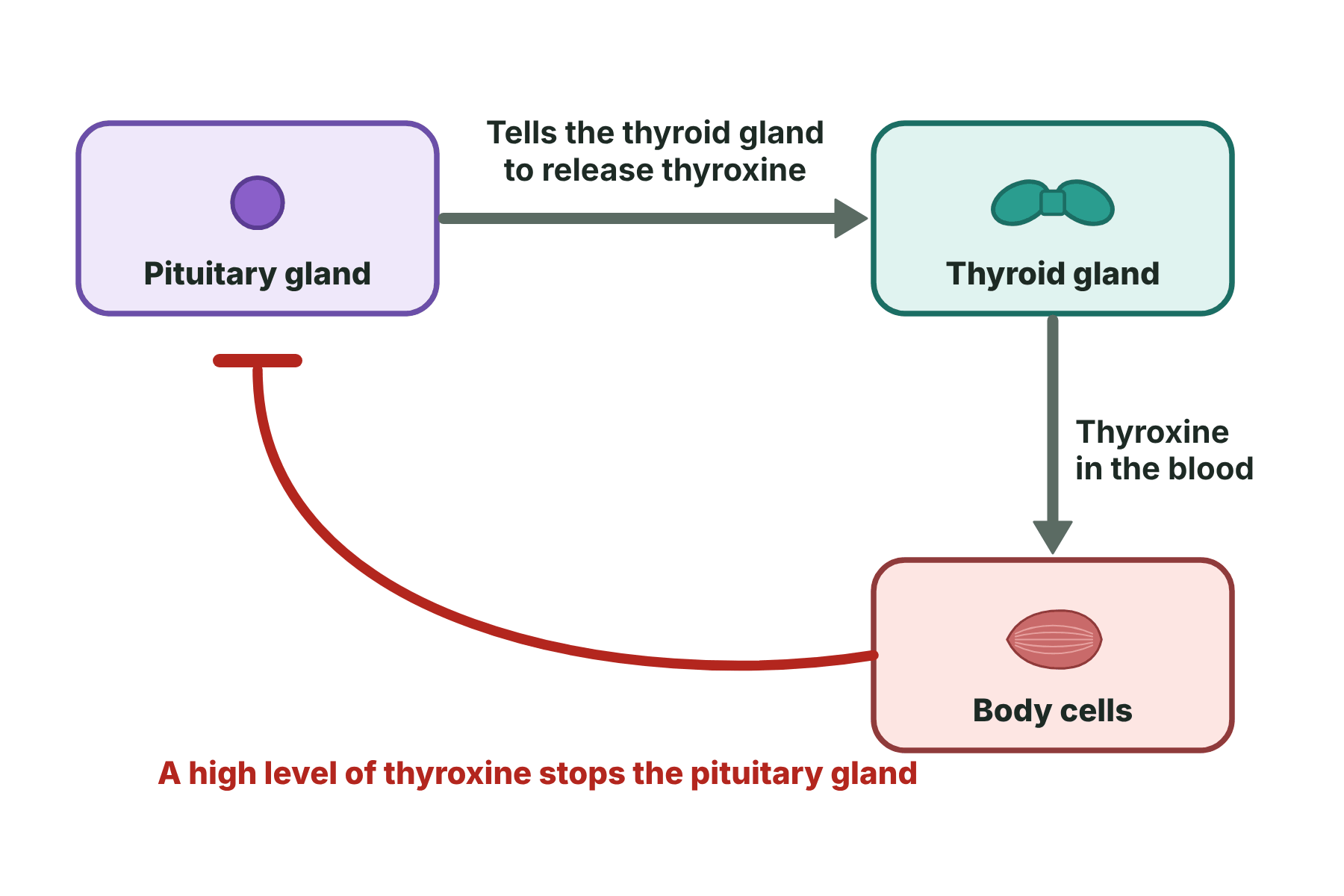
A high level of thyroxine switches the pituitary off, so the level falls.
Adrenaline (Higher tier)
Adrenaline prepares the body for fight or flight in an emergency.
-
The source
The adrenal glands release adrenaline when you are frightened or excited.
-
The effects
The heart rate increases, so more blood is pumped to the muscles. Breathing speeds up. The liver releases glucose into the blood, and blood vessels to the muscles widen.
-
The result
The muscles get more oxygen and glucose, so they can respire faster and release more energy for running or fighting.
-
Quick but not instant
Adrenaline works within seconds, but its effects last longer than a nerve impulse.
Case study
Fight or flight
You turn a corner and a large dog runs at you, barking. Your brain senses danger and tells the adrenal glands to release adrenaline. Within seconds your heart is pounding and you are breathing faster. For Higher tier, the adrenaline has widened the blood vessels to your muscles and made your liver release glucose, so your muscles can use more oxygen and glucose to release energy. You are ready to run.
The big idea
The endocrine system uses hormones released by glands into the blood, which act on target organs more slowly than nerves but for longer.
The endocrine system
The endocrine system
-
Hormones
- chemical messengers carried in the blood
-
Target organs
- have receptors that fit the hormone
-
Main glands
- pituitary
- thyroid
- pancreas
- adrenals
- ovaries
- testes
-
Compared with nerves
- slower
- longer-lasting
-
Thyroxine and adrenaline (Higher tier)
- metabolic rate and fight or flight
Summary and exam focus
- Hormones are chemical messengers released by endocrine glands into the blood.
- A hormone only affects its target organs, which have the right receptors.
- The pituitary is the master gland, and the other glands are the thyroid, pancreas, adrenals, ovaries and testes.
- Hormonal control is slower than nervous control and lasts longer.
- (Higher tier) Thyroxine controls metabolic rate, and a high level switches the pituitary off by negative feedback.
- (Higher tier) Adrenaline prepares the body for fight or flight.
Exam focus
Compare nervous control with hormonal control. (4 marks) (4 marks)
Use comparison words such as faster, slower, longer, shorter. Cover how the message travels, the speed, how long the effect lasts and where it acts.
Key terms
The words this lesson expects you to use. Each one is linked from the first place it appears above.
- Hormone
- A chemical messenger carried in the blood.
- Endocrine gland
- A gland that releases hormones into the blood.
- Target organ
- An organ with receptors that respond to a particular hormone.
- Pituitary gland
- The master gland that releases hormones controlling other glands.
- Thyroid gland
- The gland in the neck that releases thyroxine.
- Adrenal gland
- A gland above the kidney that releases adrenaline.
- Negative feedback
- A change causes a response that reverses the change (Higher tier).
- Metabolic rate
- The rate of the chemical reactions in the body.
You've finished the notes
Check your understanding
Test yourself while it is fresh. Start with the flashcards, then try the exam questions.
Something here looks wrong?
Tell us what and we will go and look. It goes to whoever writes these pages, nobody else, and we do not ask who you are — so there is nothing to sign and nothing comes back to you.