Exam questions · Biology · The Endocrine System
Hormones and the Endocrine System
- 7 exam questions
- 21 marks
- 8 quick checks
-
1 State [2 marks]
State what is meant by an endocrine gland and a hormone.
Show answerHide answer
Model answer
An endocrine gland releases its hormone into the blood. A hormone is a chemical messenger carried in the blood.
Mark scheme
- Endocrine gland releases hormones into the blood — 1 mark
- Hormone: chemical messenger carried in the blood — 1 mark
-
2 Name [3 marks]
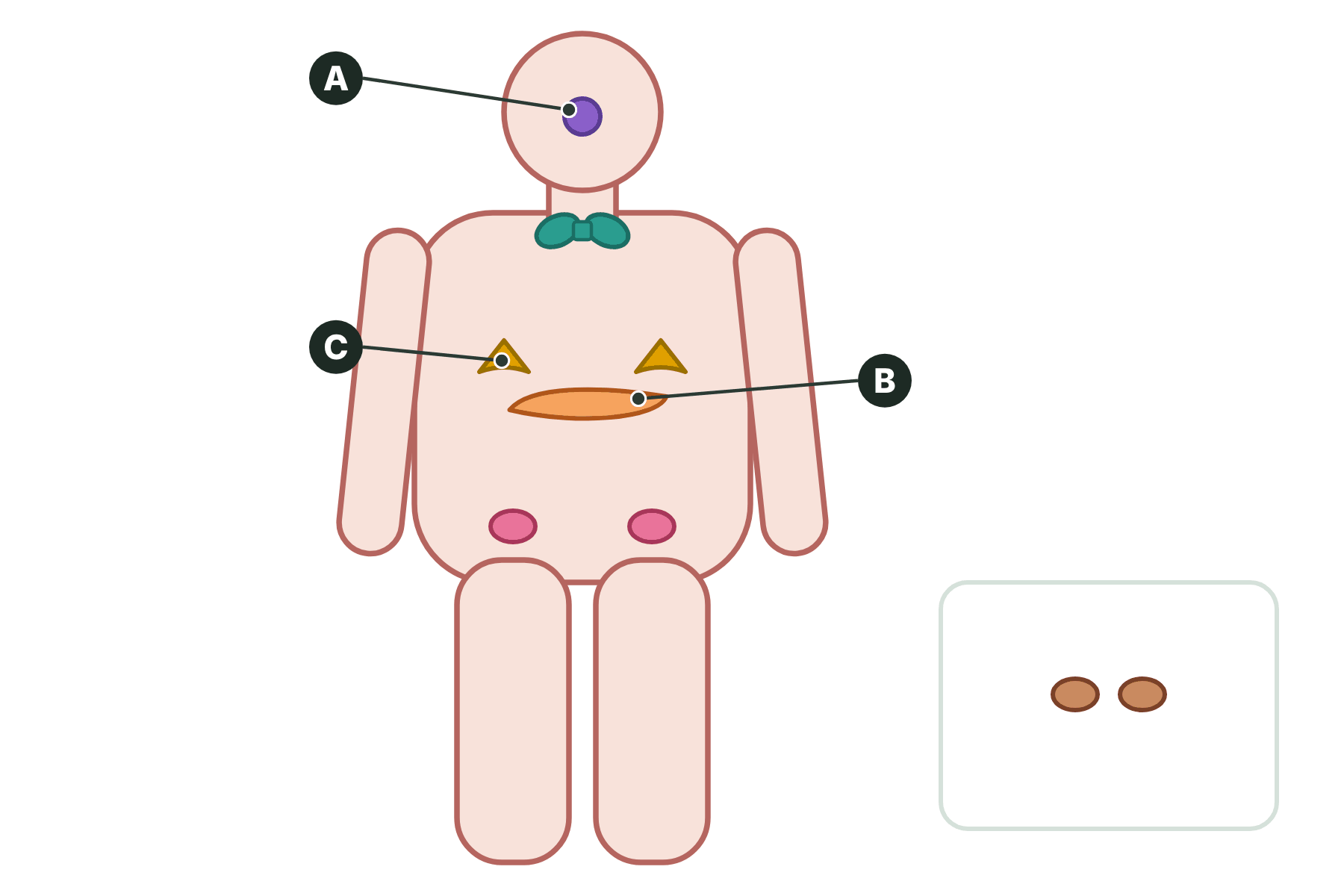
Figure 1 shows some endocrine glands. Name the glands shown at A, B and C.
Show answerHide answer
Model answer
A is the pituitary gland. B is the pancreas. C is an adrenal gland.
Mark scheme
- A: pituitary gland — 1 mark
- B: pancreas — 1 mark
- C: adrenal gland — 1 mark
-
3 Compare [4 marks]
Compare nervous control with hormonal control.
Show answerHide answer
Model answer
Nervous control uses electrical impulses but hormonal control uses chemicals in the blood. Nervous control is faster than hormonal control. The effect of nervous control is short-lived but hormones have a longer-lasting effect. Nerves act on a precise place whereas hormones act on target organs anywhere in the body.
Mark scheme
- Impulses against chemicals in the blood — 1 mark
- Nervous is faster — 1 mark
- Hormonal effect lasts longer — 1 mark
- Precise place against target organs — 1 mark
-
4 Explain [3 marks]
Explain why a hormone only affects some organs, even though it is carried to all parts of the body in the blood.
Show answerHide answer
Model answer
The hormone reaches every organ in the blood. Only its target organs have receptors that fit the hormone. Other organs do not have the receptors, so they do not respond.
Mark scheme
- Carried to all organs in the blood — 1 mark
- Only target organs have the receptors — 1 mark
- Other organs do not respond — 1 mark
-
5 Explain [3 marks]
Explain how negative feedback keeps the level of thyroxine in the blood roughly constant.
Show answerHide answer
Model answer
If the thyroxine level falls, the pituitary gland releases more hormone to stimulate the thyroid gland, so more thyroxine is made. If the level rises, the pituitary releases less, so the thyroid gland makes less thyroxine. The change is reversed each time.
Mark scheme
- Low level makes the pituitary stimulate the thyroid — 1 mark
- High level makes the pituitary release less — 1 mark
- Each change causes a response that reverses it — 1 mark
-
6 Explain [4 marks]
Explain how adrenaline helps a person to run away from danger.
Show answerHide answer
Model answer
The adrenal glands release adrenaline. It increases the heart rate and widens blood vessels to the muscles, so more blood reaches them. The liver releases glucose. The muscles get more oxygen and glucose, so they respire faster and release more energy for running.
Mark scheme
- Adrenal glands release adrenaline — 1 mark
- Heart rate increases and more blood to the muscles — 1 mark
- Liver releases glucose — 1 mark
- More oxygen and glucose, so more respiration for energy — 1 mark
-
7 State [2 marks]
State two effects of adrenaline on the body.
Show answerHide answer
Model answer
Any two of: increased heart rate, increased breathing rate, liver releases glucose, blood vessels to the muscles widen.
Mark scheme
- Effect 1 — 1 mark
- Effect 2 — 1 mark
Quick check
-
1
What carries hormones around the body?
Show answerHide answer
C: The blood
Hormones are released into the blood and carried to their target organs.
-
2
Which gland is called the master gland?
Show answerHide answer
A: The pituitary gland
The pituitary gland releases hormones that control other glands.
-
3
Which gland releases thyroxine?
Show answerHide answer
D: The thyroid gland
The thyroid gland, in the neck, releases thyroxine.
-
4
How does hormonal control compare with nervous control?
Show answerHide answer
B: Slower and longer-lasting
Hormonal control is slower, and the effects last longer.
-
5
What is a target organ?
Show answerHide answer
C: An organ with receptors for a hormone
A target organ has receptors that fit a particular hormone.
-
6
Which hormone is released by the testes?
Show answerHide answer
A: Testosterone
The testes release testosterone.
-
7
What does the thyroid hormone control?
Show answerHide answer
D: Metabolic rate
Thyroxine controls the basal metabolic rate.
-
8
What is negative feedback?
Show answerHide answer
B: A change causes a response that reverses it
In negative feedback a change causes a response that reverses the change.