Biology · The Endocrine System
The Menstrual Cycle
Hormones control the menstrual cycle and prepare the body for a possible pregnancy. This lesson covers the roles of oestrogen, progesterone, FSH, LH and testosterone, the stages of the menstrual cycle, and for Higher tier students how the hormones interact.
Learning Objectives
- 1Describe the roles of oestrogen, progesterone, FSH, LH and testosterone in human reproduction.
- 2Describe the stages of the menstrual cycle and when they happen.
- 3Interpret graphs of hormone levels through the menstrual cycle.
- 4(Higher tier) Explain the interactions of FSH, LH, oestrogen and progesterone in the control of the menstrual cycle.
Retrieval practice
-
1
Which gland is the master gland?
Show answerHide answer
The pituitary gland.
-
2
What is a target organ?
Show answerHide answer
An organ with receptors for a particular hormone.
-
3
Which glands release oestrogen and progesterone?
Show answerHide answer
The ovaries.
-
4
Which organ releases testosterone?
Show answerHide answer
The testes.
A monthly cycle
From puberty until the menopause, a woman's body goes through a regular cycle of about 28 days, in which an egg is released from an ovary and the lining of the uterus is prepared to receive it. If the egg is fertilised, the lining supports the embryo. If it is not, the lining is lost and the cycle begins again. Four hormones control it, working together.
The reproductive hormones
Each hormone has its own source and its own job.
-
FSH
Follicle stimulating hormone is released by the pituitary gland. It causes an egg to mature in a follicle in an ovary, and it stimulates the ovary to release oestrogen.
-
LH
Luteinising hormone is released by the pituitary gland. A surge of LH stimulates the release of the egg, which is called ovulation.
-
Oestrogen
Released by the ovaries. It causes the lining of the uterus to grow and repair, and it controls the development of female secondary sexual characteristics at puberty.
-
Progesterone
Released by the ovary after ovulation. It maintains the lining of the uterus.
-
Testosterone
Released by the testes in males. It controls the development of male secondary sexual characteristics at puberty and the production of sperm.
The stages of the cycle
The cycle is counted from the first day of bleeding.
-
Days 1 to 5
Menstruation. The lining of the uterus breaks down and leaves the body through the vagina, as a period.
-
Days 5 to 14
The lining of the uterus repairs and grows thick again. An egg matures in a follicle in an ovary.
-
Day 14
Ovulation. The mature egg is released from the ovary and passes into the oviduct.
-
Days 15 to 28
The lining of the uterus is maintained, ready for an embryo to implant. If there is no pregnancy, the lining breaks down again on day 28 and a new cycle begins.
Hormone levels in the menstrual cycle
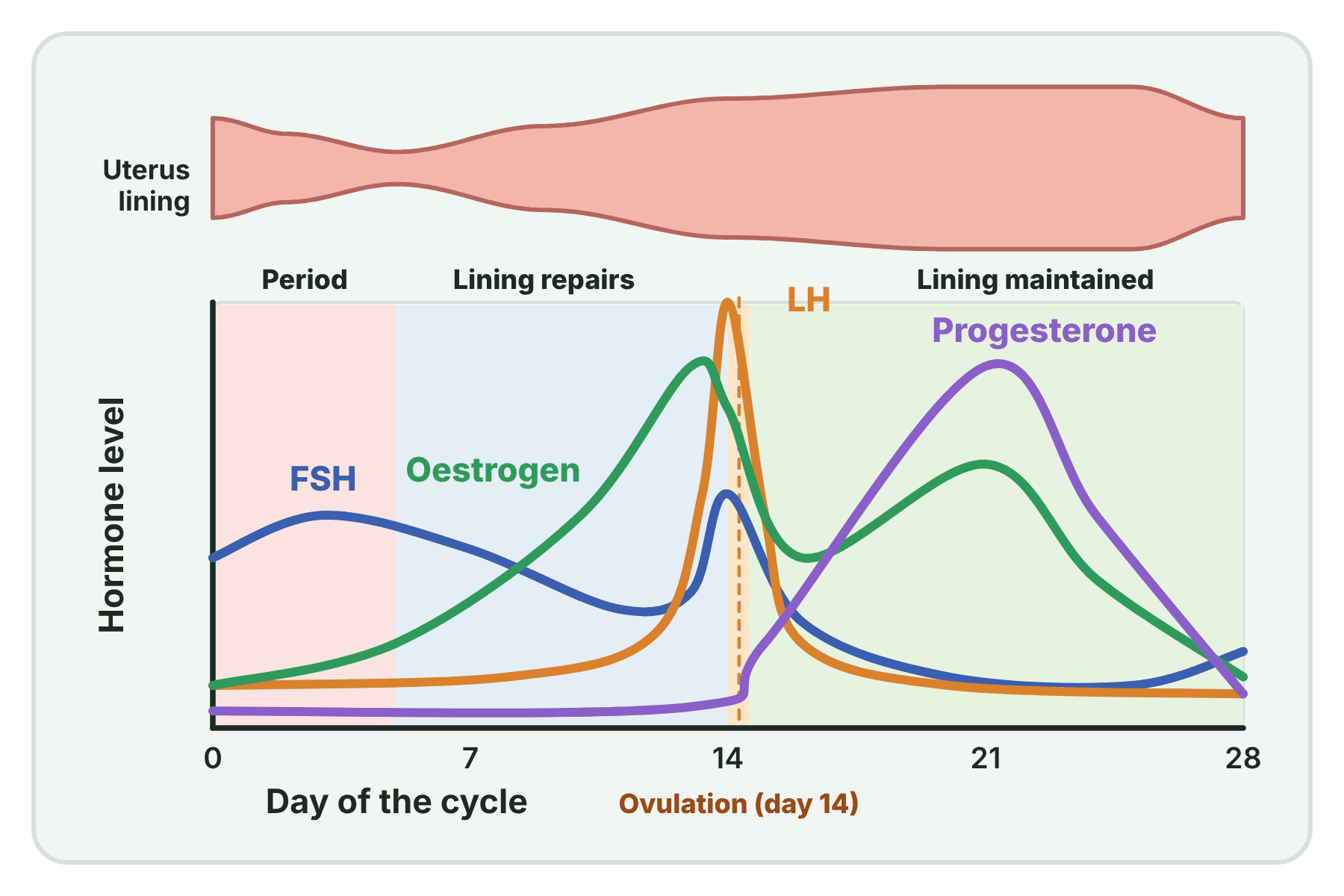
LH peaks at ovulation on day 14, and progesterone is high while the lining is maintained.
How the hormones interact (Higher tier)
The hormones control each other, so that the cycle repeats in the right order.
-
FSH and oestrogen
FSH makes a follicle mature and stimulates the ovary to release oestrogen, so the oestrogen level rises through the first half of the cycle.
-
Oestrogen and the pituitary
A rising oestrogen level stops the pituitary releasing more FSH, so only one egg normally matures. A high oestrogen level then stimulates the pituitary to release a surge of LH.
-
LH and ovulation
The surge of LH causes ovulation on about day 14.
-
Progesterone
After ovulation the empty follicle releases progesterone, which maintains the lining and stops the pituitary releasing FSH and LH, so no new egg matures.
-
The end of the cycle
If there is no pregnancy, the progesterone level falls, the lining breaks down and a new cycle begins.
FSH and LH
FSH
- Released by the pituitary gland
- Makes an egg mature in a follicle
- Stimulates the ovary to release oestrogen
- High in the first half of the cycle
LH
- Released by the pituitary gland
- A surge causes ovulation
- Peaks around day 14
- Low for the rest of the cycle
Case study
Reading the graph
A doctor looks at a graph of one patient's hormone levels. The LH level shows a sharp peak on day 14, so ovulation happened on that day. The progesterone level rises after day 14 and stays high until about day 24, which shows that the lining of the uterus was being maintained. When the progesterone level falls, the lining breaks down and the next period starts. A graph like this can show when a woman is most likely to be fertile.
The big idea
FSH matures an egg, LH triggers its release, oestrogen repairs the lining and progesterone maintains it, and for Higher tier these hormones control each other through feedback.
The menstrual cycle
The menstrual cycle
-
FSH
- matures an egg
- stimulates oestrogen
-
LH
- surge causes ovulation on day 14
-
Oestrogen
- repairs the lining of the uterus
-
Progesterone
- maintains the lining
-
Testosterone
- male sex hormone made by the testes
Summary and exam focus
- The menstrual cycle lasts about 28 days.
- FSH makes an egg mature, and LH causes ovulation on about day 14.
- Oestrogen repairs the lining of the uterus, and progesterone maintains it.
- Testosterone controls male secondary sexual characteristics and sperm production.
- (Higher tier) Oestrogen stops FSH release and then stimulates the LH surge.
- (Higher tier) Progesterone stops FSH and LH release, and its fall lets the lining break down.
Exam focus
Describe the roles of FSH, LH, oestrogen and progesterone in the menstrual cycle. (4 marks) (4 marks)
Give one specific job to each hormone and the part of the cycle it acts in: FSH matures the egg, LH causes ovulation, oestrogen repairs the lining, progesterone maintains it.
Key terms
The words this lesson expects you to use. Each one is linked from the first place it appears above.
- FSH
- Follicle stimulating hormone, which makes an egg mature in an ovary.
- LH
- Luteinising hormone, which stimulates ovulation.
- Oestrogen
- A hormone from the ovaries that repairs the uterus lining.
- Progesterone
- A hormone that maintains the lining of the uterus.
- Testosterone
- The male sex hormone made by the testes.
- Ovulation
- The release of a mature egg from an ovary.
- Menstruation
- The loss of the lining of the uterus, which is a period.
- Follicle
- The structure in the ovary in which an egg matures.
You've finished the notes
Check your understanding
Test yourself while it is fresh. Start with the flashcards, then try the exam questions.
Something here looks wrong?
Tell us what and we will go and look. It goes to whoever writes these pages, nobody else, and we do not ask who you are — so there is nothing to sign and nothing comes back to you.