Biology · The Nervous System
The Eye
The eye is the sense organ that detects light. This lesson is for separate Biology. It covers the main structures of the eye and what they do, how the pupil and the lens respond to light and distance, and the common defects of the eye and how they can be corrected.
Learning Objectives
- 1Explain how the main structures of the eye are related to their functions.
- 2Explain how the iris controls the amount of light entering the eye.
- 3Explain how the eye focuses on near and distant objects.
- 4Describe colour blindness, short-sightedness and long-sightedness, and explain how some of these problems can be overcome.
Retrieval practice
-
1
What does a receptor do?
Show answerHide answer
It detects a stimulus and starts an impulse.
-
2
What is a reflex action?
Show answerHide answer
A rapid, automatic response to a stimulus that protects the body.
-
3
What does a motor neurone carry?
Show answerHide answer
Impulses from the central nervous system to an effector.
-
4
What is refraction?
Show answerHide answer
The bending of light as it passes from one transparent material into another.
Seeing the world
The eye works like a camera. Light from an object enters the eye and is bent so that it forms a sharp image on the back of the eye, where receptor cells change the light into nerve impulses. The brain then interprets the impulses as a picture. The eye has to adjust to bright and dim light and to near and distant objects, and it can develop defects that stop the image from being sharp.
The structure of the eye
Each part of the eye has a job in getting a clear image onto the retina.
-
Cornea
The transparent front of the eye. It refracts, or bends, the light and does most of the focusing.
-
Iris
A ring of muscle that controls how much light enters the eye by changing the size of the pupil.
-
Pupil
The hole in the middle of the iris that lets light into the eye.
-
Lens
A transparent, flexible structure that changes shape to focus light on the retina.
-
Retina
The layer at the back of the eye that contains the light receptor cells.
-
Optic nerve
Carries impulses from the retina to the brain.
-
Ciliary body
A ring of muscle round the lens that changes the shape of the lens.
-
Suspensory ligaments
Fibres that connect the ciliary body to the lens and hold it in place.
The structure of the eye
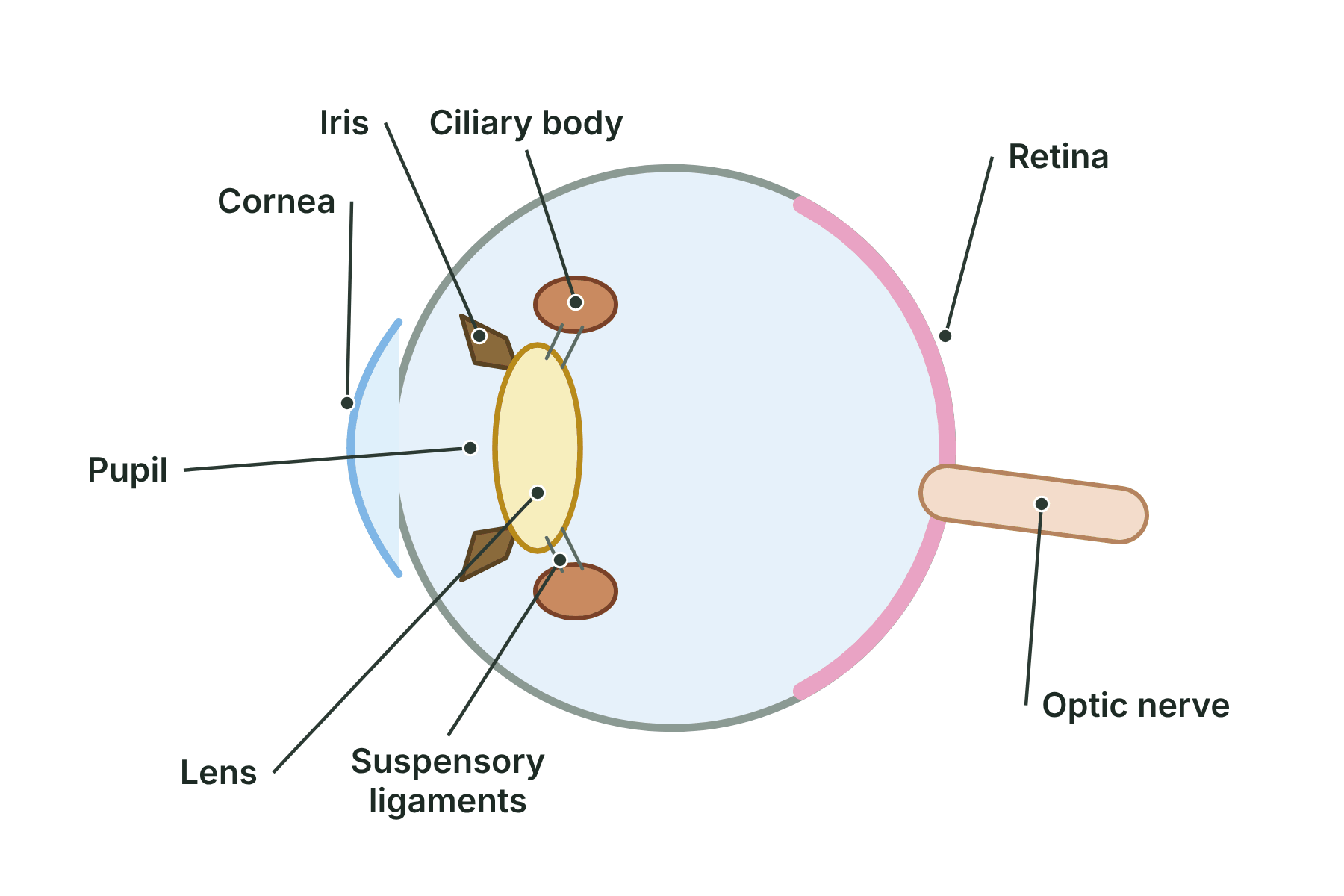
Light is bent by the cornea and the lens, and forms an image on the retina.
Rods and cones
The retina contains two kinds of light receptor cell.
-
Rod cells
Rods are very sensitive to light, so they let you see in dim light, but they do not detect colour.
-
Cone cells
Cones need brighter light, and there are three kinds, each sensitive to red, green or blue light, which lets you see in colour.
-
Impulses
When light hits a receptor cell it starts an impulse in a sensory neurone, which travels along the optic nerve to the brain.
Controlling the amount of light
Too much light would damage the retina, and too little would make it hard to see. The iris adjusts the size of the pupil in a reflex action.
-
Bright light
The circular muscles of the iris contract and the radial muscles relax. The pupil becomes smaller, so less light enters the eye.
-
Dim light
The radial muscles contract and the circular muscles relax. The pupil becomes larger, so more light enters the eye.
-
A reflex
The change is automatic, and protects the retina from damage.
Focusing on near and distant objects
To see an object clearly its light has to be brought to a focus on the retina. The lens changes shape to do this, which is called accommodation.
-
Near object
The ciliary muscles contract, which slackens the suspensory ligaments. The lens becomes thicker and more curved, so it bends the light more.
-
Distant object
The ciliary muscles relax, which pulls the suspensory ligaments tight. The lens becomes thinner and less curved, so it bends the light less.
-
The result
In both cases the light is focused on the retina and the image is sharp.
Focusing on near and distant objects
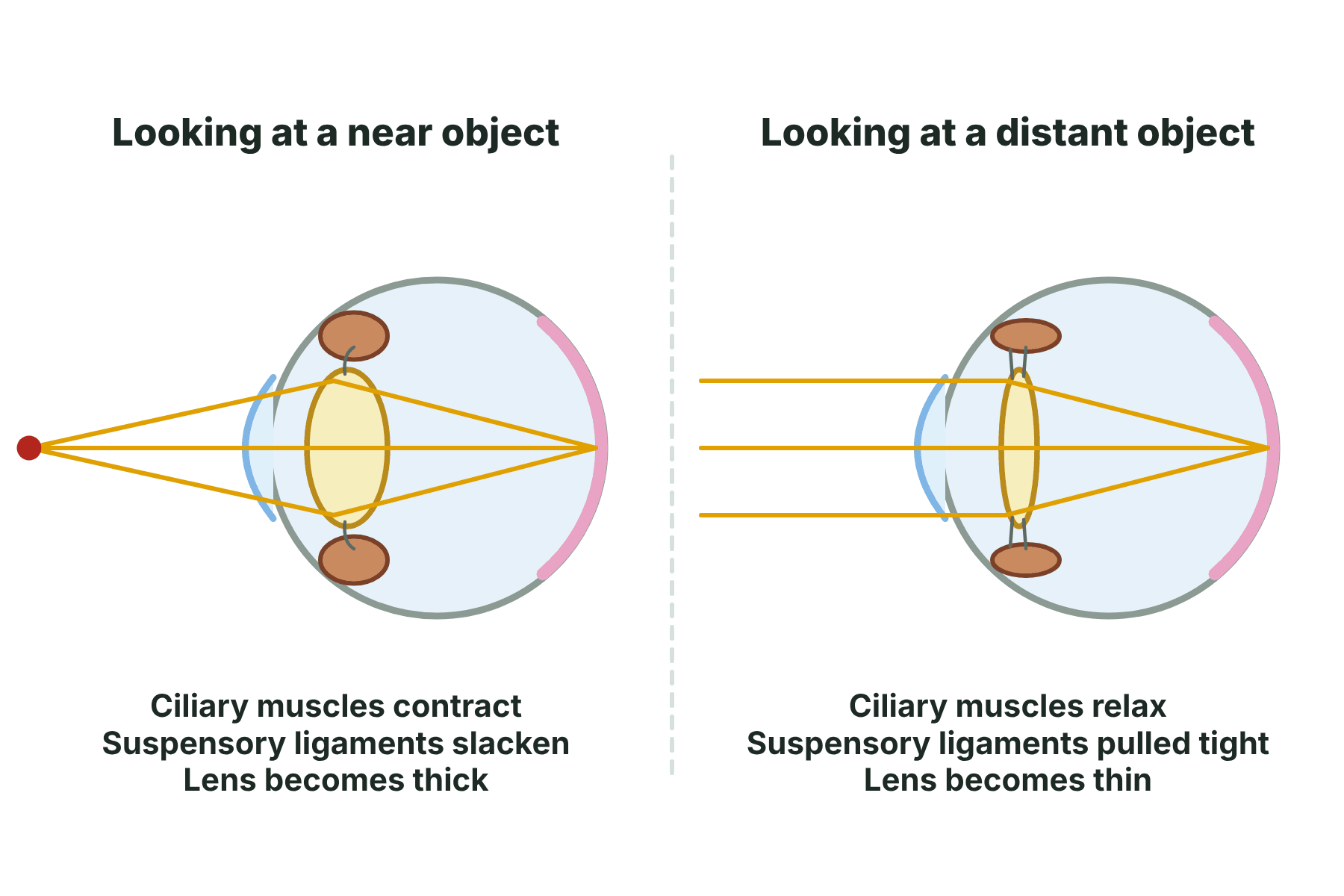
The lens becomes thicker to focus on near objects and thinner for distant ones.
Near and distant objects
Looking at a near object
- Ciliary muscles contract
- Suspensory ligaments slacken
- Lens becomes thicker and more curved
- Light is bent more
Looking at a distant object
- Ciliary muscles relax
- Suspensory ligaments are pulled tight
- Lens becomes thinner and less curved
- Light is bent less
Defects of the eye
Some people cannot focus light properly, or cannot detect all colours.
-
Short-sightedness
The person can see near objects clearly but not distant ones. The lens is too strong or the eyeball is too long, so light from distant objects focuses in front of the retina.
-
Long-sightedness
The person can see distant objects clearly but not near ones. The lens is too weak or the eyeball is too short, so light from near objects focuses behind the retina.
-
Colour blindness
The person cannot tell some colours apart, usually red and green, because one or more types of cone cell do not work. Glasses cannot correct it.
Eye defects and how they are corrected
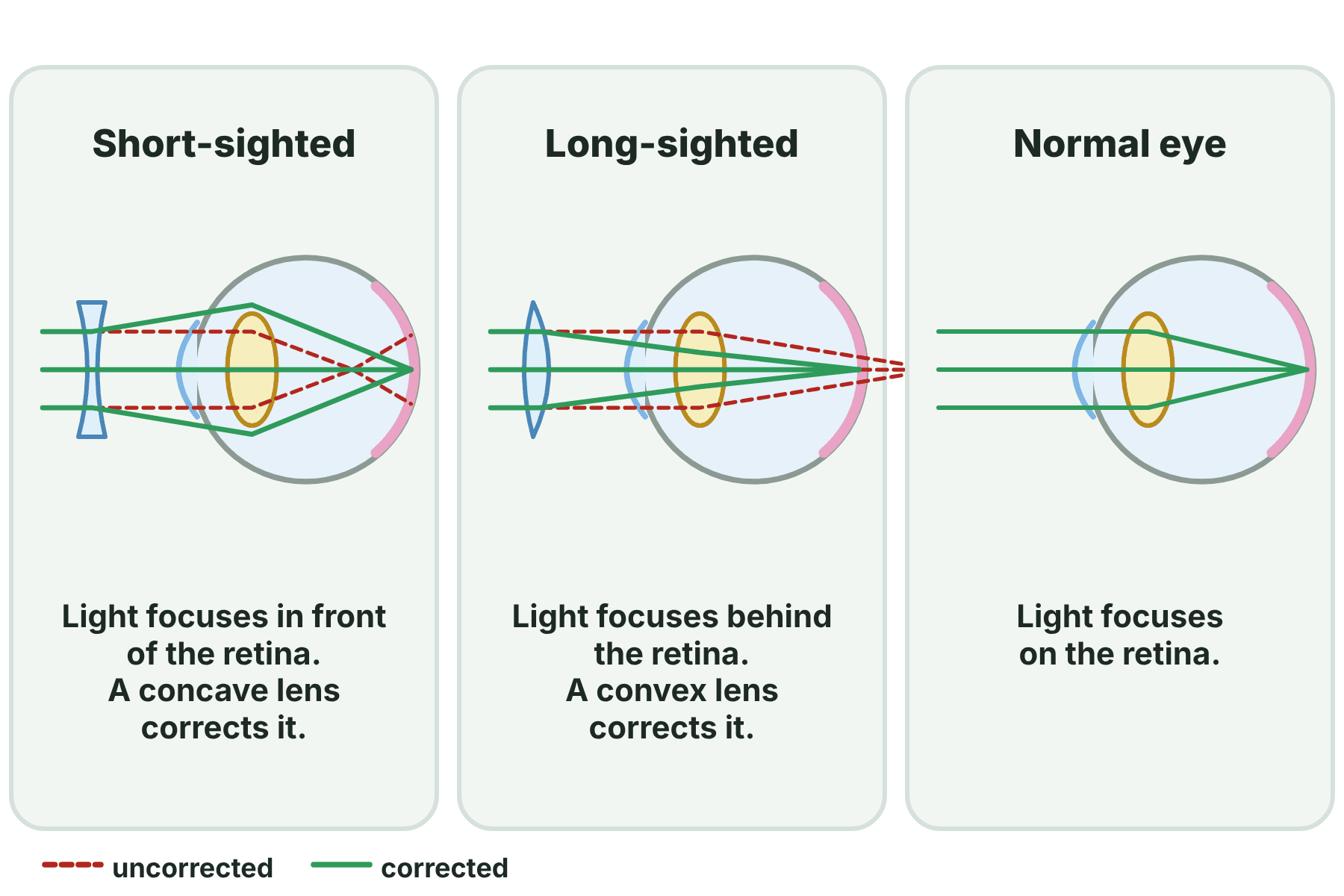
A concave lens corrects short sight and a convex lens corrects long sight.
Overcoming eye defects
Several treatments can correct a focusing problem.
-
Spectacles
A concave lens corrects short sight. A convex lens corrects long sight.
-
Contact lenses
Thin plastic lenses worn on the surface of the eye do the same job.
-
Laser eye surgery
A laser reshapes the cornea so that it bends light more or less.
-
Replacement lens
A damaged or cloudy lens can be removed and replaced with an artificial lens.
Case study
Walking into a dark room
When you walk from a bright place into a dark room you can see almost nothing at first. The radial muscles of the iris contract at once and the pupils widen, which lets more light in. The rod cells then slowly become more sensitive to light, over several minutes. After a while you can see shapes in the dim light, though not in colour, because the cones need brighter light to work.
The big idea
The cornea and the lens focus light on the retina, the iris controls how much light enters, and the ciliary muscles change the shape of the lens to focus on near and distant objects.
The eye
The eye
-
Cornea and lens
- refract light to focus it on the retina
-
Iris and pupil
- control the amount of light
-
Retina
- rod and cone cells
- optic nerve to the brain
-
Accommodation
- ciliary muscles and suspensory ligaments change the lens
-
Defects
- short sight
- long sight
- colour blindness
Summary and exam focus
- The cornea and the lens refract light onto the retina, which has rod and cone cells.
- The iris controls the size of the pupil, which controls how much light enters.
- For a near object the ciliary muscles contract, the ligaments slacken and the lens is thick.
- For a distant object the ciliary muscles relax, the ligaments are taut and the lens is thin.
- Short sight is corrected with a concave lens, and long sight with a convex lens.
- Colour blindness is caused by faulty cone cells.
Exam focus
Explain how the eye focuses on a near object. (4 marks) (4 marks)
Write the sequence in order: ciliary muscles contract, suspensory ligaments slacken, the lens becomes thicker and more curved, and so light is bent more.
Key terms
The words this lesson expects you to use. Each one is linked from the first place it appears above.
- Cornea
- The transparent front of the eye that refracts light.
- Iris
- The ring of muscle that controls the size of the pupil.
- Pupil
- The hole in the iris through which light enters.
- Lens
- The flexible structure that focuses light on the retina.
- Retina
- The layer at the back of the eye with the light receptor cells.
- Accommodation
- The change in the shape of the lens to focus on near or distant objects.
- Ciliary muscles
- The muscles that change the shape of the lens.
- Suspensory ligaments
- The fibres that hold the lens and are slack or taut as the ciliary muscles change.
You've finished the notes
Check your understanding
Test yourself while it is fresh. Start with the flashcards, then try the exam questions.
Something here looks wrong?
Tell us what and we will go and look. It goes to whoever writes these pages, nobody else, and we do not ask who you are — so there is nothing to sign and nothing comes back to you.