Biology · Communities in Ecosystems
Levels of Organisation in an Ecosystem
Living things do not live alone. This lesson describes the different levels of organisation in an ecosystem, from a single organism up to the whole ecosystem, and shows how each level contains the one before it.
Learning Objectives
Retrieval practice
-
1
What is a species?
Show answerHide answer
A group of similar organisms that can breed together and produce fertile offspring.
-
2
What is an ecosystem?
Show answerHide answer
All the living things in an area and their non-living surroundings.
-
3
What are the abiotic parts of an ecosystem?
Show answerHide answer
The non-living parts, such as air, water and soil.
-
4
What is a habitat?
Show answerHide answer
The place where an organism lives.
From one fish to a whole pond
Look into a pond and you may see one stickleback. A little further and you can see many sticklebacks, and also newts, snails, water plants and insects. All of them depend on the water, the light and the temperature of the pond. Ecologists describe this in levels: a single organism, a population of the same species, a community of different species, and the whole ecosystem.
The four levels
Each level of organisation contains the one before it.
-
Organism
A single living thing, such as one stickleback.
-
Population
All the organisms of one species living in an area at the same time, such as all the sticklebacks in the pond.
-
Community
All the populations of different species living in an area, such as the sticklebacks, newts, snails and water plants in the pond.
-
Ecosystem
The community together with the non-living, or abiotic, parts of the environment such as the water, light, temperature and minerals, and how they interact.
Levels of organisation
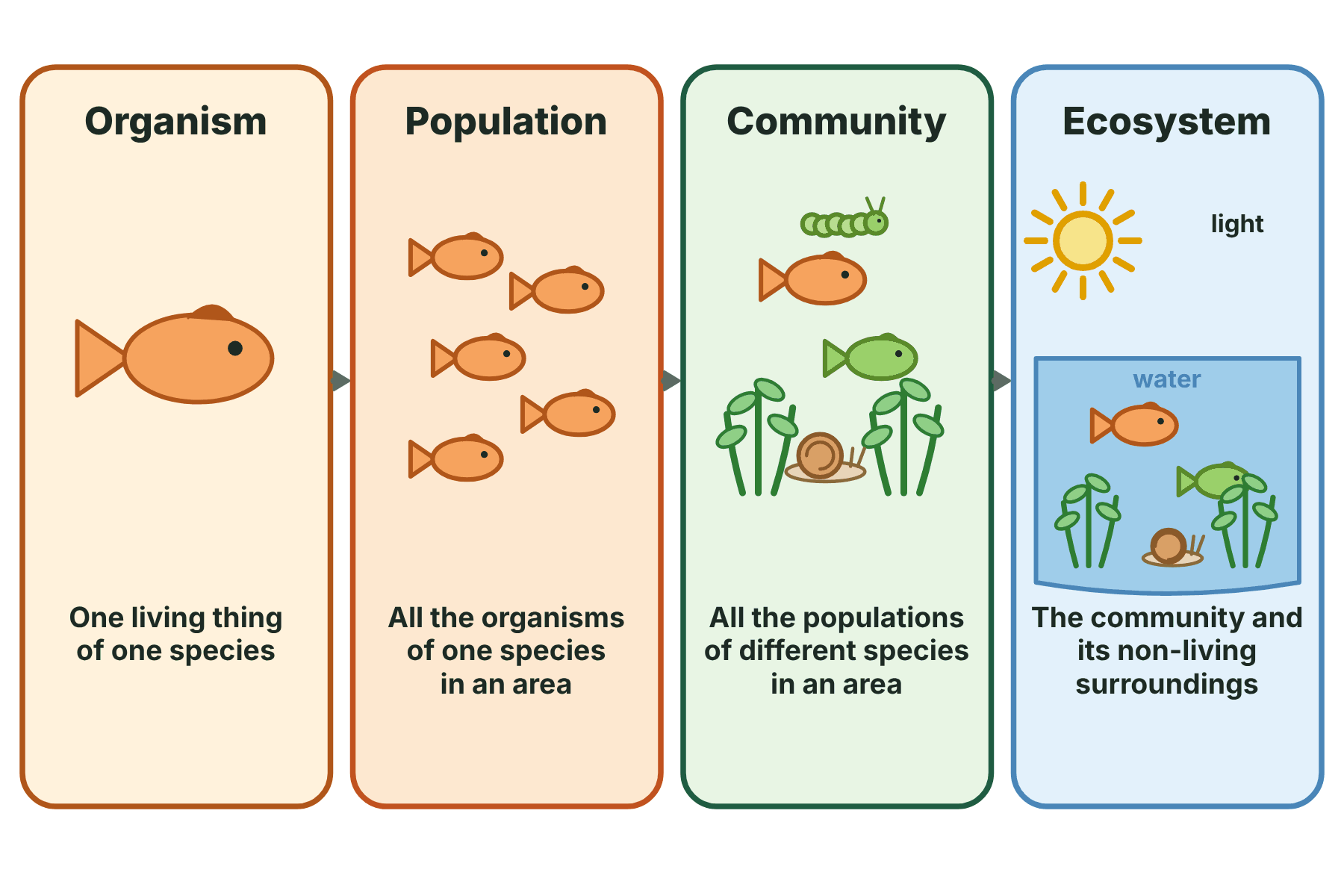
Each level of organisation contains the one before it.
Habitats and species
Two more terms help to describe where organisms live.
-
Species
A group of organisms that are similar to each other and can breed together to produce fertile offspring.
-
Habitat
The particular place where an organism lives, such as the mud at the bottom of a pond, a rock pool or a tree trunk.
-
Many habitats
An ecosystem often has several habitats. A woodland has the canopy, the leaf litter and the soil, and different organisms live in each.
-
Niche
Each species has its own role in the community, so many species can share the same ecosystem.
Community and ecosystem
Community
- All the living things in an area
- Many populations of different species
- Only the biotic parts
Ecosystem
- The community and the abiotic factors
- Living and non-living parts together
- Materials and energy flow through it
Ecosystems of different sizes
An ecosystem can be very small or very large.
-
Small
A puddle, a rotting log or a garden pond.
-
Medium
A woodland, a meadow or a rocky shore.
-
Large
A whole ocean, a rainforest or a desert.
-
Linked
Ecosystems are linked together, because materials and organisms can move from one to another, such as water flowing from a woodland stream into a river.
Describing the populations in a community
A student surveys a pond community and counts 60 sticklebacks, 20 newts, 40 snails and 80 water beetles. What fraction of the animals in the pond community are newts, and what percentage of the animals are sticklebacks?
Show the solutionHide the solution
- 1 Add up the animals \(60 + 20 + 40 + 80 = 200\)
- 2 Fraction of newts \(\frac{20}{200} = \frac{1}{10}\)
- 3 Percentage of sticklebacks \(\frac{60}{200} \times 100 = 30\%\)
AnswerOne tenth of the animals are newts, and 30 per cent are sticklebacks.
Case study
A garden pond
A garden pond contains 12 frogs, which are one population. It also contains water snails, pond weed, water beetles and algae, and each of these is another population. All the populations together are the community. The pond ecosystem is the community together with the water, the light, the temperature and the minerals in the water. If the water temperature rises, or if the pond is polluted, the whole ecosystem can be affected.
The big idea
Living things are organised into organisms, populations of one species, communities of many species, and ecosystems that include the abiotic environment, and each level contains the one before.
Levels of organisation
Levels of organisation
-
Organism
- one living thing
-
Population
- one species in an area
-
Community
- all the species in an area
-
Ecosystem
- the community and the abiotic factors
-
Habitat
- where an organism lives
Summary and exam focus
- An organism is a single living thing.
- A population is all the organisms of one species in an area.
- A community is all the populations of different species in an area.
- An ecosystem is the community and the abiotic environment.
- A habitat is the place where an organism lives.
Exam focus
Explain the difference between a community and an ecosystem. (2 marks) (2 marks)
A community is only the living things, all the different populations in an area. An ecosystem is the community plus the non-living factors, such as water, light and temperature.
Key terms
The words this lesson expects you to use. Each one is linked from the first place it appears above.
- Organism
- A single living thing.
- Species
- A group of similar organisms that can breed together to produce fertile offspring.
- Population
- All the organisms of one species in an area.
- Community
- All the populations of different species in an area.
- Ecosystem
- A community and its non-living surroundings.
- Habitat
- The place where an organism lives.
- Abiotic factor
- A non-living part of the environment.
- Biotic factor
- A living part of the environment.
You've finished the notes
Check your understanding
Test yourself while it is fresh. Start with the flashcards, then try the exam questions.
Something here looks wrong?
Tell us what and we will go and look. It goes to whoever writes these pages, nobody else, and we do not ask who you are — so there is nothing to sign and nothing comes back to you.