Biology · Communities in Ecosystems
Abiotic and Biotic Factors
Where an organism lives, and how many of them there are, depends on its surroundings. This lesson explains how abiotic factors such as temperature, light intensity, moisture level and soil pH, and biotic factors such as predators, food and disease, affect the communities in an ecosystem.
Learning Objectives
- 1Explain how abiotic factors such as temperature, light intensity, moisture level and the pH of soil can affect communities.
- 2Explain how biotic factors such as predators, food and disease can affect communities.
- 3Describe how abiotic and biotic factors are measured in an ecosystem using sampling techniques.
- 4Interpret data on how a factor affects the number of organisms.
Retrieval practice
-
1
What is a community?
Show answerHide answer
All the populations of different species living in an area.
-
2
What does a predator do?
Show answerHide answer
It hunts and eats other animals.
-
3
What is photosynthesis?
Show answerHide answer
The process in which plants make glucose using light energy.
-
4
What is a pathogen?
Show answerHide answer
A microorganism that causes disease.
Why does it live here?
Bluebells carpet some woods in spring, and heather covers moors, but neither grows in the middle of a lawn or in a desert. Every organism is suited to a certain range of conditions. When those conditions change, the numbers and the kinds of organisms in a community change as well. The conditions are of two kinds: the non-living, abiotic, factors and the living, biotic, factors.
Abiotic factors
Abiotic factors are the non-living conditions in an ecosystem. They affect which organisms can live there.
-
Temperature
Affects how fast enzymes work, so it affects growth and activity. Organisms are adapted to certain temperatures, and many animals move away from, or die in, the wrong temperature.
-
Light intensity
Plants need light for photosynthesis. Where there is little light, such as under a thick canopy, fewer plants can grow, so there is less food for herbivores.
-
Moisture level
Organisms need water. Drier habitats support fewer species, and some plants and animals are adapted to wet or to dry conditions.
-
Soil pH
Affects which plants can grow, because it changes how well the roots take up minerals. Some plants, such as heather, grow well in acid soil, and others in alkaline soil.
Abiotic and biotic factors
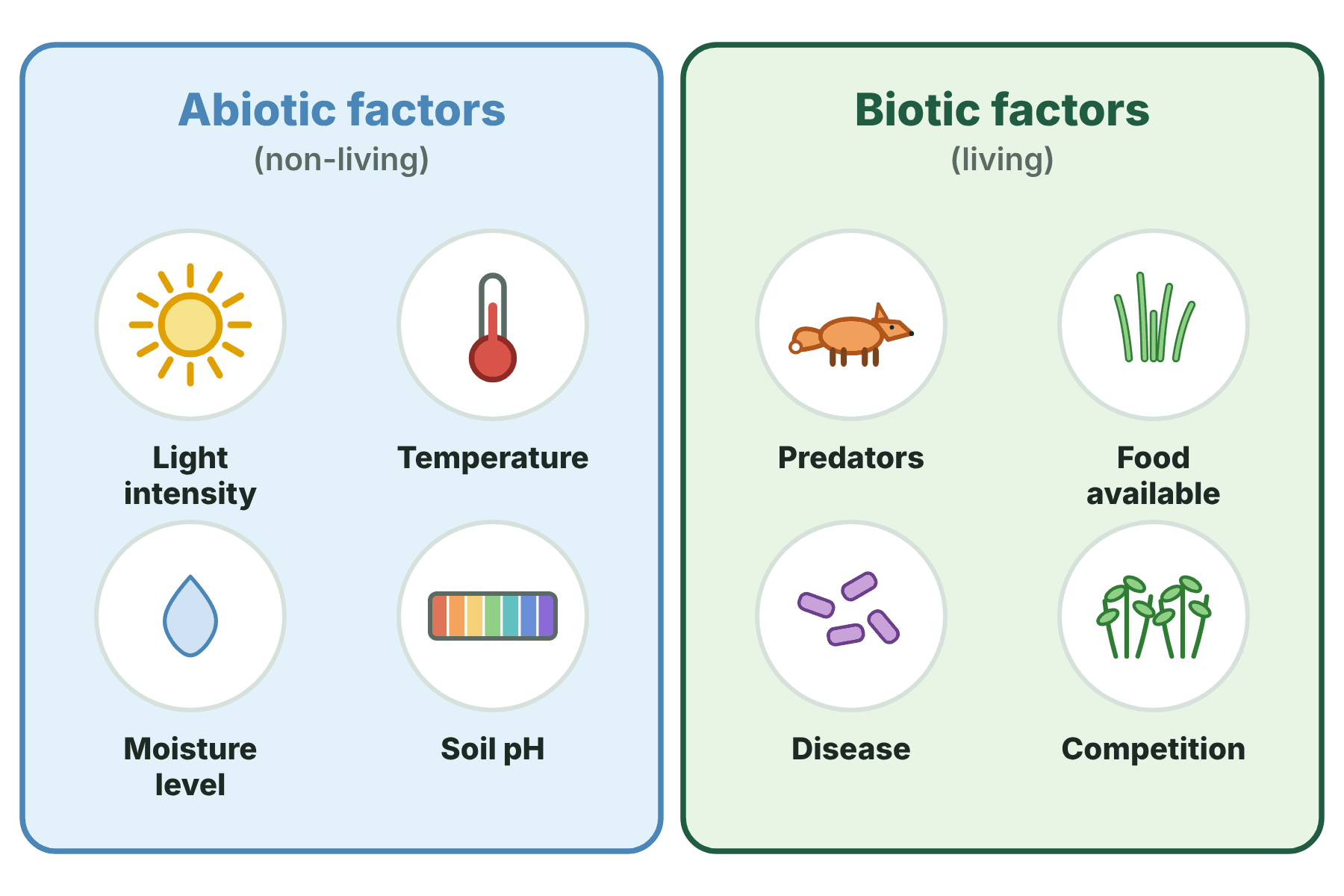
Abiotic factors are non-living, and biotic factors are living.
Biotic factors
Biotic factors are the living things that affect an organism.
-
Predators
If there are more predators, the population of their prey falls. If predators are removed, the prey may increase.
-
Food
The population of an animal depends on how much food is available. If the food runs out, the population falls.
-
Disease
A pathogen can spread quickly and kill many individuals, so the population falls.
-
Competition
Organisms of the same or different species compete for the same resources, and this limits the population of each.
-
New species
A new predator, competitor or pathogen arriving in a community can change it a great deal.
Abiotic and biotic factors
Abiotic factors
- Non-living
- Temperature, light intensity, moisture level, soil pH
- Affect plants directly, and animals directly and through plants
Biotic factors
- Living
- Predators, food, disease, competition
- Change when the populations of other species change
Measuring the factors
Ecologists use sampling to find out which organisms live in a place, and measure the abiotic factors there.
-
Quadrats
A square frame placed on the ground to count the plants or slow-moving animals in a small area. Many samples are taken at random, to estimate the population in the whole area.
-
Transects
A line across a habitat, along which samples are taken at intervals, to see how the species change as a factor changes, such as from the edge of a wood to the middle.
-
Light
A light meter measures the light intensity.
-
Temperature and moisture
A thermometer measures the temperature, and a moisture meter measures the moisture in the soil.
-
Soil pH
A pH probe, or indicator, measures the pH of soil mixed with water.
Using data
You may be asked to link the numbers of organisms to a factor.
-
Describe the pattern
Say what happens to the numbers as the factor increases or decreases, using the numbers from the graph.
-
Suggest a reason
Link the factor to the needs of the organism, such as light for photosynthesis or moisture for survival.
-
Careful with cause
A pattern shows a link, but other factors may also change, so it does not prove cause.
-
Use averages
Take many samples and calculate a mean to make the result reliable.
Case study
Bluebells in a wood
In an oak wood, bluebells flower in the early spring. The trees have no leaves yet, so a lot of light reaches the woodland floor, and the temperature is rising. The bluebells use the light to photosynthesise and store food in their bulbs. In summer, the oak leaves grow and block most of the light, so the bluebells die back. The light intensity, an abiotic factor, decides when the bluebells can grow.
The big idea
Abiotic factors such as temperature, light intensity, moisture level and soil pH, and biotic factors such as predators, food and disease, together decide which organisms live in a place and how many of them there are.
Abiotic and biotic factors
Abiotic and biotic factors
-
Abiotic
- temperature
- light intensity
- moisture level
- soil pH
-
Biotic
- predators
- food
- disease
- competition
-
Effect
- change the size of populations and the community
-
Measuring
- quadrats
- transects and sensors
-
Data
- describe the pattern
- then explain it
Summary and exam focus
- Abiotic factors are non-living: temperature, light intensity, moisture level and soil pH.
- Biotic factors are living: predators, food, disease and competition.
- Both kinds change the size of populations, and so change the community.
- Quadrats and transects are used to sample, and sensors measure abiotic factors.
- A pattern in data shows a link, but not always the cause.
Exam focus
Explain how a change in light intensity could affect the number of rabbits in a meadow. (3 marks) (3 marks)
Link the factor to the plants first, then to the animals. Less light means less photosynthesis, so the plants grow less and there is less food, so fewer rabbits can be supported.
Key terms
The words this lesson expects you to use. Each one is linked from the first place it appears above.
- Abiotic factor
- A non-living factor that affects organisms, such as temperature.
- Biotic factor
- A living factor that affects organisms, such as a predator.
- Light intensity
- How bright the light is.
- Moisture level
- How much water there is in the soil or the environment.
- Soil pH
- How acidic or alkaline the soil is.
- Quadrat
- A square frame used to sample the organisms in an area.
- Transect
- A line along which samples are taken, to see how species change across a habitat.
- Predator
- An animal that hunts and eats other animals.
You've finished the notes
Check your understanding
Test yourself while it is fresh. Start with the flashcards, then try the exam questions.
Something here looks wrong?
Tell us what and we will go and look. It goes to whoever writes these pages, nobody else, and we do not ask who you are — so there is nothing to sign and nothing comes back to you.