Biology · Cycles in Ecosystems
Cycling of Materials and Decomposers
The materials that living things are made from are used again and again. This lesson covers how materials such as carbon, nitrogen and water cycle between the living and non-living parts of an ecosystem, and the part that microorganisms play as decomposers in returning materials to the environment.
Learning Objectives
- 1Recall that many different materials, such as carbon and nitrogen, cycle through the abiotic and biotic components of an ecosystem.
- 2Explain why materials have to be cycled.
- 3Explain the role of microorganisms in the cycling of materials through an ecosystem by decomposition.
- 4Give examples of microorganisms that act as decomposers in different ecosystems.
Retrieval practice
-
1
What is an ecosystem?
Show answerHide answer
All the living things in an area and their non-living surroundings.
-
2
What is a food chain?
Show answerHide answer
A diagram that shows what eats what.
-
3
What is a bacterium?
Show answerHide answer
A single-celled organism with no nucleus.
-
4
What is respiration?
Show answerHide answer
The reaction that releases energy from glucose in every living cell.
Using the same atoms again
A tree that falls in a wood does not stay there for ever. Within a few years it has rotted away, and the atoms it was made of are in the soil, the air and new plants. The Earth does not get new carbon or nitrogen from outside, so every ecosystem has to reuse the materials that it already has. Materials are passed from the non-living environment to living things and back again, in cycles.
The living and non-living parts of an ecosystem
An ecosystem has biotic parts and abiotic parts, and materials move between them.
-
Abiotic
The non-living parts: the air, the soil, water, rocks and the energy from the Sun.
-
Biotic
The living parts: producers, consumers and decomposers.
-
Producers
Plants and algae take materials such as carbon dioxide, water and mineral ions from the abiotic environment and build them into their own bodies.
-
Consumers
Animals get materials by eating producers or other animals.
-
Decomposers
Microorganisms feed on dead plants and animals and on waste, and return the materials to the abiotic environment.
Materials cycle through an ecosystem
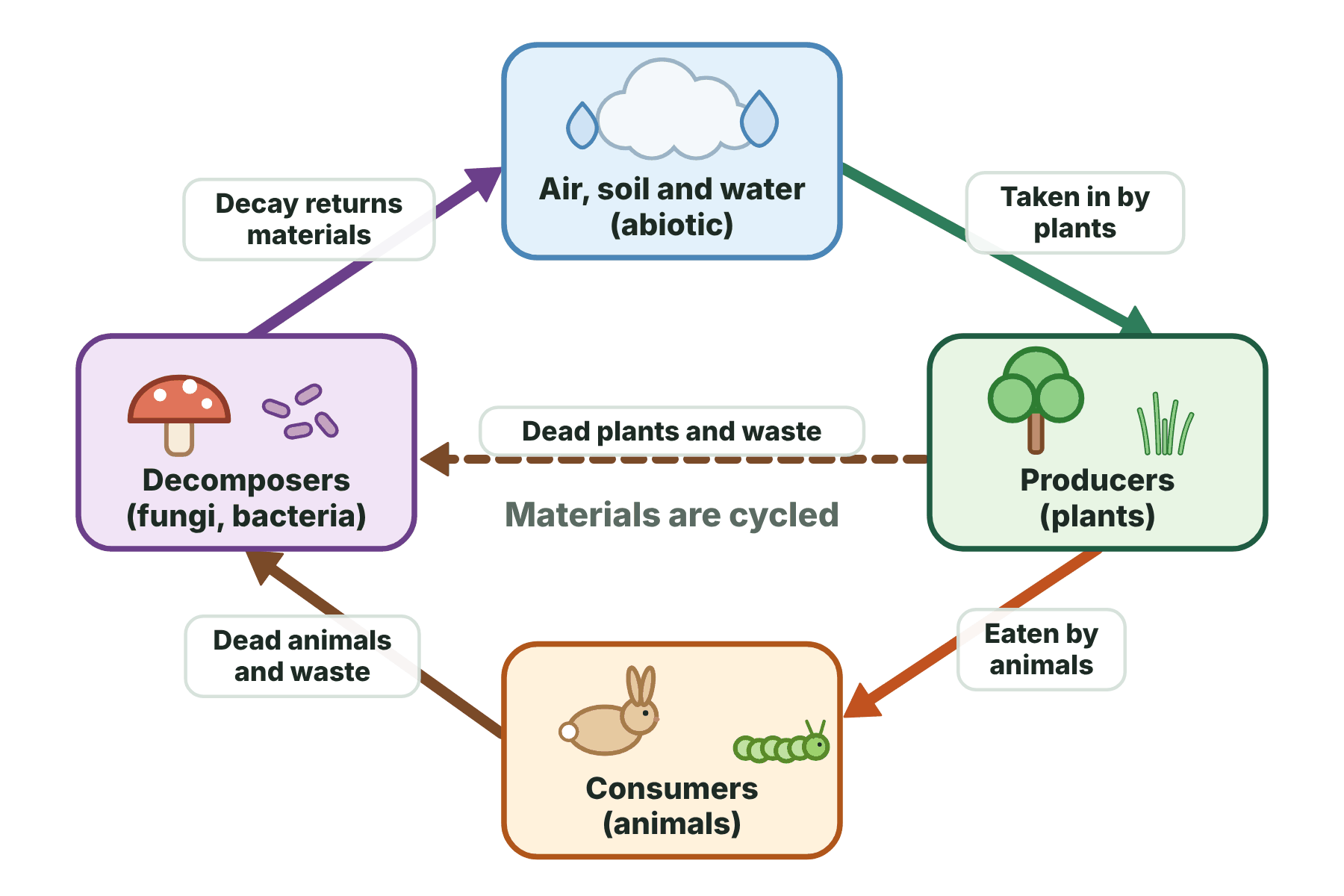
Decomposers return the materials in dead organisms and waste to the environment.
Why materials have to be cycled
The supply of materials on Earth is limited, so they have to be used again.
-
A fixed supply
There is only a certain amount of carbon, nitrogen and water on Earth, and no new supply arrives.
-
Used by many organisms
The same atoms are used in different organisms, one after another.
-
Without cycling
If dead material never rotted, the nutrients would stay locked up in it, and plants would run out of mineral ions to grow.
-
The result
Cycling keeps the ecosystem going for many years, because producers can always find the materials they need.
Examples of cycled materials
Many different materials cycle, such as carbon, nitrogen and water.
-
Carbon
Carbon dioxide in the air is taken in by plants in photosynthesis, passes through food chains, and is returned to the air by respiration and decay.
-
Nitrogen
Plants take in nitrates from the soil to make proteins. Animals get nitrogen by eating plants or other animals. Decomposers break down proteins and urea in dead material and waste, and release nitrogen compounds back into the soil.
-
Nitrogen-fixing bacteria
Some bacteria, for example in the root nodules of clover and peas, turn nitrogen from the air into compounds that plants can use.
-
Water
Water moves between the sea, the air, the land and living things.
Decomposers
Decomposers are the microorganisms, mainly bacteria and fungi, that break down dead material.
-
Where they feed
They feed on dead plants and animals, on the waste that animals produce such as faeces, and on fallen leaves.
-
How they feed
They release enzymes onto the dead material. The enzymes break it down into small, soluble molecules, which the microorganism then absorbs.
-
What they release
Decomposers respire, so they release carbon dioxide into the air. Their waste and the breakdown of dead material also release mineral ions, such as nitrates and phosphates, into the soil.
-
The result
The mineral ions can be taken up again by plant roots, so the materials are cycled.
-
Helped by
Larger animals such as earthworms and woodlice break dead material into smaller pieces, which gives the microorganisms a larger surface area to work on.
Producers, consumers and decomposers
Producers and consumers
- Take materials from the environment or from food
- Build materials into their own bodies
- Plants take in carbon dioxide, water and mineral ions
- Animals eat plants or other animals
Decomposers
- Break down dead plants and animals and waste
- Release enzymes to digest the material outside the cell
- Return carbon dioxide and mineral ions to the environment
- Bacteria and fungi
Decomposers in different ecosystems
Decomposers are found in every ecosystem, and different ones are suited to different places.
-
Woodland
Fungi and bacteria in the soil and leaf litter break down fallen leaves and dead wood.
-
Compost heap
Bacteria and fungi break down plant waste into compost, which can be used to feed crops.
-
Pond or lake
Bacteria in the mud at the bottom break down dead plants, dead animals and waste.
-
The sea
Bacteria break down dead organisms and waste, and so return mineral ions to the water.
-
Farmland
Soil microorganisms release nitrates from dead roots and manure, which the next crop can use.
Case study
A fallen tree
A storm blows a tree down in a wood. Fungi grow into the dead wood and release enzymes that break down the cellulose and other compounds. Bacteria feed on the softer material. Over many years the tree rots away. The carbon dioxide released by their respiration goes into the air, and the mineral ions go into the soil, where the roots of nearby trees take them up. The materials that made one tree are used by the next.
The big idea
Materials such as carbon, nitrogen and water cycle between the abiotic and biotic parts of an ecosystem, and decomposers, mainly bacteria and fungi, return the materials in dead organisms and waste to the environment so they can be used again.
Cycling of materials
Cycling of materials
-
Abiotic
- air
- soil
- water
-
Biotic
- producers
- consumers
- decomposers
-
Why
- the supply of materials is limited
-
Decomposers
- bacteria and fungi
- enzymes break down dead material
-
Returned
- carbon dioxide
- mineral ions
Summary and exam focus
- Materials such as carbon, nitrogen and water cycle through the abiotic and biotic parts of an ecosystem.
- The supply of materials is limited, so they have to be used again and again.
- Decomposers, mainly bacteria and fungi, break down dead plants and animals and waste.
- They release enzymes, absorb the soluble products and release carbon dioxide and mineral ions.
- The mineral ions are taken up by plants, so the materials are cycled.
Exam focus
Explain why decomposers are important in an ecosystem. (3 marks) (3 marks)
Say what decomposers do (break down dead material and waste), what they release (carbon dioxide and mineral ions), and what happens next (plants take up the mineral ions, so the materials are cycled).
Key terms
The words this lesson expects you to use. Each one is linked from the first place it appears above.
- Ecosystem
- All the living things in an area and their non-living surroundings.
- Abiotic
- Non-living, such as air, water and soil.
- Biotic
- Living, such as plants, animals and microorganisms.
- Decomposer
- A microorganism that breaks down dead plants and animals and waste.
- Decomposition
- The breakdown of dead material by microorganisms.
- Mineral ion
- A dissolved substance such as nitrate that plants take up from the soil.
- Nitrogen-fixing bacteria
- Bacteria that turn nitrogen from the air into compounds that plants can use.
- Detritivore
- An animal, such as an earthworm, that feeds on dead material.
You've finished the notes
Check your understanding
Test yourself while it is fresh. Start with the flashcards, then try the exam questions.
Something here looks wrong?
Tell us what and we will go and look. It goes to whoever writes these pages, nobody else, and we do not ask who you are — so there is nothing to sign and nothing comes back to you.