Biology · Cycles in Ecosystems
The Carbon Cycle
Every living thing is made of carbon compounds, and the carbon in them is passed round and round. This lesson covers the stages of the carbon cycle, which are photosynthesis, respiration, feeding, death and decay, and combustion, and explains why the carbon cycle is important to living organisms.
Learning Objectives
- 1Describe the stages of the carbon cycle: photosynthesis, respiration, feeding, death and decay, and combustion.
- 2Explain how carbon moves between the air, producers, consumers, decomposers and fossil fuels.
- 3Explain the importance of the carbon cycle to living organisms.
Retrieval practice
-
1
What is the word equation for photosynthesis?
Show answerHide answer
Carbon dioxide + water, using light energy, makes glucose + oxygen.
-
2
What is respiration?
Show answerHide answer
The reaction that releases energy from glucose, producing carbon dioxide and water.
-
3
What is a fossil fuel?
Show answerHide answer
A fuel such as coal, oil or gas, formed from the remains of living things over millions of years.
-
4
What is a decomposer?
Show answerHide answer
A microorganism that breaks down dead material.
Carbon, the atom of life
Carbohydrates, proteins, fats and DNA all have carbon at the centre of their molecules, so every living thing contains carbon. Yet the air holds only a tiny amount of carbon, as carbon dioxide, about 0.04 per cent. That small store is used by plants, passed along food chains, and put back into the air again and again. This movement is the carbon cycle.
Taking carbon out of the air
Only one process removes carbon dioxide from the air on a large scale, and that is photosynthesis.
-
Photosynthesis
Producers, such as plants and algae, take in carbon dioxide from the air and use it with water to make glucose. The carbon becomes part of the producer's carbohydrates, proteins and fats.
-
Making biomass
The carbon in glucose is built into the cellulose, protein and other compounds that make the plant's biomass.
-
A store
A large amount of carbon is locked up for many years in the wood of trees.
Passing carbon along and putting it back
Several processes move carbon between living things, and back into the air.
-
Feeding
When an animal eats a plant, or another animal, the carbon compounds in its food become part of its body. Carbon is passed along the food chain.
-
Respiration
Plants, animals and decomposers all respire. Respiration breaks down glucose and releases carbon dioxide into the air.
-
Death and decay
When plants and animals die, and when animals produce waste, decomposers break down the material. The decomposers respire, so they release carbon dioxide into the air.
-
Combustion
When wood and fossil fuels, such as coal, oil and gas, are burnt, the carbon in them is released into the air as carbon dioxide.
-
Fossil fuels
Over millions of years, the remains of dead plants and animals that did not decay can be changed into coal, oil and gas. This locks up carbon for a very long time, until the fuels are burnt.
The carbon cycle
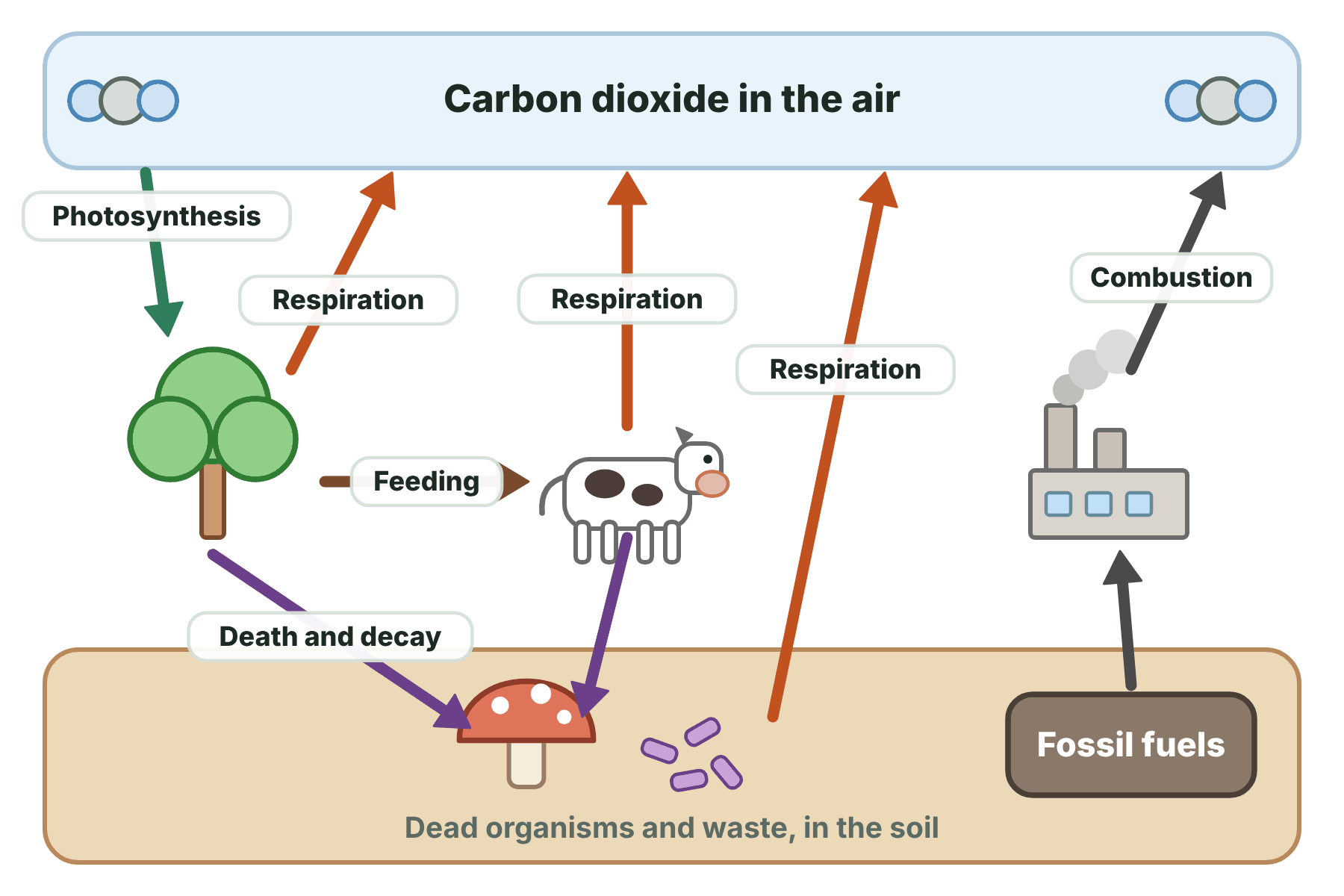
Photosynthesis takes carbon dioxide out of the air, and respiration, decay and combustion put it back.
Taking carbon in and putting it back
Carbon dioxide removed from the air
- Photosynthesis in plants and algae
- Carbon is built into glucose and biomass
- Carbon is stored in plants, in wood and in fossil fuels
Carbon dioxide returned to the air
- Respiration by plants, animals and decomposers
- Decay of dead material by decomposers
- Combustion of wood and fossil fuels
Why the carbon cycle is important
The carbon cycle matters to living things in several ways.
-
A supply of carbon
Plants need carbon dioxide for photosynthesis, and all living things need carbon to make their carbohydrates, proteins and fats.
-
A constant supply
Because carbon is cycled, the same carbon can be used again by new organisms.
-
Balancing the air
Respiration and photosynthesis help to keep the level of carbon dioxide in the air fairly constant.
-
Flow of nutrients
Carbon compounds move through food chains and carry energy to consumers.
-
When it is disturbed
Burning large amounts of fossil fuels adds carbon dioxide to the air faster than photosynthesis takes it out, so the level in the air rises.
Case study
A carbon atom's journey
A carbon atom in the air in a carbon dioxide molecule is taken in by a grass leaf and made into glucose by photosynthesis. A rabbit eats the grass, and the carbon becomes part of the rabbit's muscle. A fox eats the rabbit. When the fox dies, fungi and bacteria break down its body and the carbon is released again as carbon dioxide, by their respiration. The same atom may be taken in by another plant tomorrow, or it may stay in the air for years.
The big idea
Carbon is cycled between the air, producers, consumers, decomposers and fossil fuels: photosynthesis removes carbon dioxide from the air, feeding passes carbon along food chains, and respiration, decay and combustion return it to the air.
The carbon cycle
The carbon cycle
-
Photosynthesis
- removes carbon dioxide from the air
-
Feeding
- passes carbon along the food chain
-
Respiration
- plants
- animals and decomposers release carbon dioxide
-
Death and decay
- decomposers release carbon dioxide
-
Combustion
- burning wood and fossil fuels releases carbon dioxide
Summary and exam focus
- Photosynthesis removes carbon dioxide from the air and builds the carbon into glucose and biomass.
- Feeding passes carbon along the food chain.
- Respiration by plants, animals and decomposers returns carbon dioxide to the air.
- Death and decay release carbon dioxide because the decomposers respire.
- Combustion of wood and fossil fuels releases carbon dioxide.
- The carbon cycle gives living things a constant supply of carbon.
Exam focus
Describe how carbon in the air becomes part of an animal and then returns to the air. (4 marks) (4 marks)
Follow the carbon in order: photosynthesis puts carbon dioxide into plants, feeding passes it to the animal, and respiration or decay, by the animal or the decomposers, returns carbon dioxide to the air.
Key terms
The words this lesson expects you to use. Each one is linked from the first place it appears above.
- Carbon cycle
- The movement of carbon between the air, living things and fossil fuels.
- Photosynthesis
- The process in which plants take carbon dioxide from the air and make glucose.
- Respiration
- The release of energy from glucose, which releases carbon dioxide.
- Feeding
- The passing of carbon compounds along a food chain when one organism eats another.
- Combustion
- Burning, which releases carbon dioxide into the air.
- Fossil fuel
- A fuel such as coal, oil or gas made from the remains of living things over millions of years.
- Decay
- The breakdown of dead material by decomposers.
- Biomass
- The mass of living material.
You've finished the notes
Check your understanding
Test yourself while it is fresh. Start with the flashcards, then try the exam questions.
Something here looks wrong?
Tell us what and we will go and look. It goes to whoever writes these pages, nobody else, and we do not ask who you are — so there is nothing to sign and nothing comes back to you.