Biology · Cycles in Ecosystems
The Rate of Decomposition
Dead material rots quickly in some places and very slowly in others. This lesson is for separate Biology. It explains how temperature, water content and oxygen affect the rate of decay, why aerobic decay is faster than anaerobic decay, how to investigate composting, and how to calculate the rate of decay.
Learning Objectives
- 1Explain the effect of temperature, water content and oxygen availability on the rate of decomposition.
- 2Use the terms aerobic and anaerobic in explaining decomposition.
- 3Plan an investigation into the most favourable conditions for composting.
- 4Calculate the rate of change in the decay of biological material, and the percentage change in mass.
Retrieval practice
-
1
What is a decomposer?
Show answerHide answer
A microorganism, such as a bacterium or a fungus, that breaks down dead material.
-
2
What happens to an enzyme at a high temperature?
Show answerHide answer
It denatures and stops working.
-
3
What does aerobic respiration need?
Show answerHide answer
Oxygen.
-
4
How do you calculate a percentage change?
Show answerHide answer
Change divided by the original value, multiplied by 100.
Slow in a freezer, fast in a compost heap
Food rots in days on a warm kitchen worktop, lasts weeks in a fridge, and stays fresh for months in a freezer. A gardener's compost heap gets warm and breaks plant waste down in a few months, while a layer of leaves under a frozen lake can last for years. The microorganisms that decompose dead material are living things, so the rate at which they work depends on their conditions.
Temperature
The rate of decay changes with temperature, because decomposers are living things that depend on enzymes.
-
Low temperature
The enzymes and the movement of particles are slow, so the decomposers work slowly and decay is slow. In a freezer the microorganisms hardly work at all.
-
Warm
As the temperature rises, the decomposers respire, grow and release enzymes faster, so the rate of decay increases.
-
Optimum
There is an optimum temperature, often about 40 °C for the microorganisms in compost, at which the rate of decay is fastest.
-
Too hot
At higher temperatures the enzymes denature and the microorganisms die, so decay slows and then stops.
Water content
Decomposers need water, but not too much.
-
Too dry
The microorganisms need moisture to be active. In very dry conditions, such as a desert or dried food, decay is very slow.
-
Moist
In moist conditions the enzymes can work in solution and the microorganisms can grow, so decay is fast.
-
Waterlogged
If the material is soaked, water fills the spaces between the particles and pushes out the air. The oxygen runs out, and the rate of decay falls.
Oxygen availability
Decomposition happens with or without oxygen, but at different rates.
-
Aerobic decay
When there is plenty of oxygen, the decomposers carry out aerobic respiration. This releases more energy, so they grow and work faster, and the material breaks down quickly and completely.
-
Anaerobic decay
When there is no oxygen, for example in waterlogged soil or the bottom of a pond, decomposers can only respire anaerobically. This releases less energy, so decay is slower, and substances such as methane are produced.
-
In practice
Turning a compost heap lets air in, so that it keeps decaying aerobically.
What affects the rate of decay
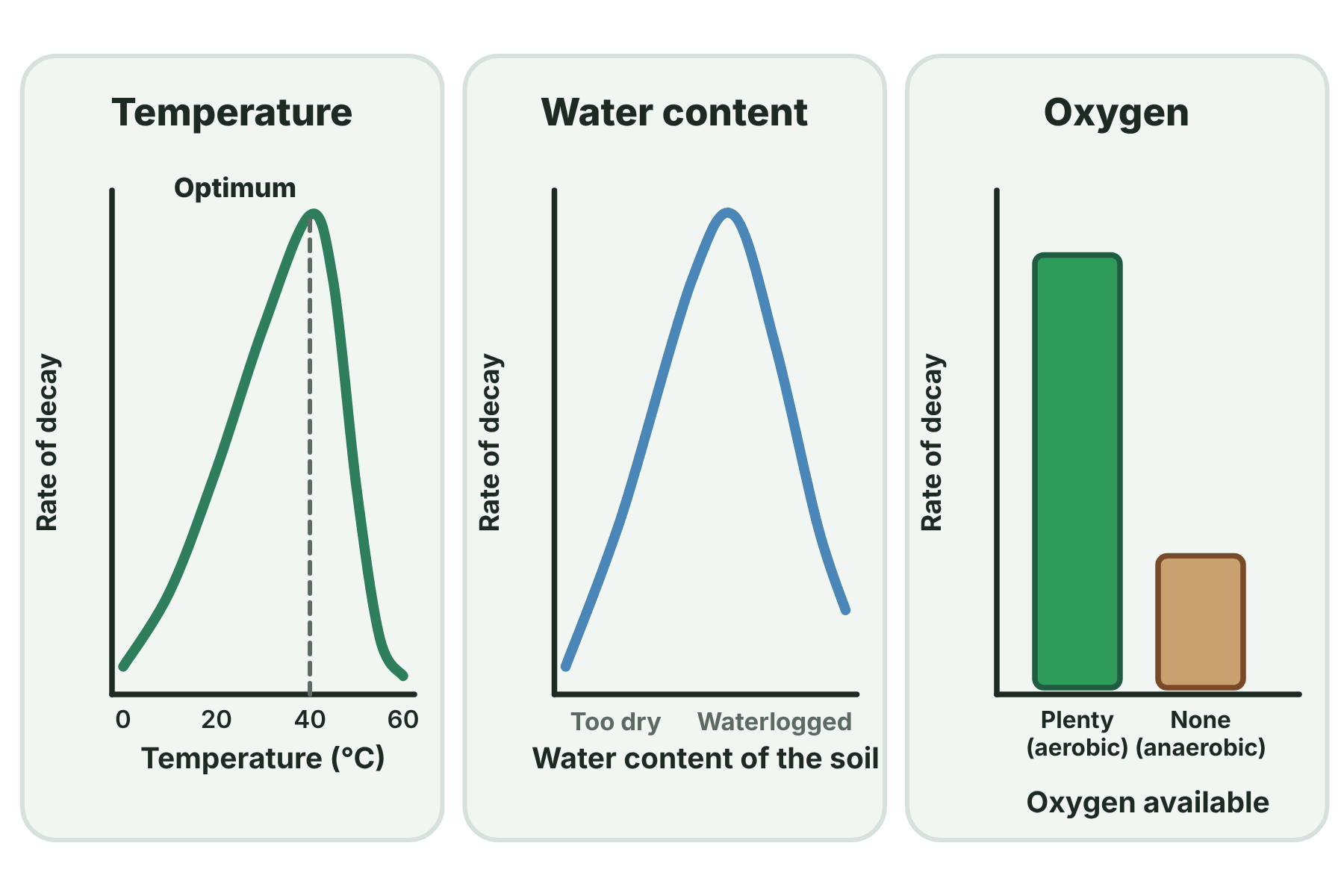
Decay is fastest when it is warm, moist and there is plenty of oxygen.
Aerobic and anaerobic decay
Aerobic decay
- Oxygen is available
- Aerobic respiration releases more energy
- Faster and more complete
- Carbon dioxide and water are released
Anaerobic decay
- No oxygen, for example in waterlogged soil
- Anaerobic respiration releases less energy
- Slower and less complete
- Substances such as methane are produced
Investigating the best conditions for composting
A compost investigation compares the rate of decay of plant material when one condition is changed.
-
1
Set up
Put the same mass of chopped plant material, such as grass clippings, into several identical containers, such as plastic bottles with holes in them.
-
2
Change one factor
Change only one condition, for example the temperature, the amount of water or the amount of air, and keep the others the same.
-
3
Measure
Measure how quickly the material decays. You can measure the mass of the material at the start and at regular intervals, or the temperature of the heap, or watch how a leaf disc disappears.
-
4
Repeat
Repeat each condition several times and calculate a mean, because decay can vary.
-
5
Interpret
Draw a graph and decide which condition gave the fastest decay.
Using the factors to control decay
People make use of these factors to slow down or to speed up decay.
-
Preserving food
Freezing, drying and salting food, and sealing it so oxygen cannot get in, all slow down the decomposers.
-
Composting
Gardeners keep the heap moist, mix it and turn it to let air in, and keep it warm, to make compost quickly.
-
Biogas
In biogas generators, microorganisms break down waste without oxygen, and the methane they produce is used as a fuel.
-
Bogs
Dead plants in cold, waterlogged peat bogs do not decay fully, and form peat.
Calculating the rate of decay
A student measures 50 g of dead leaves in a compost bin. After 10 days the mass is 38 g. Calculate the mean rate of decay in grams per day, and the percentage decrease in mass.
Show the solutionHide the solution
- 1 Find the change in mass \(50 - 38 = 12\) g
- 2 Divide by the time \(12 \div 10 = 1.2\) g per day
- 3 Find the percentage change \(\frac{12}{50} \times 100 = 24\%\)
AnswerThe rate of decay is 1.2 g per day, and the mass has decreased by 24 per cent.
Case study
A hot compost heap
A garden compost heap is turned every week and kept moist. Inside the heap, the temperature rises to about 50 °C because the bacteria release heat when they respire. The material breaks down in a few months. A second heap is packed tightly and left in the shade, and it becomes soggy. The air is squeezed out, so the heap decays anaerobically. It smells bad, because of the substances that anaerobic microorganisms make, and takes far longer to rot.
The big idea
Decomposers work fastest when it is warm, moist and there is plenty of oxygen; they work slowly when it is cold, dry or waterlogged, and aerobic decay is faster than anaerobic decay.
Rate of decomposition
Rate of decomposition
-
Temperature
- optimum about 40 °C
- slow when cold
- enzymes denature when hot
-
Water
- needed for activity
- waterlogging removes oxygen
-
Oxygen
- aerobic decay is faster than anaerobic decay
-
Practical
- compost investigation
- change one factor
-
Calculating
- change in mass divided by time
- percentage change
Summary and exam focus
- Low temperatures slow decay, there is an optimum temperature, and high temperatures denature enzymes.
- Decomposers need water, but waterlogging stops oxygen getting in.
- Aerobic decay, with oxygen, is faster than anaerobic decay.
- Anaerobic decay can produce methane.
- Rate of decay is the change in mass divided by the time taken.
Exam focus
Explain why a compost heap that is kept warm, moist and turned decays faster than one that is cold, soggy and never turned. (4 marks) (4 marks)
Deal with each factor in turn. Warmth makes the enzymes and the decomposers work faster. Moisture lets them be active. Turning lets in oxygen, so the decay is aerobic, which is faster and releases more energy.
Key terms
The words this lesson expects you to use. Each one is linked from the first place it appears above.
- Rate of decay
- How quickly dead material is broken down.
- Aerobic
- With oxygen.
- Anaerobic
- Without oxygen.
- Optimum temperature
- The temperature at which the rate of decay is fastest.
- Compost
- Decayed plant material that is used to feed plants.
- Waterlogged
- Soaked with water, so there is no air in the spaces.
- Biogas
- A fuel gas, mainly methane, made by the anaerobic breakdown of waste.
- Percentage change
- The change divided by the starting value, multiplied by 100.
You've finished the notes
Check your understanding
Test yourself while it is fresh. Start with the flashcards, then try the exam questions.
Something here looks wrong?
Tell us what and we will go and look. It goes to whoever writes these pages, nobody else, and we do not ask who you are — so there is nothing to sign and nothing comes back to you.