Biology · Cycles in Ecosystems
The Water Cycle
Water is needed by every living thing, and it is constantly moving between the sea, the air, the land and living organisms. This lesson covers the stages of the water cycle, and explains why the water cycle is important for maintaining habitats, providing fresh water and the flow of nutrients.
Learning Objectives
- 1Describe the stages of the water cycle: evaporation, transpiration, condensation, precipitation, run-off and infiltration.
- 2Explain the importance of the water cycle to living organisms.
- 3Explain how the water cycle maintains habitats, provides fresh water and helps the flow of nutrients.
Retrieval practice
-
1
What is evaporation?
Show answerHide answer
The change from liquid to gas at the surface of a liquid.
-
2
What is transpiration?
Show answerHide answer
The loss of water vapour from the leaves of a plant.
-
3
What is condensation?
Show answerHide answer
The change from gas to liquid when a gas cools.
-
4
What is a habitat?
Show answerHide answer
The place where an organism lives.
The same water for millions of years
The water in your next drink may have been in a cloud last week, a river last month, and the body of a dinosaur long ago. The total amount of water on Earth hardly changes. Energy from the Sun drives it round and round between the sea, the air, the land and living things, in the water cycle.
The stages of the water cycle
The water cycle has six main stages.
-
Evaporation
The Sun heats the surface of the sea, lakes and rivers, and the water turns into water vapour, which rises into the air.
-
Transpiration
Plants take up water through their roots and lose water vapour through their leaves, which adds to the water vapour in the air.
-
Condensation
As the water vapour rises it cools, and condenses into tiny droplets of liquid water, which form clouds.
-
Precipitation
The droplets join together and fall as rain, snow, sleet or hail.
-
Run-off
Some of the water flows over the surface of the land, into streams and rivers, and back to the sea.
-
Infiltration
Some of the water soaks into the soil, and may sink into the rocks below as groundwater. Plant roots take up the water in the soil.
The water cycle
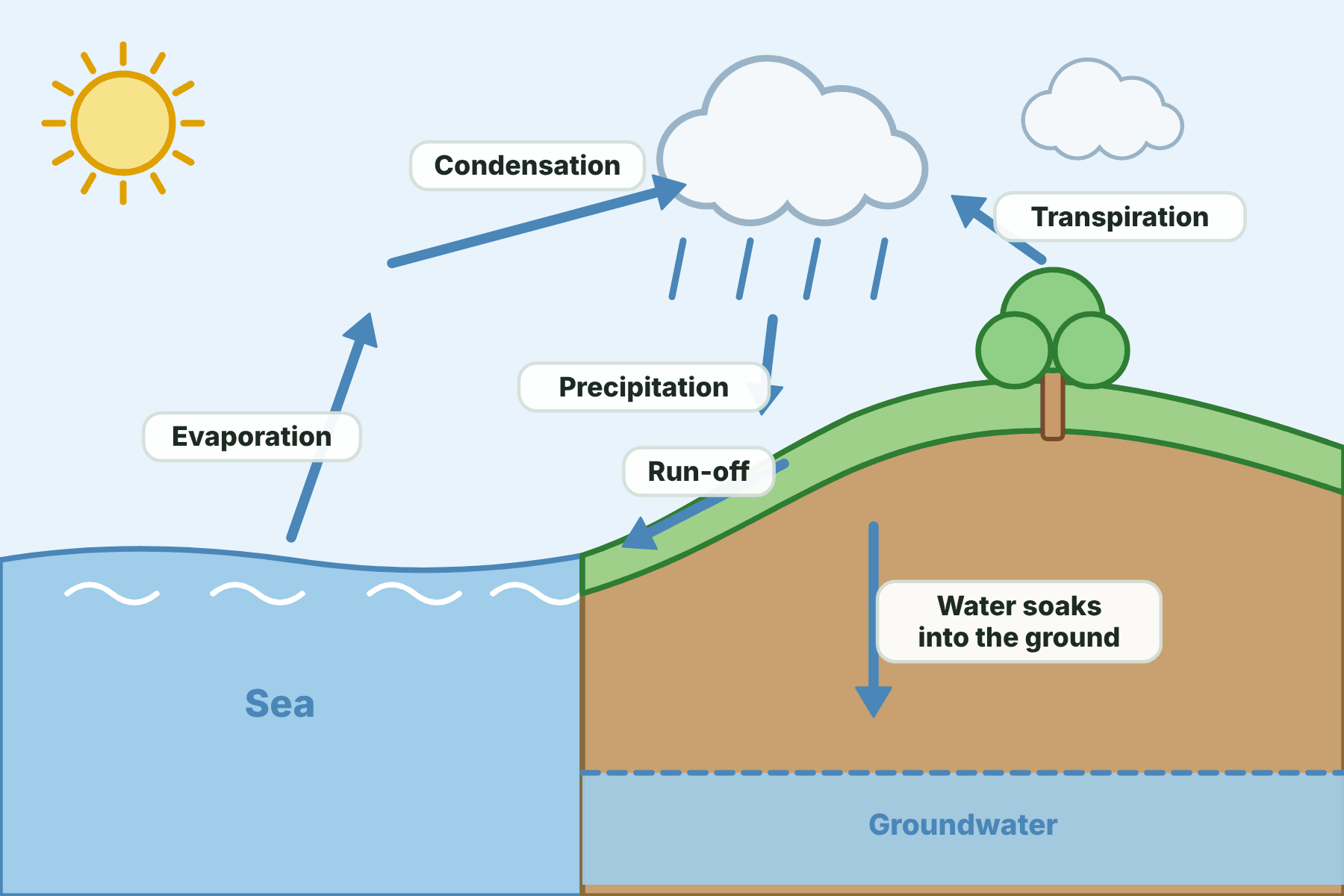
The Sun drives the water cycle, and the water moves between the sea, the air and the land.
Evaporation and transpiration
Evaporation
- From the sea, lakes, rivers and the soil
- Caused by heat from the Sun
- Liquid water becomes water vapour
Transpiration
- From the leaves of plants
- Water is taken up by roots first
- Water vapour leaves through the stomata
Why the water cycle is important
The water cycle matters to living things in three main ways.
-
Maintaining habitats
Rain refills rivers, lakes and ponds and keeps the soil moist, so the habitats of aquatic and land organisms are kept going. Without it, many habitats would dry up.
-
Fresh water
Evaporation leaves the salt behind in the sea, so the rain is fresh water. It provides drinking water for animals and people, and water for farming and for plants.
-
Flow of nutrients
Water dissolves mineral ions. Rain and run-off carry nutrients from the land into rivers, lakes and the sea, and water in the soil carries mineral ions to plant roots.
-
Inside living things
Water is needed by every cell. It is a reactant in photosynthesis, and it carries substances around the body.
How the water cycle supports the carbon cycle and other cycles
The cycles are linked, so changes in one affect the others.
-
Plants
Water taken up by plant roots, and carbon dioxide from the air, are used by plants in photosynthesis to make glucose.
-
Decay
Decomposers need moisture to work, so the water cycle supports decomposition and the return of nutrients to the soil.
-
Droughts and floods
Too little or too much rain can change which organisms can live in a habitat.
Case study
A raindrop's journey
A raindrop falls on a hill. Some of it soaks into the soil, where a plant root takes it up. The plant loses some of the water vapour through its leaves by transpiration. The rest of the raindrop runs off over the surface into a stream, and then a river, which carries it to the sea. The Sun heats the sea, the water evaporates, and the vapour condenses into a cloud, ready to fall again.
The big idea
In the water cycle, the Sun's heat makes water evaporate and plants transpire, the water vapour condenses into clouds and falls as precipitation, and the water returns by run-off and by soaking into the ground, which keeps habitats going and supplies fresh water.
The water cycle
The water cycle
-
Evaporation
- the Sun turns water into vapour
-
Transpiration
- plants lose water vapour
-
Condensation
- vapour cools and forms clouds
-
Precipitation
- rain
- snow and hail
-
Run-off and infiltration
- water returns to the sea and soaks into the soil
Summary and exam focus
- The water cycle moves water between the sea, the air, the land and living things.
- Evaporation and transpiration put water vapour into the air.
- The vapour condenses to form clouds, and falls as precipitation.
- Water returns to the sea by run-off, or soaks into the ground.
- The water cycle maintains habitats, provides fresh water and carries nutrients.
Exam focus
Describe how water from the sea can become water in a stream on land. (4 marks) (4 marks)
Put the stages in order and name each one: evaporation of the water by the Sun, condensation to form clouds, precipitation as rain, then run-off into the stream.
Key terms
The words this lesson expects you to use. Each one is linked from the first place it appears above.
- Water cycle
- The movement of water between the sea, the air, the land and living things.
- Evaporation
- The change from liquid water to water vapour.
- Transpiration
- The loss of water vapour from the leaves of plants.
- Condensation
- The change from water vapour to liquid water droplets.
- Precipitation
- Water falling from clouds as rain, snow, sleet or hail.
- Run-off
- Water flowing over the surface of the land.
- Infiltration
- Water soaking into the soil.
- Groundwater
- Water stored in the soil and rocks.
You've finished the notes
Check your understanding
Test yourself while it is fresh. Start with the flashcards, then try the exam questions.
Something here looks wrong?
Tell us what and we will go and look. It goes to whoever writes these pages, nobody else, and we do not ask who you are — so there is nothing to sign and nothing comes back to you.