Flashcards · Biology · Cycles in Ecosystems
The Rate of Decomposition
-
What is the effect of low temperature on the rate of decay?
The decomposers work slowly, so decay is slow.
-
What happens to the rate of decay at very high temperatures?
It falls, because the enzymes denature and the microorganisms die.
-
What is the optimum temperature for decay in compost?
About 40 °C.
-
Why do decomposers need water?
The microorganisms need moisture to be active, and enzymes work in solution.
-
Why does waterlogging slow decay?
It pushes out the air, so there is no oxygen.
-
What does aerobic mean?
With oxygen.
-
What does anaerobic mean?
Without oxygen.
-
Which is faster, aerobic or anaerobic decay?
Aerobic decay.
-
Why is aerobic decay faster?
Aerobic respiration releases more energy, so the decomposers grow and work faster.
-
What gas can anaerobic decay produce?
Methane.
-
Why do gardeners turn compost?
To let air in, so the decay is aerobic.
-
Why does a freezer keep food fresh?
The low temperature slows the microorganisms that cause decay.
-
How can you measure the rate of decay of leaves?
The change in their mass over time.
-
What is biogas?
A fuel gas, mainly methane, made from waste by anaerobic microorganisms.
-
In an investigation, how many factors should you change at a time?
One.
-
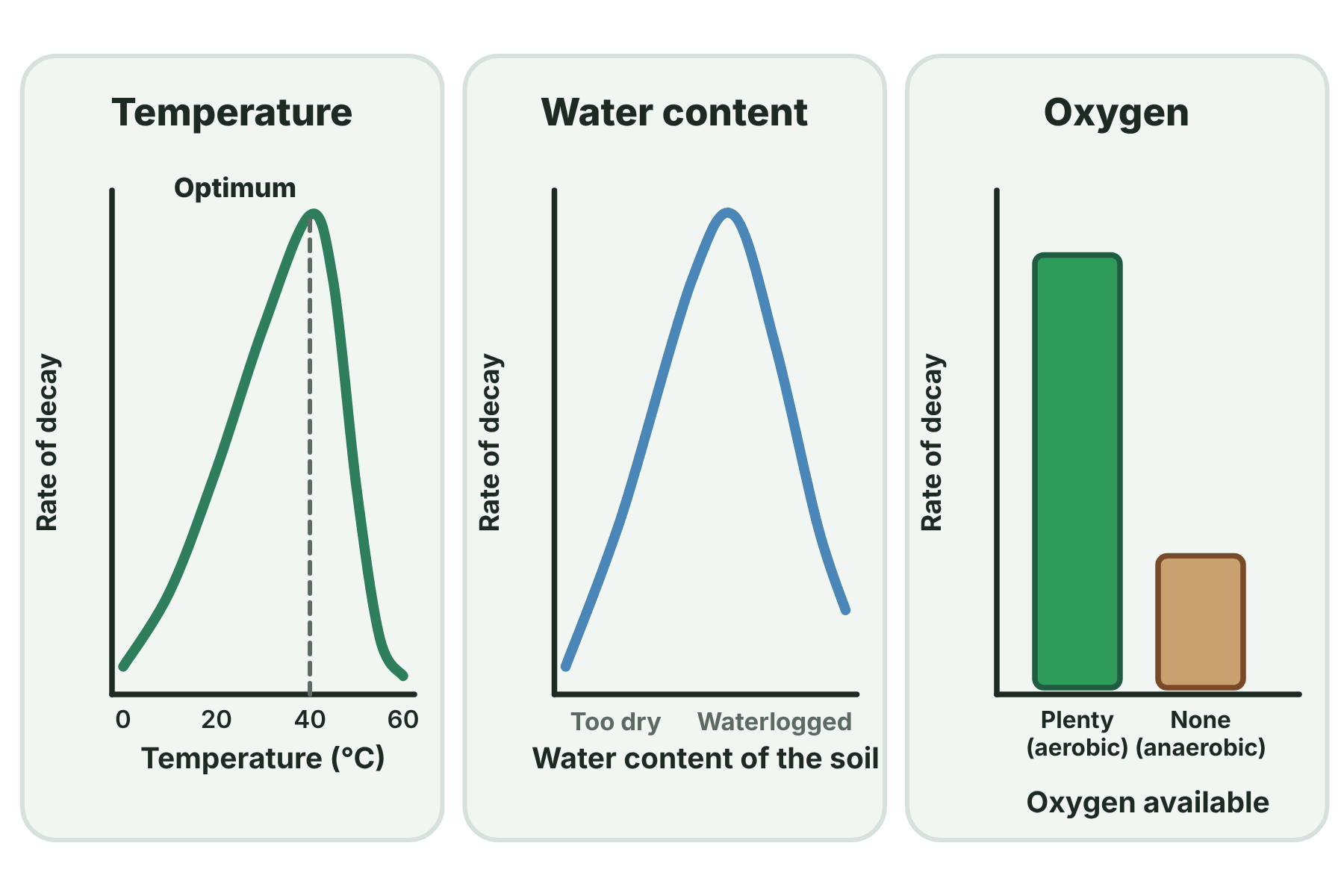 Describe how temperature affects the rate of decay.
 Decay is slow in the cold, increases as it gets warmer to an optimum of about 40 °C, and then falls because the enzymes denature.