Biology · Feeding the Human Race
Biotechnology and Food Production
Living organisms can be used as factories, to make food, medicines and crops that the world needs. This lesson is for separate Biology only: Combined Science students do not need it. It covers mycoprotein from a fungus, GM bacteria that make insulin, GM crops such as golden rice and GM livestock, with the benefits and the concerns about each.
Learning Objectives
- 1Describe how mycoprotein is made using the fungus Fusarium in a fermenter, and explain why the conditions are controlled.
- 2Describe and explain how GM bacteria, GM crops such as golden rice and GM livestock could help to meet the demand for food and medicines.
- 3Evaluate the benefits and the concerns about each biotechnological solution.
- 4Use data to compare biotechnological solutions with traditional food production.
Retrieval practice
-
1
What is food security?
Show answerHide answer
Having access to enough safe, nutritious food at all times to live a healthy life.
-
2
What is genetic engineering?
Show answerHide answer
Modifying the genome of an organism by inserting a gene to give it a desirable characteristic.
-
3
Why do the bacteria that make insulin grow in a fermenter?
Show answerHide answer
A fermenter gives them the right conditions to grow and multiply, so that they make a lot of insulin.
-
4
What is aerobic respiration?
Show answerHide answer
The release of energy from glucose using oxygen, which gives carbon dioxide and water.
Living factories
Biotechnology means using living organisms, or parts of them such as enzymes, to make useful products. People have done this for thousands of years in baking, brewing and cheese making, but genetic engineering and large-scale fermentation have made it much more powerful. Biotechnology can produce protein without needing as much land as farming, it can make crops richer in nutrients, and it can make animals and microorganisms produce medicines. Each solution brings benefits, and each raises concerns that have to be weighed.
Mycoprotein from Fusarium
Mycoprotein is a protein-rich food that is made from a fungus, and it is sold as meat-free products such as Quorn.
-
The fungus
Mycoprotein is made from Fusarium venenatum, a fungus that grows as a mass of thin threads called hyphae. The fungal threads are the food.
-
The food it grows on
In the fermenter the fungus is fed with glucose syrup as a source of energy, with a source of nitrogen such as ammonia so that it can make proteins, and with minerals and vitamins.
-
Air and temperature
Sterile air is bubbled through so that the fungus gets oxygen for aerobic respiration, and also stirs the mixture. The fungus releases heat, so the vessel is cooled to keep it at about 30 degrees Celsius, where it grows best.
-
Harvesting
The fungus grows continuously and some of the culture is drawn off all the time, while fresh nutrients are added. The fungus is heated to reduce its RNA content, then mixed with a binder and flavouring, and shaped and frozen as food.
A fermenter for making mycoprotein
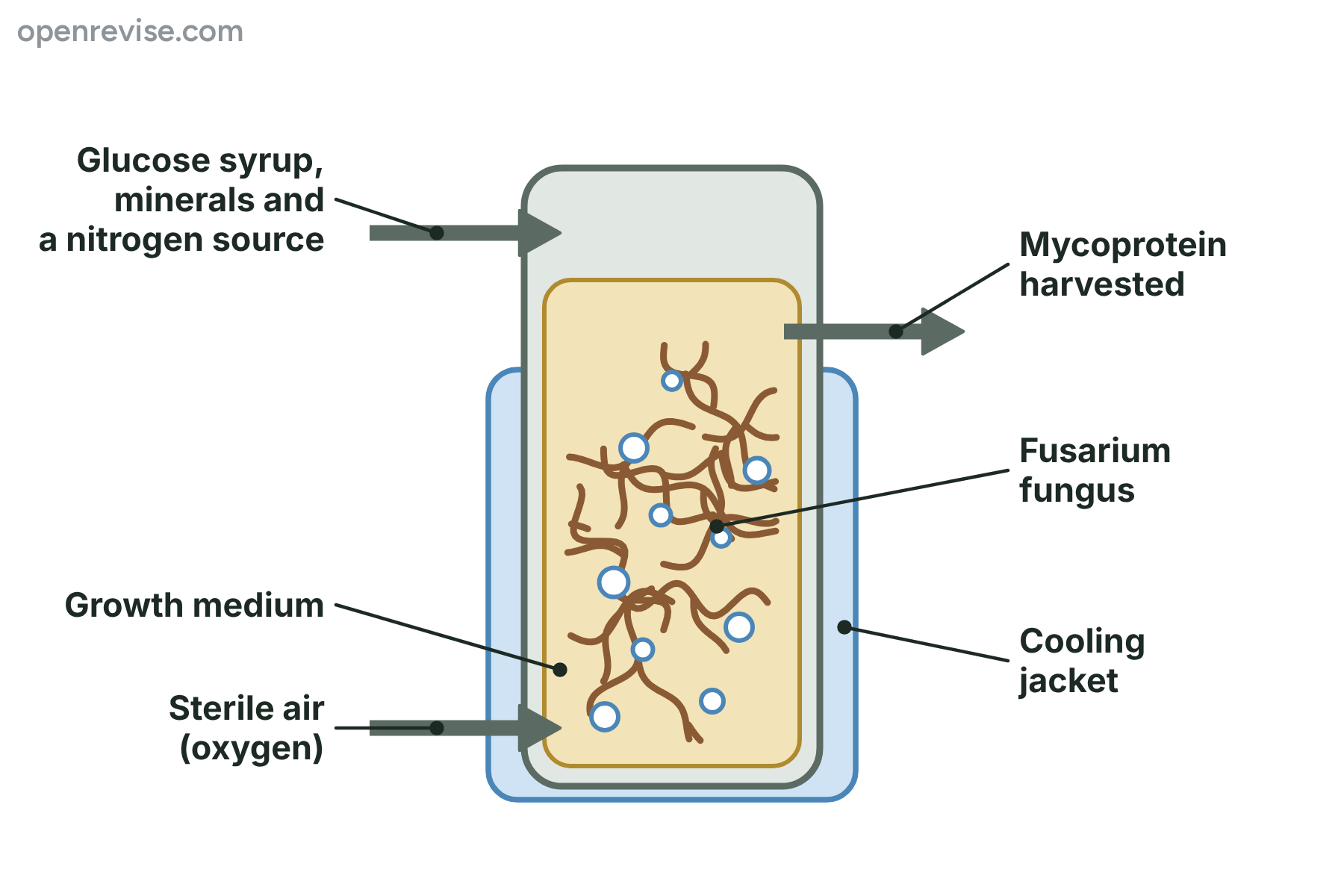
In the fermenter the fungus has everything it needs to grow: food, oxygen and the right temperature.
From fungus to food
Learn the order of the stages, and the reason for each one.
-
1
Sterilise
The fermenter and the nutrients are sterilised so that no other microorganisms can grow and spoil the culture.
-
2
Feed
Glucose syrup, a nitrogen source, minerals and vitamins are added to the growth medium.
-
3
Inoculate and grow
The fungus is added. It grows fast, and doubles its mass in a few hours, using the nutrients.
-
4
Aerate and cool
Sterile air supplies oxygen for respiration, and the cooling jacket removes the heat released, so that the temperature stays close to the optimum.
-
5
Harvest and process
The fungus is drawn off, heated to lower its RNA, and shaped into food such as mince or pieces.
Mycoprotein and meat
Mycoprotein
- High in protein, with all of the essential amino acids
- Low in fat and contains fibre
- Needs far less land than rearing animals
- Needs energy, sterile conditions and costly equipment
Meat from farm animals
- High in protein, but often higher in fat
- No fibre
- Needs land and crops to feed the animals, and energy is lost along the food chain
- Not suitable for vegetarians
GM bacteria and medicines
Bacteria that carry a human gene can be used as living factories to make human proteins.
-
Insulin
Bacteria that contain the human insulin gene make human insulin as they grow in fermenters. It is identical to human insulin, it is cheap to make in large amounts, and no animals are needed.
-
Other proteins
The same method is used to make other human proteins, such as growth hormone for children who do not make enough, and some enzymes used in food production.
-
Benefits
A reliable supply of a pure medicine, and a reduced need for animal sources.
-
Concerns
The cost of the fermenters and of the research, and the need to keep the GM bacteria contained in the factory.
GM crops: golden rice
GM crops can be given extra nutrients to tackle malnutrition, as well as being given resistance to pests.
-
The problem
Rice is the staple food of billions of people, but white rice has no beta-carotene. In places where people eat little else, children may not get enough vitamin A, which can cause blindness and weaken their immune systems.
-
The solution
Golden rice has been genetically engineered with genes from maize and from a bacterium (the first version used a gene from a daffodil). The grains then make beta-carotene, which gives them a golden colour. The body turns beta-carotene into vitamin A.
-
Benefits
It could reduce vitamin A deficiency in areas where this is a problem, without people having to change their diet.
-
Concerns
Some people object to genetic engineering for ethical reasons or are concerned about the effects on the environment, and some argue that a varied diet is a better solution than a single modified crop. It has taken a long time to be approved, and the amount of vitamin A that it supplies is limited.
Golden rice
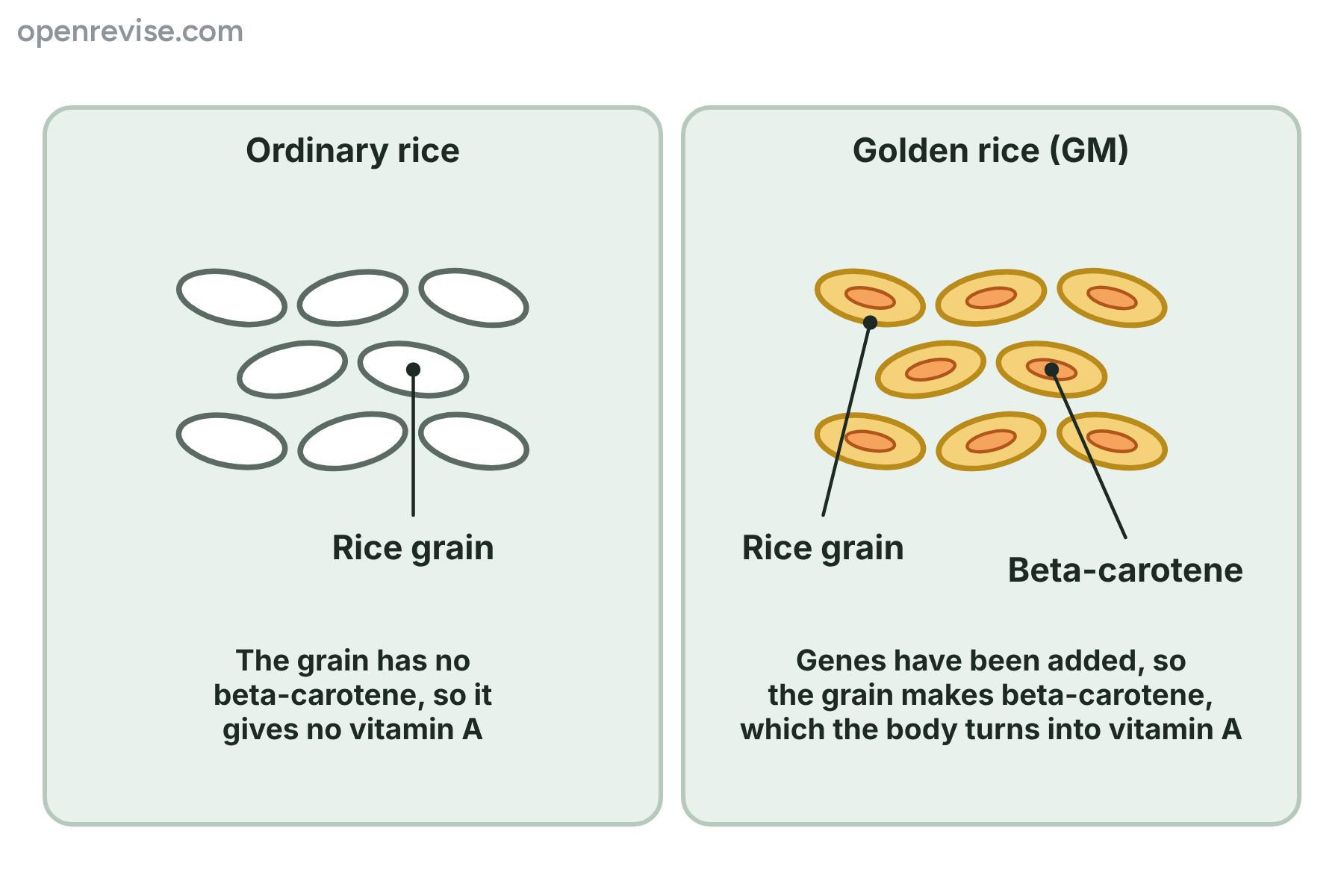
Golden rice has genes that make the grains produce beta-carotene.
GM livestock
Genetic engineering has been used to change farm animals and fish, to make them produce more or to make medicines.
-
Faster growth
A GM salmon has an extra growth hormone gene that is switched on all year, so that it reaches market size in about half the time and uses less food. It was approved for sale in the USA in 2015 and is raised in tanks on land.
-
Making medicines
Goats have been given the human gene for the blood protein antithrombin, so that they make it in their milk. The protein is collected from the milk and used as a medicine.
-
Disease resistance
Research is trying to produce farm animals that cannot be infected by serious diseases, which could reduce the need for drugs and the losses to farmers.
-
Concerns
The animals may suffer health problems, and an escaped GM fish could breed with wild fish and harm the wild population. Many people also object on ethical grounds to altering animals, and the cost is high.
Case study
Quorn, a food made by fermentation
Quorn products are made from mycoprotein, which was developed in Britain in the 1960s and 1970s, in response to fears that the world's growing population would soon run short of protein. The fungus Fusarium venenatum was found in a soil sample, and was grown in a fermenter at Billingham, and it first went on sale in 1985. It is high in protein and fibre and low in fat, and it uses much less land than beef. A small number of people have an allergic reaction to it.
How efficient is the fermenter?
In one fermenter, 300 kg of glucose is fed to the fungus over a day and 120 kg of mycoprotein is produced. Calculate the percentage of the mass of the glucose that is turned into mycoprotein, and the mass of glucose needed to make 1 kg of mycoprotein.
Show the solutionHide the solution
- 1 Divide the mycoprotein by the glucose \(120 \div 300 = 0.4\)
- 2 Multiply by 100 \(0.4 \times 100 = 40\%\)
- 3 Divide the glucose by the mycoprotein \(300 \div 120 = 2.5\ \text{kg of glucose per kg of mycoprotein}\)
Answer40% of the glucose mass is converted, and 2.5 kg of glucose is needed to make 1 kg of mycoprotein.
Benefits and concerns of biotechnological solutions
Possible benefits
- More food and protein from less land
- Crops with extra nutrients to tackle malnutrition
- Cheap, pure medicines made on a large scale
- Faster growing animals that need less feed
Possible concerns
- High cost of equipment, energy and research
- Effects on health and the environment may not be known
- Animal welfare and ethical objections
- Some people allergic to, or unwilling to eat, the products
The big idea
Biotechnology can produce more food, richer food and medicines from living organisms, but every solution has to be judged on its costs, its safety and the concerns of the people it affects.
Biotechnology and food
Biotechnology and food
-
Mycoprotein
- Fusarium fungus
- fermenter
- glucose and ammonia
- sterile air
- cooling
-
GM bacteria
- human insulin
- growth hormone
- fermenters
-
GM crops
- golden rice
- beta-carotene
- vitamin A
-
GM livestock
- fast-growing salmon
- goats making medicines
-
Benefits
- more food
- nutrients
- medicines
- less land
-
Concerns
- cost
- welfare
- environment
- ethics
- allergies
Summary and exam focus
- Biotechnology uses living organisms to make useful products, such as food and medicines.
- Mycoprotein is made by growing the fungus Fusarium in a fermenter on glucose and a nitrogen source, with sterile air and cooling.
- GM bacteria make human proteins such as insulin in fermenters.
- Golden rice is a GM crop that makes beta-carotene, which the body turns into vitamin A, to reduce vitamin A deficiency.
- GM livestock can grow faster or produce medicines, but there are welfare, environmental and ethical concerns.
Exam focus
Describe how mycoprotein is produced and evaluate the use of mycoprotein as a food to help to feed the growing human population. (6 marks) (6 marks)
Describe the process in order, with the reasons: the fungus Fusarium grows in a fermenter, fed on glucose and a nitrogen source, with sterile air for oxygen and cooling to control the temperature. Then give at least one benefit and one concern, such as high protein with less land use, against high costs and allergies, and finish with a judgement.
Key terms
The words this lesson expects you to use. Each one is linked from the first place it appears above.
- Biotechnology
- Using living organisms, or parts of them such as enzymes, to make useful products.
- Mycoprotein
- A protein-rich food made from the fungus Fusarium that is grown in a fermenter.
- Fusarium
- The fungus that is grown to produce mycoprotein.
- Hyphae
- The thin threads that make up the body of a fungus.
- Fermenter
- A large vessel in which microorganisms are grown under controlled conditions to make a product.
- Beta-carotene
- An orange pigment that the body can turn into vitamin A.
- Vitamin A deficiency
- A lack of vitamin A in the diet, which can cause blindness and weaken the immune system.
- Golden rice
- A genetically modified rice whose grains make beta-carotene.
- GM livestock
- Farm animals or fish whose genomes have been changed by genetic engineering.
- Staple food
- A food, such as rice, that makes up a large part of the diet of a population.
You've finished the notes
Check your understanding
Test yourself while it is fresh. Start with the flashcards, then try the exam questions.
Something here looks wrong?
Tell us what and we will go and look. It goes to whoever writes these pages, nobody else, and we do not ask who you are — so there is nothing to sign and nothing comes back to you.