Biology · Feeding the Human Race
Benefits and Risks of Gene Technology in Agriculture
Genetically modified crops divide opinion, and the exam expects you to weigh up both sides. This lesson is for both Combined Science and separate Biology. It covers the possible benefits and risks of using gene technology in modern agriculture, the practical and ethical considerations, and how to answer evaluation questions.
Learning Objectives
- 1Explain some of the possible benefits of using gene technology in modern agriculture.
- 2Explain some of the possible risks of using gene technology in agriculture.
- 3Distinguish between practical and ethical considerations about GM crops.
- 4Evaluate the use of gene technology in agriculture by weighing up benefits, risks and the evidence.
Retrieval practice
-
1
What is genetic engineering?
Show answerHide answer
Modifying the genome of an organism by inserting a gene to give it a desirable characteristic.
-
2
What does the Bt gene do in a crop?
Show answerHide answer
It makes the crop produce a protein that kills caterpillars that eat it.
-
3
What is variation?
Show answerHide answer
The differences between individuals of the same species.
-
4
What is meant by biodiversity?
Show answerHide answer
The variety of living organisms in an ecosystem or on Earth.
Weighing up gene technology
Gene technology can help to feed more people, but it also raises questions. Some of these are practical considerations: will it work, what will it cost, and what will it do to the environment and to human health. Others are ethical considerations: is it right to change the genes of living things, who should control the technology and who benefits. A good answer does not just say that GM crops are good or bad. It explains the benefits and the risks, says who is affected and reaches a judgement that is supported by the evidence.
A benefit and a risk of a GM crop
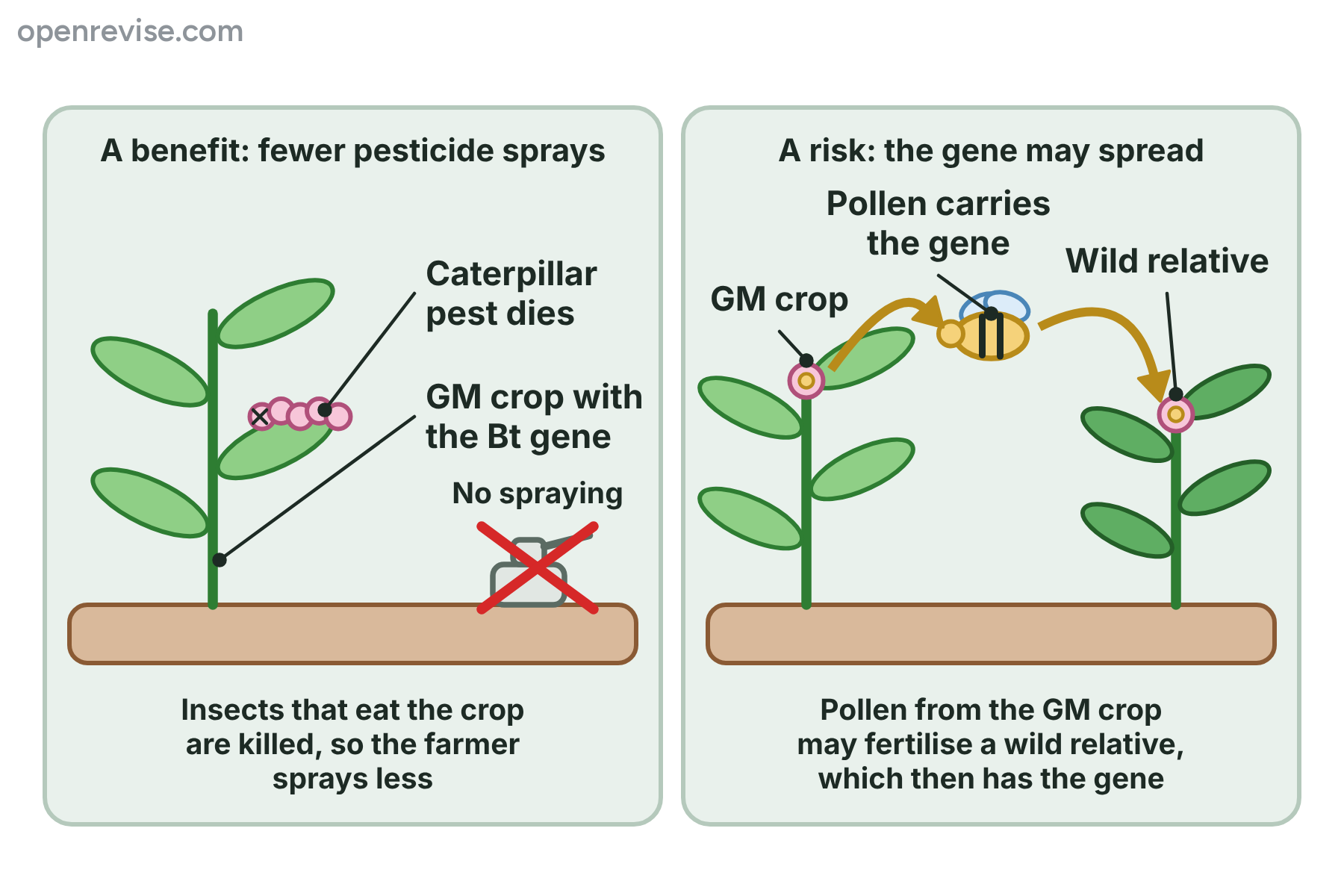
Gene technology can reduce spraying, but a gene may escape into wild plants.
Possible benefits of gene technology in agriculture
The main benefit is that more food can be grown from the same land with fewer losses.
-
Higher yield
Crops that resist pests, diseases or weedkillers lose less to damage, so more of the crop is harvested from each hectare, and food is cheaper and more available.
-
Less pesticide
A crop that makes its own protection, such as Bt maize, needs fewer insecticide sprays. This saves the farmer money and time, and means less harm to harmless insects and to the workers who spray.
-
Better nutrition and quality
Crops can be given more vitamins or minerals, or a longer shelf life so that less food is thrown away.
-
Tolerance of harsh conditions
Crops can be engineered to survive drought, salt or flooding, so food can be grown on land that was once too poor to farm, which will matter more as the climate changes.
-
Speed
A new characteristic is added in a single step, while selective breeding takes many generations.
Possible risks: practical considerations
Practical considerations are about what could happen in the environment, to health and to farmers.
-
Gene flow
Pollen can carry the new gene to wild relatives of the crop, or to non-GM crops in nearby fields. A wild plant that gained herbicide resistance would be difficult to kill, and organic farmers may find their crops cross-pollinated.
-
Harm to other organisms
A protein that kills pests could harm harmless insects that feed on the crop or on its pollen. Wider use of one herbicide can also kill the wild plants on which insects feed, which reduces biodiversity.
-
Resistance
Pests and weeds that survive the Bt protein or the herbicide reproduce, so resistance spreads through the population. Herbicide-resistant weeds, sometimes called superweeds, have appeared in some places where a herbicide was used year after year.
-
Human health
Some people worry that eating GM food could cause allergies or other long-term effects. Regulators have judged the GM foods on sale to be as safe to eat as other foods, but some people want more long-term studies.
-
Cost and dependence
GM seed is more expensive, and it is often patented, so farmers may have to buy new seed from a company every year.
-
Less variation
If a whole region grows a single GM variety, there is less genetic variation, and a new disease could do more damage.
Ethical considerations
Ethical considerations are about right and wrong, and different people reach different conclusions.
-
Is it right to change genes
Some people think that it is wrong to alter the genome of a living organism, or to move genes between species, because it is unnatural.
-
Fairness
If a few companies own the patents, they may profit most, while poor farmers may be unable to afford the seed. Others argue that GM crops could help the poorest farmers most, by raising yields in places where food is short.
-
Consumer choice
People want to know what they are eating, so many believe that GM food should be labelled, and that the choice to buy non-GM food must be kept.
-
Future generations
Because the effects of GM crops on ecosystems may not be seen for many years, some people feel that we must be cautious and that a decision cannot easily be undone once a gene has spread.
-
Hunger
Others argue that it would be unethical not to use a technology that could reduce hunger and malnutrition.
Benefits and risks of GM crops
Possible benefits
- Higher yield, so more food from the same land
- Less pesticide used, saving money and wildlife
- More nutritious or longer-lasting food
- Can grow in drought, salt or flooded land
Possible risks
- Gene flow to wild relatives and non-GM crops
- Harm to non-target insects and to biodiversity
- Pests and weeds may become resistant
- Costly patented seed, and unknown long-term effects
Case study
Bt cotton in India
India approved Bt cotton in 2002, and within about ten years almost all of its cotton was a Bt variety. Many farmers reported fewer attacks from the bollworm caterpillar and less insecticide spraying, as well as a higher yield. Later, however, the pink bollworm evolved resistance to the Bt protein in some regions, and the GM seed was more costly than ordinary seed. The case shows both the benefits and the risks, and it shows that a GM trait does not stay effective for ever.
How to evaluate gene technology in an exam answer
A six-mark evaluation needs a balanced argument that ends in a judgement.
-
1
State a benefit
Say what the benefit is and explain how it helps, for example the yield rises because fewer plants are destroyed by pests.
-
2
State a risk
Say what the risk is and explain why it matters, for example the gene may spread to wild plants by pollen.
-
3
Say who is affected
Link the point to farmers, consumers, the environment or poor communities.
-
4
Use the evidence
Refer to data or to an example, and note any uncertainty such as a lack of long-term studies.
-
5
Reach a conclusion
Give a judgement, such as that GM crops are useful if they are carefully tested and monitored.
Reading a field trial
In a field trial, a Bt maize crop gave a yield of 9.1 tonnes per hectare and was sprayed with insecticide 1 time. A non-GM maize crop gave a yield of 7.4 tonnes per hectare and was sprayed 4 times. Calculate the percentage increase in yield of the Bt crop compared with the non-GM crop, and say what this shows about gene technology.
Show the solutionHide the solution
- 1 Find the difference in yield \(9.1 - 7.4 = 1.7\) tonnes per hectare
- 2 Divide by the non-GM yield \(\frac{1.7}{7.4} = 0.23\)
- 3 Multiply by 100 \(0.23 \times 100 = 23\%\)
- 4 State what the data show The Bt crop gave a higher yield and needed fewer sprays, so there is a benefit. One field trial does not show the long-term effects or the effect on other species.
AnswerThe yield of the Bt crop was 23% higher, with three fewer sprays.
The big idea
Gene technology brings real benefits to yield and to pesticide use, and real risks to ecosystems and to people, so each use has to be judged on the evidence.
Gene technology in agriculture
Gene technology in agriculture
-
Benefits
- higher yield
- less pesticide
- nutrition
- harsh conditions
-
Practical risks
- gene flow
- non-target species
- resistance
- health
- cost
-
Ethical issues
- unnatural?
- fairness
- labelling
- future generations
-
Evidence
- field trials
- long-term studies
- regulators
-
Evaluating
- benefit
- risk
- who is affected
- conclusion
-
Examples
- Bt maize
- Bt cotton
- herbicide-tolerant crops
Summary and exam focus
- The benefits of GM crops include a higher yield, less pesticide, more nutritious food and crops that survive harsh conditions.
- The practical risks include gene flow to wild plants, harm to other organisms, resistance in pests and weeds, and the cost of seed.
- Ethical considerations include whether it is right to change genomes, who owns the technology, consumer choice and the effects on future generations.
- Evidence such as field trials is needed, and long-term effects can be uncertain.
- A good evaluation weighs the benefits against the risks and gives a supported conclusion.
Exam focus
Evaluate the use of genetically modified crops to increase food production. (6 marks) (6 marks)
Give at least two benefits and two risks, and explain each one. Name who is affected, and write a conclusion that follows from your points. Avoid one-sided answers and avoid saying that GM is simply unnatural or dangerous without a reason.
Key terms
The words this lesson expects you to use. Each one is linked from the first place it appears above.
- GM crop
- A crop plant whose genome has been changed by genetic engineering.
- Gene flow
- The spread of genes from one population to another, for example by pollen from a GM crop to a wild relative.
- Non-target organism
- An organism that is harmed by a pesticide or a GM trait although it is not the pest that was aimed at.
- Resistance
- The ability of a pest or weed to survive a pesticide, herbicide or Bt protein.
- Herbicide
- A chemical that kills weeds.
- Biodiversity
- The variety of living organisms in an ecosystem or on Earth.
- Patent
- Legal protection that gives a company the sole right to sell a new invention, such as a GM seed.
- Ethical consideration
- A question about what is right or wrong, rather than what is possible.
- Practical consideration
- A question about what will happen, what it will cost and whether it will work.
You've finished the notes
Check your understanding
Test yourself while it is fresh. Start with the flashcards, then try the exam questions.
Something here looks wrong?
Tell us what and we will go and look. It goes to whoever writes these pages, nobody else, and we do not ask who you are — so there is nothing to sign and nothing comes back to you.