Exam questions · Biology · Feeding the Human Race
Biotechnology and Food Production
- 8 exam questions
- 27 marks
- 8 quick checks
-
1 Name [1 mark]
Name the fungus that is grown in fermenters to make mycoprotein.
Show answerHide answer
Model answer
Fusarium (Fusarium venenatum).
Mark scheme
- Fusarium — 1 mark
-
2 Name [3 marks]
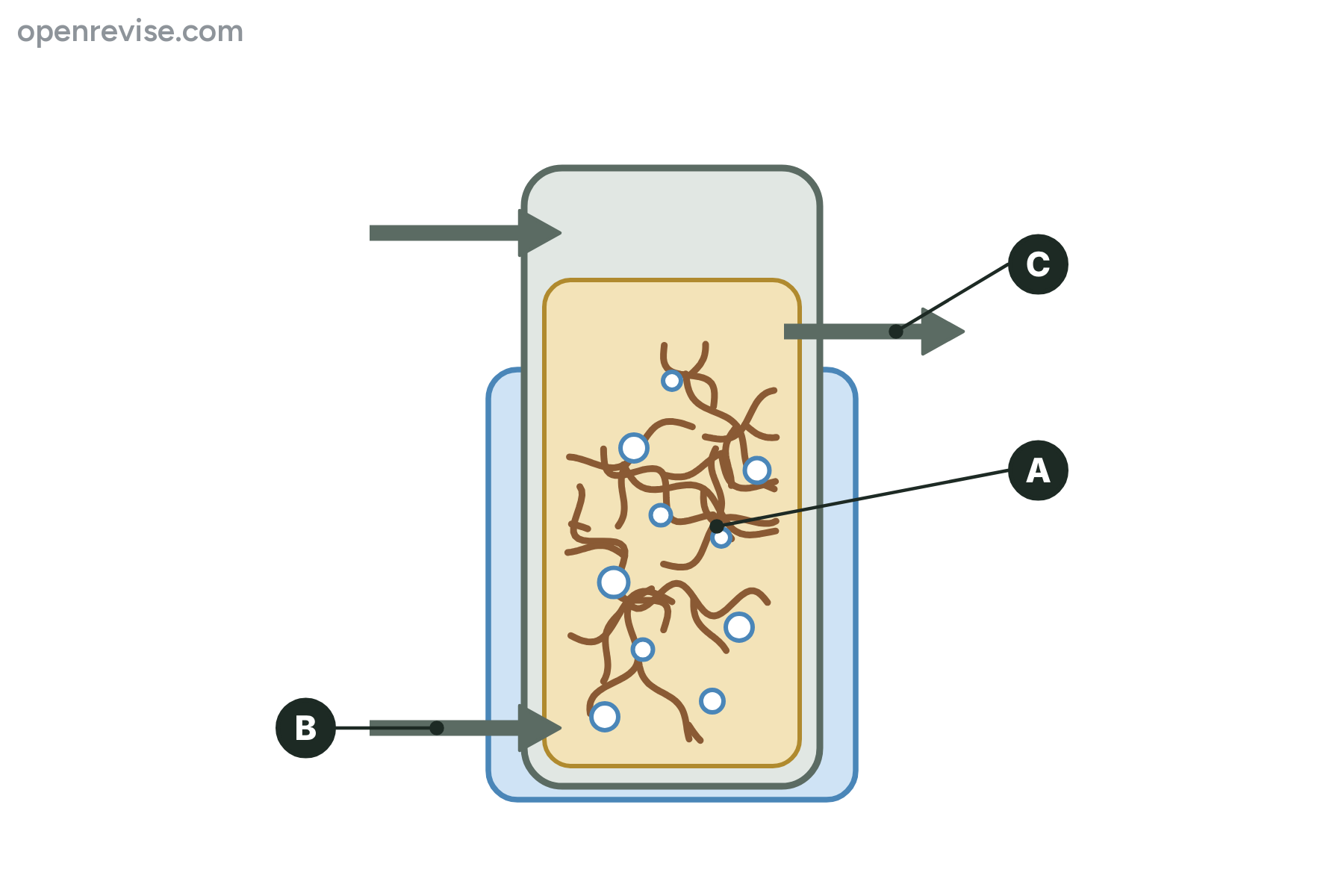
The diagram shows a fermenter that is used to make mycoprotein. Name the parts labelled A, B and C.
Show answerHide answer
Model answer
A is the fungus (Fusarium). B is the (sterile) air inlet. C is the outlet through which the mycoprotein is harvested.
Mark scheme
- A: fungus (Fusarium) — 1 mark
- B: sterile air (oxygen) inlet — 1 mark
- C: outlet (harvesting the mycoprotein) — 1 mark
-
3 Explain [3 marks]
Sterile air is bubbled through the fermenter, and the fermenter has a cooling jacket. Explain why.
Show answerHide answer
Model answer
The air supplies oxygen that the fungus needs for aerobic respiration, to release energy for growth, and it mixes the contents. Respiration releases heat, so the fermenter has to be cooled to keep it at the optimum temperature. If it were too hot, the enzymes of the fungus would be damaged and the fungus would grow slowly or die.
Mark scheme
- Air supplies oxygen for respiration — 1 mark
- Respiration releases heat, so cooling is needed — 1 mark
- To keep the temperature at the optimum, so that the enzymes work and the fungus grows well — 1 mark
-
4 Describe [3 marks]
Describe how golden rice could help to reduce vitamin A deficiency.
Show answerHide answer
Model answer
Golden rice has been genetically engineered with genes that make the grains produce beta-carotene. When people eat it, the body turns the beta-carotene into vitamin A. People who eat mainly rice, which normally has no beta-carotene, can then get vitamin A.
Mark scheme
- Genes have been added by genetic engineering — 1 mark
- The grains make beta-carotene, which the body turns into vitamin A — 1 mark
- It gives vitamin A to people whose diet is mainly rice — 1 mark
-
5 Calculate [3 marks]
Source: A fermenter is fed with 450 kg of glucose in one day. It produces 135 kg of mycoprotein in that day. Calculate the percentage of the mass of the glucose that is converted to mycoprotein, and calculate the mass of glucose needed to make 1 kg of mycoprotein.
Show answerHide answer
Model answer
\(\frac{135}{450} \times 100 = 30\%\). The mass of glucose needed per kilogram of mycoprotein is \(450 \div 135 = 3.3\) kg (to 2 significant figures).
Mark scheme
- \(135 \div 450 \times 100\) — 1 mark
- 30% — 1 mark
- \(450 \div 135 = 3.3\) kg of glucose — 1 mark
-
6 Explain [4 marks]
Explain two advantages of using mycoprotein, instead of beef, as a source of protein for a growing human population.
Show answerHide answer
Model answer
Fungi grow very quickly and can double their mass in a few hours, so a lot of protein is produced in a small space, but beef animals take years to grow and need a lot of land. Mycoprotein is made without the loss of energy that happens at each stage of the food chain when plants are fed to cattle, so less land and fewer crops are needed to make the same amount of protein. Mycoprotein is also low in fat and high in fibre, which is healthier than a diet high in fat.
Mark scheme
- The fungus grows quickly, so protein is produced quickly in a small space — 1 mark
- Explanation: a high yield of protein compared with the time and land needed for beef — 1 mark
- A second advantage, such as less land or fewer crops needed, because energy is not lost in a food chain — 1 mark
- Explanation or another advantage, such as low fat and high fibre — 1 mark
-
7 Discuss [4 marks]
A company breeds GM salmon that grow to market size in half the usual time. Discuss one benefit and two concerns about the use of GM livestock.
Show answerHide answer
Model answer
A benefit is that the fish grow faster, so they need less time and less feed to reach market size, and more food is produced. One concern is that the GM fish may have health problems or suffer, which is an animal welfare problem. Another concern is that if they escape from their tanks, they could breed with wild salmon and spread the gene, which would damage the wild population and the ecosystem.
Mark scheme
- Benefit: faster growth, so less feed and time needed — 1 mark
- Benefit explained, such as more food produced from the same resources — 1 mark
- Concern 1, with an explanation, such as animal welfare — 1 mark
- Concern 2, with an explanation, such as escape and breeding with wild fish — 1 mark
-
8 Evaluate [6 marks]
Evaluate biotechnological solutions, such as mycoprotein, golden rice and GM livestock, to the demands of a growing human population.
Show answerHide answer
Model answer
Mycoprotein makes a high protein, low fat food from a fungus grown in fermenters. It needs much less land than cattle, so it could supply more protein to a growing population. However, the fermenters are expensive to run, they need energy and sterile conditions, and a few people are allergic to it. Golden rice makes beta-carotene, which the body turns into vitamin A, and so could reduce blindness and illness in areas where rice is the main food. But some people object to GM crops on ethical or environmental grounds, and it supplies only one nutrient, so a varied diet may be a better solution. GM livestock, such as fast-growing fish, produce more food from less feed, but there are concerns about animal welfare, escape and breeding with wild populations. Overall, these solutions can help, particularly mycoprotein, which does not rely on gene technology, and they will be most useful if they are carefully regulated and used with other approaches, such as more sustainable farming.
Mark scheme
- Level 3 (5 to 6 marks): at least two solutions evaluated with benefits and concerns, linked to food supply, and a supported conclusion — A balanced judgement based on explained points
- Level 2 (3 to 4 marks): benefits and concerns for one or two solutions, with some explanation, but limited balance or no conclusion — Points explained in part
- Level 1 (1 to 2 marks): simple statements about one or two solutions — A list of ideas with little explanation
- Possible points: less land; protein; fermenter cost; allergies; vitamin A; ethics; animal welfare; escape; cost — Content that can earn credit at any level
Quick check
-
1
Which organism is grown to make mycoprotein?
Show answerHide answer
B: Fusarium
Mycoprotein is made from the fungus Fusarium.
-
2
Why is a nitrogen source added to the mycoprotein fermenter?
Show answerHide answer
D: To allow the fungus to make proteins
The fungus needs nitrogen to make amino acids and so proteins.
-
3
Why is the fermenter cooled?
Show answerHide answer
A: Respiration releases heat that would raise the temperature
Respiration by the fungus releases heat, and the temperature has to stay near the optimum for growth.
-
4
What do hyphae make up?
Show answerHide answer
C: The body of a fungus
Hyphae are the thin threads that make up the body of a fungus, and they are what is harvested as mycoprotein.
-
5
What does the body make from the beta-carotene in golden rice?
Show answerHide answer
B: Vitamin A
The body turns beta-carotene into vitamin A.
-
6
What is one use of GM goats?
Show answerHide answer
C: To make a human protein in their milk
Goats have been given the human gene for antithrombin, so that they make this medicine in their milk.
-
7
A fermenter converts 200 kg of glucose into 50 kg of mycoprotein. What percentage of the glucose mass is converted?
Show answerHide answer
A: 25%
50 divided by 200 is 0.25, which is 25%.
-
8
What is a possible concern about GM fish that escape into the wild?
Show answerHide answer
D: They could breed with wild fish and spread the gene
They could breed with wild fish and spread the new gene, which may harm the wild population.