Biology · Feeding the Human Race
Food Security
Why do hundreds of millions of people go hungry when the world grows more food than ever before? This lesson is for separate Biology only: Combined Science students do not need it. It covers what food security means, the biological factors that put it at risk, and how to read population and food-production data.
Learning Objectives
- 1Describe what is meant by food security and explain why a growing population puts it at risk.
- 2Describe how changing diets in wealthier populations, new pests and pathogens, and environmental change affect the amount of food available.
- 3Explain why the sustainability and the cost of agricultural inputs matter for food production.
- 4Interpret and calculate from data on population and food production, using percentage change and food produced per person.
Retrieval practice
-
1
What is a pathogen?
Show answerHide answer
A microorganism, such as a virus, bacterium, protist or fungus, that causes disease.
-
2
Why do plants need nitrate ions from the soil?
Show answerHide answer
To make amino acids, and so proteins, for growth.
-
3
What is biodiversity?
Show answerHide answer
The variety of living organisms in an ecosystem or on Earth.
-
4
What happens to the energy in a food chain at each trophic level?
Show answerHide answer
Some is lost, for example as heat and in waste, so less is passed on to the next level.
Having enough to eat, all the time
Food security means that everyone has access to enough safe, nutritious food, all of the time, to live a healthy life. It is not only about how much food the world grows. Food has to be grown, moved, stored, bought and eaten, and a failure at any of these stages leaves people hungry. Around one person in ten in the world does not have enough to eat, so food security is one of the biggest global challenges that biologists are asked to help with.
Pressures on food security
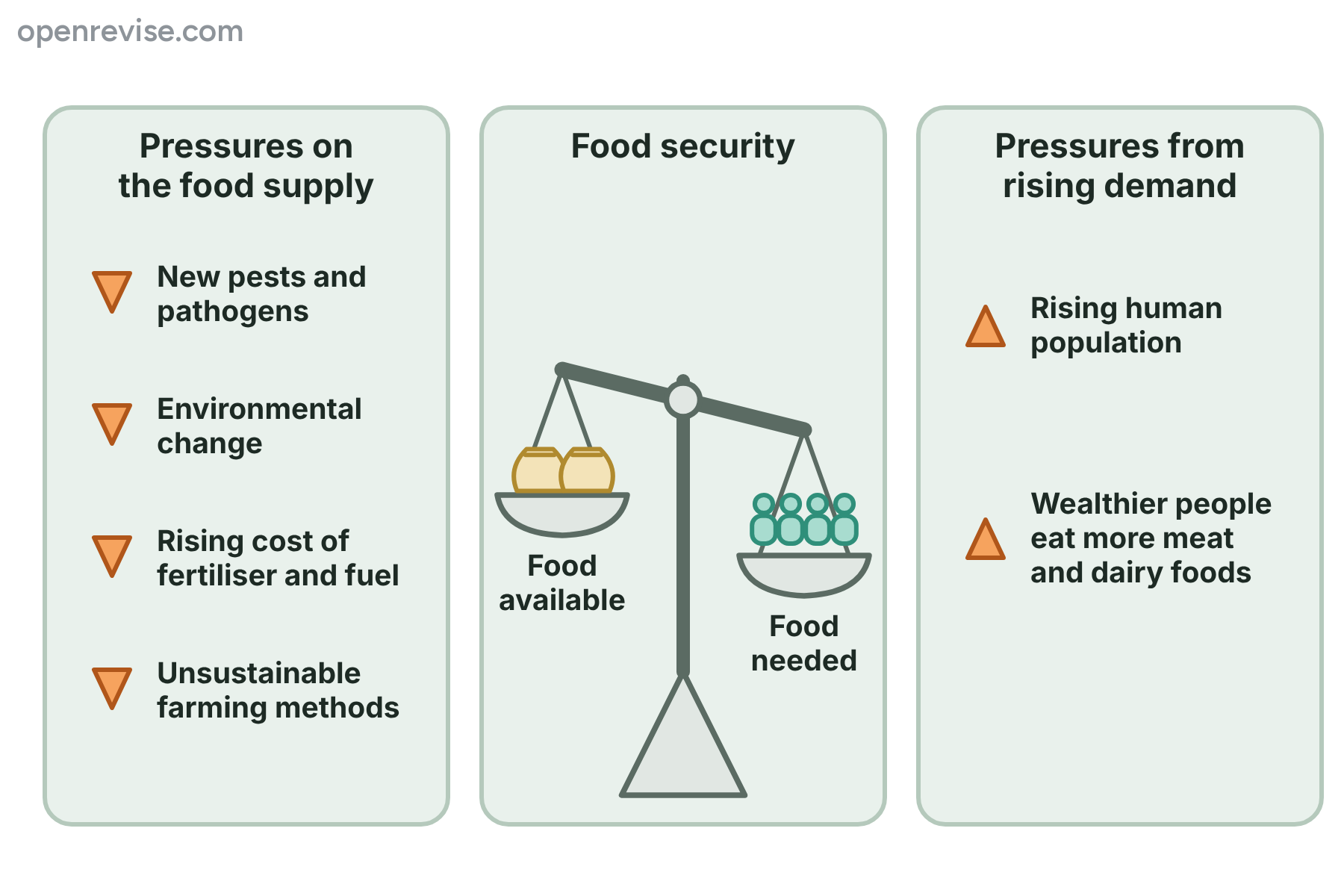
Food security is a balance between the food that can be grown and the food that people need.
A rising population
The more people there are, the more food has to be grown, and the human population is still going up.
-
Population growth
The world population has risen from about 3 billion in 1960 to nearly 8 billion today, and the United Nations expects it to approach 10 billion by about 2050.
-
Improved health
Better medicine, vaccination and clean water mean that fewer people die young and more people live longer, so numbers rise even when families get smaller.
-
More mouths, less land
The area of farmland cannot grow without destroying forests and other habitats, so each hectare of land has to feed more and more people.
-
Uneven growth
Population is rising fastest in some of the poorest regions, where food production is already hardest to improve.
Changing diets in wealthier populations
As incomes rise, people usually eat differently, and this raises the demand for farmland.
-
More meat and dairy
In wealthier countries many people eat more meat, milk and cheese than they once did, and the same change is now happening in fast-growing economies.
-
A less efficient food chain
When we eat an animal, we are one trophic level further along the food chain, and much of the energy in the animal's feed is lost as heat and in waste. Producing meat therefore needs far more land and crops than eating the plants directly.
-
More feed crops
A large share of the world's cereals and soya is grown to feed livestock instead of people, so a diet rich in meat takes food and land from other people.
-
Imported food
Wealthier people also expect a wide choice of foods all year round, which relies on transport and on growing crops in other countries.
New pests and pathogens
Pests eat crops and pathogens cause crop disease, so both cut the amount of food that reaches the table.
-
Pests
Insects such as locusts and fall armyworm eat leaves and stems and can destroy a whole crop in days, which is why a swarm of desert locusts is so dangerous for local food supplies.
-
Pathogens
Fungi, bacteria and viruses cause plant diseases such as wheat rust, which lower the yield or kill the plants altogether.
-
Why new ones appear
Global trade and travel carry pests and pathogens to new countries where the crops have no resistance, and a warming climate lets them survive in places that were once too cold.
-
Resistance
Pests and pathogens evolve. Strains that survive a pesticide or fungicide reproduce, so a chemical that worked for years may stop working.
Case study
Wheat stem rust, Ug99
Wheat stem rust is a fungus that grows inside wheat stems and leaves, and it can wipe out most of a harvest. A new strain called Ug99 was found in Uganda in 1999. It can infect wheat varieties that had been bred to resist older strains, and its spores are carried on the wind, so it has spread across Africa and into the Middle East. Wheat is a staple food for billions of people, so scientists are racing to breed new resistant varieties.
Environmental change
Crops are grown in the open, so they depend on the weather and the soil, and both are changing.
-
Climate change
Rising temperatures, droughts and floods damage crops and shorten the growing season. A single drought can ruin a harvest, and crops that grew well in one region may not grow there in future.
-
Soil damage
Heavy rain, ploughing and clearing trees wash topsoil away, and growing the same crop for years removes minerals, so the soil becomes less fertile.
-
Water supply
Irrigation takes water from rivers and from underground, and in dry regions the supply is running low.
-
Rising seas
Sea water floods low-lying farmland and makes the soil salty, so crops cannot be grown there.
Sustainability and the cost of agricultural inputs
Farming has to produce enough food now without making it harder to produce food in the future.
-
Sustainable farming
Sustainable means meeting people's needs now without stopping future generations from meeting theirs. Taking too much water, wearing out the soil or catching too many fish are all unsustainable.
-
Agricultural inputs
These are the things a farmer has to buy or provide, such as seed, fertiliser, pesticide, animal feed, fuel, machinery and water. Each costs money.
-
Rising costs
If fertiliser, fuel or feed becomes more expensive, farmers can afford less of it, so yields fall and food prices rise. Poorer farmers are hit hardest and may be unable to buy enough to grow a good crop.
-
Damage to ecosystems
Fertiliser washed into rivers can cause eutrophication, and pesticides can kill harmless insects and reduce biodiversity, so intensive farming can harm the ecosystems that farming depends on.
The world population, 1960 to 2020
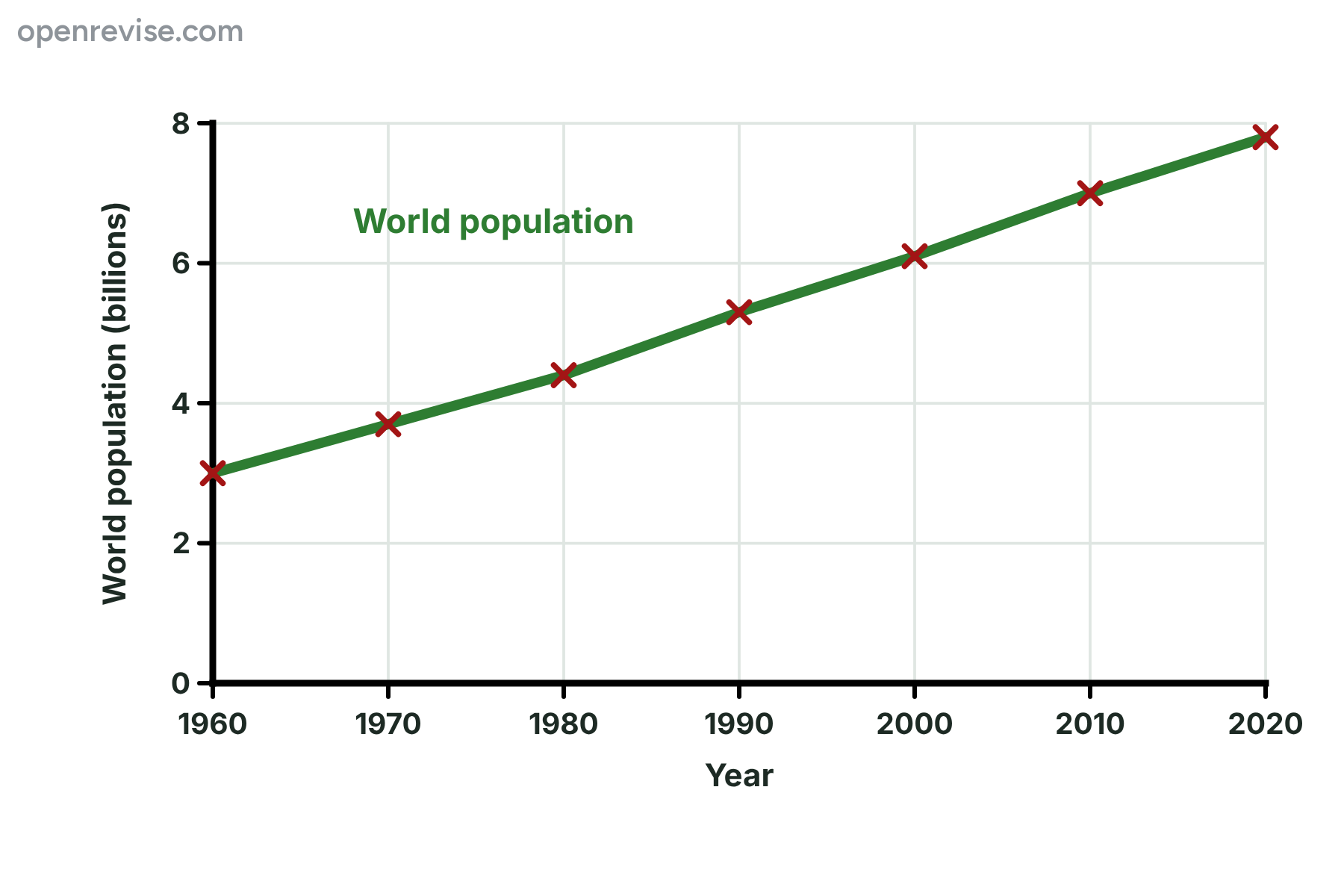
The population has more than doubled in 60 years. Figures are rounded.
Interpreting population and food data
Exam questions give a table or a graph and ask what it shows, so practise a few standard moves.
-
Describe the trend
Say whether it rises or falls, quote two values with their units and years, and say whether it is steady or speeding up.
-
Percentage change
Work out the change, divide by the starting value and multiply by 100. For example, a rise from 3.0 to 7.8 billion is a 160% increase.
-
Food per person
Divide the total food produced by the population. If this falls, food production is not keeping up with population growth.
-
Careful conclusions
Totals can hide differences between countries, and a correlation between two sets of data does not by itself prove that one causes the other.
Is food production keeping up with the population?
In Country X the population rose from 40 million to 52 million in 20 years. In the same time the amount of food produced rose from 12 million tonnes to 13 million tonnes. Calculate the food produced per person at the start and at the end, in kilograms, and state what this shows. (1 tonne = 1000 kg)
Show the solutionHide the solution
- 1 Convert the food to kilograms \(12\ \text{million tonnes} = 12\,000\,000\,000\ \text{kg}\) and \(13\ \text{million tonnes} = 13\,000\,000\,000\ \text{kg}\)
- 2 Divide by the population at the start \(12\,000\,000\,000 \div 40\,000\,000 = 300\ \text{kg per person}\)
- 3 Divide by the population at the end \(13\,000\,000\,000 \div 52\,000\,000 = 250\ \text{kg per person}\)
- 4 State the conclusion Food per person fell by 50 kg, so the people of Country X are less food secure.
AnswerFood per person fell from 300 kg to 250 kg, so food production is not keeping up with the growth in population.
Percentage increase in the population
Use the graph to calculate the percentage increase in the world population between 1960 and 2020.
Show the solutionHide the solution
- 1 Read the values 1960: 3.0 billion; 2020: 7.8 billion
- 2 Find the increase \(7.8 - 3.0 = 4.8\ \text{billion}\)
- 3 Divide by the starting value and multiply by 100 \(\frac{4.8}{3.0} \times 100 = 160\%\)
AnswerThe world population rose by 160%.
The big idea
Food security is not one problem with one cause: it is a balance between a rising demand for food and a supply that is threatened by pests, climate and the cost of farming.
Food security
Food security
-
Rising demand
- growing population
- changing diets
- more meat and dairy
-
Threats to supply
- new pests
- new pathogens
- resistance
-
Environmental change
- drought
- flooding
- soil damage
- rising seas
-
Sustainability
- water
- soil
- fish stocks
- habitats
-
Cost of inputs
- fertiliser
- pesticide
- fuel
- feed
-
Data
- percentage change
- food per person
- trends
Summary and exam focus
- Food security means that everyone has access to enough safe, nutritious food at all times.
- A rising population and the move to a diet with more meat and dairy foods both raise the demand for food and farmland.
- New pests and pathogens, and environmental change such as drought, flooding and soil loss, lower the yield of crops.
- Farming must be sustainable, and a rise in the cost of fertiliser, pesticide, fuel or feed makes it harder to grow enough food.
- Data on food and population can be compared using percentage change and the food produced per person.
Exam focus
Describe three biological factors that could reduce food security. (3 marks) (3 marks)
Give three different factors and say how each one cuts the amount of food available or raises the amount needed, for example new pests destroying crops, drought lowering the yield, or more people eating meat. A bare list of factor names earns little, and two versions of the same factor earn one mark.
Key terms
The words this lesson expects you to use. Each one is linked from the first place it appears above.
- Food security
- Having access to enough safe, nutritious food, at all times, to live a healthy life.
- Food insecurity
- A lack of reliable access to enough food, so that people go hungry or are undernourished.
- Pest
- An organism, usually an insect, that damages crops or livestock.
- Pathogen
- A microorganism that causes disease, such as a fungus, bacterium or virus.
- Environmental change
- A change in the conditions of the environment, such as a rise in temperature, a drought or the loss of soil.
- Sustainable
- Meeting the needs of people now without stopping future generations from meeting their needs.
- Agricultural inputs
- The things a farmer has to provide to grow crops or rear animals, such as seed, fertiliser, pesticide, feed, fuel and water.
- Yield
- The mass of a crop or animal product that is harvested from an area of land or from an animal.
- Population
- All of the individuals of one species, such as humans, living in one place.
You've finished the notes
Check your understanding
Test yourself while it is fresh. Start with the flashcards, then try the exam questions.
Something here looks wrong?
Tell us what and we will go and look. It goes to whoever writes these pages, nobody else, and we do not ask who you are — so there is nothing to sign and nothing comes back to you.