Exam questions · Biology · Feeding the Human Race
Food Security
- 8 exam questions
- 25 marks
- 8 quick checks
-
1 State [1 mark]
State one reason why a rising human population threatens food security.
Show answerHide answer
Model answer
There are more people to feed, so more food has to be grown (and more land is needed).
Mark scheme
- More people need more food, which may be more than can be produced — 1 mark
-
2 Give [2 marks]
Give two ways in which new pests or pathogens can reduce the amount of food produced.
Show answerHide answer
Model answer
Pests eat the leaves, stems or roots of crops, so the yield falls. Pathogens such as fungi cause disease, which damages the crop or kills the plants.
Mark scheme
- Pests eat or damage the crop, so yield falls — 1 mark
- Pathogens cause disease, which damages or kills plants — 1 mark
-
3 Explain [3 marks]
Explain why the increase in meat eating in wealthier countries makes it harder to feed the world.
Show answerHide answer
Model answer
Animals are one trophic level further along the food chain than plants. A large amount of the energy in their feed is lost as heat and in waste. So it takes much more land and many more crops to produce meat than to produce the same energy as plant foods, and this land could have fed more people.
Mark scheme
- Meat comes from animals higher up the food chain — 1 mark
- Much of the energy in feed is lost, so it is an inefficient way to use crops — 1 mark
- More land and crops are needed per person, leaving less food for others — 1 mark
-
4 Describe [3 marks]
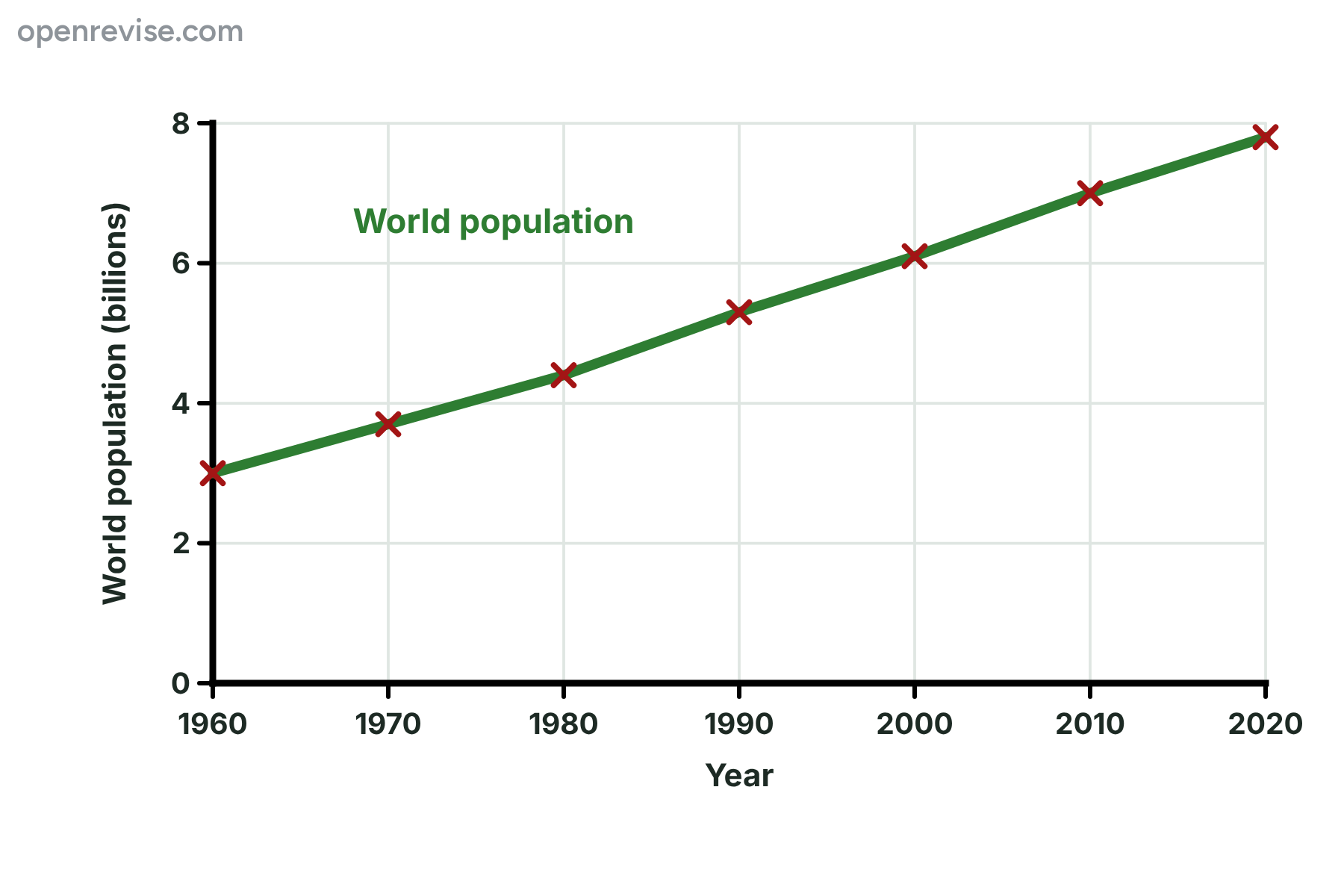
The graph shows the size of the world population from 1960 to 2020. Describe the trend shown by the graph.
Show answerHide answer
Model answer
The population increased throughout the period, from 3.0 billion in 1960 to 7.8 billion in 2020. It rose by about 0.7 to 0.9 billion in every ten years, so the number of extra people added each decade stayed high. The population more than doubled in sixty years.
Mark scheme
- The population increases all the way from 1960 to 2020 — 1 mark
- Quotes figures with units, such as 3.0 billion to 7.8 billion — 1 mark
- Says that it more than doubled, or that the rise is steady and continuing — 1 mark
-
5 Calculate [3 marks]
Use the graph to calculate the percentage increase in the world population between 1980 and 2020.
Show answerHide answer
Model answer
Population in 1980 is 4.4 billion and in 2020 is 7.8 billion. The increase is \(7.8 - 4.4 = 3.4\) billion. The percentage increase is \(\frac{3.4}{4.4} \times 100 = 77\%\) (to 2 significant figures).
Mark scheme
- Reads both values correctly: 4.4 and 7.8 — 1 mark
- \(3.4 \div 4.4 \times 100\) — 1 mark
- 77% (accept 77.3%) — 1 mark
-
6 Calculate [3 marks]
In 2000 a country had a population of 25 million and produced 7.5 million tonnes of food. In 2020 the population was 30 million and 8.1 million tonnes of food were produced. Calculate the mass of food produced per person in each year, and state what the figures show about food security in the country. (1 tonne = 1000 kg)
Show answerHide answer
Model answer
In 2000: \(7\,500\,000\,000 \div 25\,000\,000 = 300\) kg per person. In 2020: \(8\,100\,000\,000 \div 30\,000\,000 = 270\) kg per person. The food produced per person has fallen, so food production is not keeping up with the rising population and the country is less food secure.
Mark scheme
- 300 kg per person in 2000 — 1 mark
- 270 kg per person in 2020 — 1 mark
- Food per person has fallen, so food security is reduced — 1 mark
-
7 Explain [4 marks]
A farmer in a poor country finds that the price of fertiliser and fuel has doubled and that the rains have failed for two years. Explain how these changes could affect food security in the farmer's region.
Show answerHide answer
Model answer
The fertiliser is too expensive, so the farmer buys less, and the crop gets fewer mineral ions, so the yield is lower. Dearer fuel makes ploughing and transport more expensive, and so raises the price of the food. A drought means that the crops do not get enough water, so they grow poorly or die, and so less food is grown. Less food and higher prices mean that fewer people can get enough to eat.
Mark scheme
- Fertiliser too expensive, so less is used and yield falls — 1 mark
- Fuel cost raises the cost of farming and the price of food — 1 mark
- Drought (environmental change) means crops get too little water and yields fall — 1 mark
- Less food and higher prices mean fewer people can afford enough food — 1 mark
-
8 Discuss [6 marks]
The human population is expected to reach nearly 10 billion by 2050. Discuss the biological factors that could make it difficult to feed this population in a sustainable way.
Show answerHide answer
Model answer
More people means a greater demand for food, and as people become wealthier they eat more meat and dairy foods. Meat takes more land and more crops to produce than plant foods, because energy is lost at every trophic level, so the demand for farmland rises even faster than the population. At the same time the supply is threatened. New pests and pathogens can spread to new countries in trade and travel and destroy crops, and they can become resistant to pesticides. Environmental change, such as drought, flooding and rising temperatures, lowers yields, and soil can be lost or made less fertile. Growing more food has to be sustainable. Using more fertiliser, pesticide and water is expensive for farmers, can pollute rivers and harm biodiversity, and may not be possible for ever. So the food supply must be increased without using up the soil, the water and the habitats that future farming depends on.
Mark scheme
- Level 3 (5 to 6 marks): several different factors are explained, with links to both demand and supply and a clear reference to sustainability or cost — A logical, well-structured answer in which the factors are linked to food security
- Level 2 (3 to 4 marks): two or three factors are explained, but the link to food production or sustainability is partial — Some reasoning, but not every point is developed
- Level 1 (1 to 2 marks): one or two factors are named or described with little explanation — A list of factors with no link to the amount of food
- Possible points: rising population; more meat and dairy foods; energy lost between trophic levels; new pests and pathogens; resistance; climate change; soil loss; cost of inputs — Content that can earn credit at any level
Quick check
-
1
Which statement defines food security?
Show answerHide answer
C: Access to enough safe, nutritious food at all times
Food security is having access to enough safe, nutritious food at all times to live a healthy life.
-
2
Why does eating more meat increase the demand for farmland?
Show answerHide answer
A: Animals need crops, and energy is lost when it passes through them
Animals are higher up the food chain, so energy is lost and more crops are needed to produce meat than plant foods.
-
3
Which of these is an example of environmental change that could reduce crop yields?
Show answerHide answer
D: A long drought
Drought is a change in the environment that leaves crops without enough water.
-
4
Why do new pests and pathogens often reach new countries?
Show answerHide answer
B: Because of trade, travel and a warming climate
Trade and travel carry them across the world, and a warmer climate lets them survive in new places.
-
5
The population of a country rises from 20 million to 25 million. What is the percentage increase?
Show answerHide answer
C: 25%
The increase is 5 million, and 5 divided by 20, multiplied by 100, gives 25%.
-
6
A country produced 600 000 tonnes of food for 2 million people. How much food is that per person?
Show answerHide answer
B: 300 kg
600 000 tonnes is 600 000 000 kg, and dividing by 2 000 000 people gives 300 kg per person.
-
7
Which of these is an agricultural input?
Show answerHide answer
D: Pesticide sprayed on the crop
Seed, fertiliser, pesticide, feed, fuel and water are inputs that a farmer has to provide.
-
8
What is meant by sustainable farming?
Show answerHide answer
A: Producing food without harming future food production
Sustainable farming meets needs now without making it harder for future generations to produce food.