Biology · Feeding the Human Race
Agricultural Solutions to the Demands of the Growing Population
Farmers have to grow more food from the same amount of land without wrecking the environment. This lesson is for separate Biology only: Combined Science students do not need it. It covers fertilisers and pesticides, hydroponics, biological control and gene technology, and the advantages and disadvantages of each.
Learning Objectives
- 1Describe how fertilisers and pesticides increase crop yields and explain the problems that they can cause.
- 2Describe how hydroponics works and evaluate its advantages and disadvantages.
- 3Explain how biological control is used to reduce pests and evaluate its advantages and disadvantages.
- 4Evaluate the agricultural solutions to the demands of a growing human population, including gene technology.
Retrieval practice
-
1
Why do plants need nitrate ions?
Show answerHide answer
To make amino acids, which are joined together to make proteins for growth.
-
2
What is food security?
Show answerHide answer
Having access to enough safe, nutritious food at all times to live a healthy life.
-
3
What is a predator?
Show answerHide answer
An animal that hunts and eats other animals, which are its prey.
-
4
What does sustainable mean?
Show answerHide answer
Meeting the needs of people now without harming the ability of future generations to meet theirs.
More food from the same land
The demand for food is rising, but the amount of good farmland is not. The answer has to be a higher yield from every hectare. Farmers can give crops the minerals they need, protect them from the organisms that eat or infect them, grow them in a controlled system without soil, or change the crops themselves. Each of these solutions has benefits, and each has costs, and the exam expects you to weigh both.
Fertilisers
Fertilisers replace the minerals that crops take out of the soil, so that the plants can grow as fast as light and water allow.
-
What they contain
Most artificial fertilisers are NPK fertilisers, which supply nitrate (N), phosphate (P) and potassium (K) ions. Natural fertilisers such as manure and compost supply the same minerals more slowly.
-
Why plants need them
Nitrate is used to make amino acids and so proteins, phosphate is needed for DNA and cell membranes, and potassium helps the enzymes of photosynthesis and respiration to work. A shortage of any of them stunts growth and lowers the yield.
-
Advantages
Fertilisers make crops grow faster and larger, so more food comes from the same field, and the same crop can be grown year after year on the same land.
-
Disadvantages
Fertilisers cost money, and rain washes the extra minerals into rivers and lakes, where they cause eutrophication and pollute drinking water.
How fertiliser run-off kills fish
Eutrophication is the harm caused when too many minerals reach a river or lake.
-
1
Run-off
Rain washes nitrate and phosphate from the fertilised field into the water.
-
2
Algal bloom
The extra minerals make the algae on the surface grow very fast, and they form a thick green layer.
-
3
Light is blocked
The layer shuts out light, so the water plants below cannot photosynthesise and they die.
-
4
Decomposers
Bacteria feed on the dead plants and algae and use up the oxygen in the water in respiration.
-
5
Fish die
With too little dissolved oxygen, fish and other aquatic animals suffocate, and the biodiversity of the water falls.
Pesticides
Pesticides are chemicals that kill the organisms that damage crops.
-
Types
Insecticides kill insects that eat crops, herbicides kill weeds that compete with the crop for light, water and minerals, and fungicides kill fungi that cause diseases such as blight and mildew.
-
Advantages
Crops lose less to pests, weeds and disease, so the yield and the quality of the harvest are higher, and the pesticides act quickly and are easy to use.
-
Harm to other organisms
Many pesticides kill harmless insects as well, including bees and other pollinators, and so reduce biodiversity and the pollination of crops.
-
Food chains
Some pesticides are not broken down and build up in the bodies of animals along a food chain. The pesticide DDT made the shells of birds of prey thin and weak, and their numbers fell.
-
Resistance
A pest that survives the spray passes on its resistance, so a pesticide may stop working over time and a new one has to be found.
Fertilisers and pesticides compared
Fertilisers
- Add nitrate, phosphate and potassium to the soil
- Make the crop grow larger and faster
- Run-off causes eutrophication
- Cost money, and rising prices hit poor farmers
Pesticides
- Kill insects, weeds and fungi that damage the crop
- Protect the yield and quality of the harvest
- Can kill pollinators and build up in food chains
- Pests can become resistant to them
Hydroponics
In hydroponics, plants are grown with their roots in a nutrient solution instead of in soil.
-
How it works
The roots are held in a solution of water with all of the mineral ions the plant needs, and a pump bubbles air through it so that the roots get oxygen for respiration. The plants are held up by a support, and light is provided by the sun or by lamps.
-
Control
The farmer can set the exact amount of each mineral, the pH, the temperature and the light for every crop, so each plant gets exactly what it needs.
-
Advantages
Yields are high, crops can be grown all year round and in places with poor soil or no space, such as cities and deserts, and less water is used because it is recycled. There are no soil pests and fewer diseases.
-
Disadvantages
The equipment, the lighting and the pumps are expensive to set up and to run, and the farmer needs skill. A power failure or an infection can ruin the whole crop, because every plant shares the same solution.
A hydroponics set-up
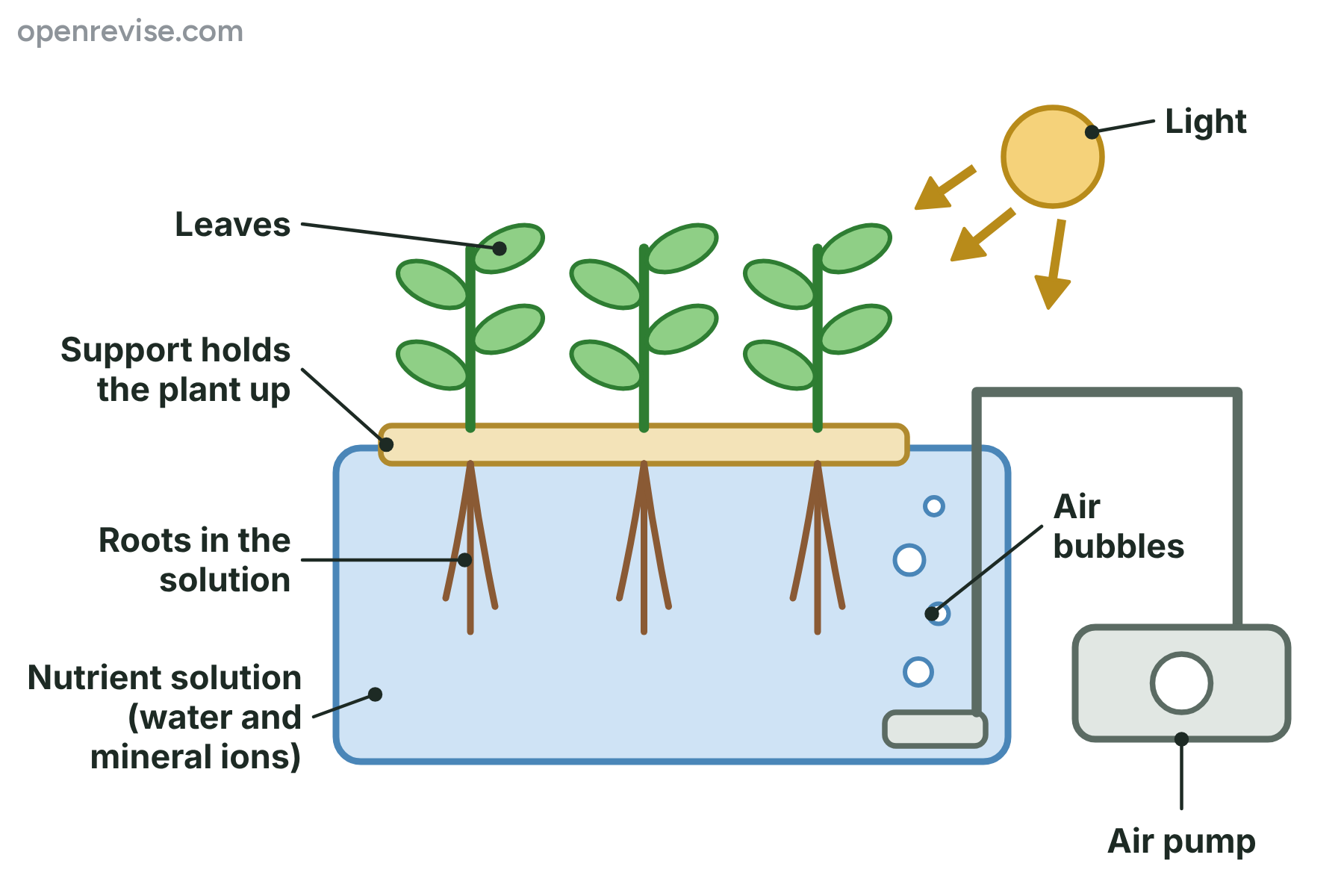
The roots take mineral ions from the solution and oxygen from the bubbles.
Biological control
Biological control uses living organisms, instead of chemicals, to reduce the numbers of a pest.
-
Predators
The farmer releases an animal that eats the pest. Ladybirds and their larvae eat aphids, and in greenhouses predatory mites are released to eat red spider mites.
-
Parasites
Parasitic wasps lay their eggs in pests such as whitefly or caterpillars, and the wasp larvae feed on the host and kill it.
-
Pathogens and plant eaters
A bacterium called Bacillus thuringiensis, sprayed on a crop, makes caterpillars ill and kill them. Insects that eat only one weed can be released to control it.
-
Advantages
There are no chemical residues, it does not kill most other species, pests do not become resistant to it as quickly, and it can be sustainable because the control organism reproduces.
-
Disadvantages
It works slowly and does not completely remove the pest, the control species may not survive or may eat other organisms, and it can be expensive to buy and release the organisms.
Case study
The cane toad in Australia
In 1935, 102 cane toads were taken from Hawaii to Queensland to eat the beetles that were damaging sugar cane. The toads did not control the beetles, which live high on the cane stalks, but they bred very fast and spread across northern Australia. The toads are poisonous, so native predators that eat them die, and there are now millions of them. It shows why a species must be tested thoroughly before it is released.
Gene technology
Genetic engineering changes the crop itself, so that it grows better without extra chemicals.
-
Pest resistance
A gene from the bacterium Bacillus thuringiensis (the Bt gene) makes maize and cotton produce a protein that kills caterpillars that eat them, so the farmer sprays less pesticide.
-
Other changes
Crops can be given resistance to a herbicide, to drought, or extra vitamins such as vitamin A in golden rice.
-
Advantages
Yields rise and losses to pests fall, so more food is produced from the same land.
-
Disadvantages
The seed is expensive, and some people are concerned about the effects on other organisms and on human health. The details are covered in the lessons on genetic engineering.
Hydroponics and soil farming
Hydroponics
- Roots in a solution of mineral ions
- Exact control of nutrients, pH and temperature
- High yields all year round, in a small space
- Costly to set up and run, and needs skill
Growing in soil
- Roots in soil that supplies minerals and water
- The weather and the soil decide the growing conditions
- Cheaper for crops grown over large areas
- Soil pests and diseases, and soil can be lost
The big idea
There is no perfect solution: each way of growing more food raises the yield, and each one has a cost to money, to the environment or to other organisms.
Agricultural solutions
Agricultural solutions
-
Fertilisers
- nitrate, phosphate, potassium
- higher yield
- eutrophication
-
Pesticides
- insecticides, herbicides, fungicides
- pollinators harmed
- resistance
-
Hydroponics
- roots in solution
- control
- high cost
-
Biological control
- predators
- parasites
- slow
- may become a pest
-
Gene technology
- pest resistance
- golden rice
- risks and cost
-
Evaluating
- advantages
- disadvantages
- sustainability
- cost
Summary and exam focus
- Fertilisers supply nitrate, phosphate and potassium to raise yields, but run-off causes eutrophication.
- Pesticides kill pests, weeds and fungi, but they can harm other organisms, build up in food chains and lose their effect through resistance.
- Hydroponics grows plants in a nutrient solution with exact control and high yields, but it is expensive and needs skill.
- Biological control uses predators, parasites and pathogens to reduce pests without chemicals, but it is slow and can go wrong.
- Gene technology can make crops resistant to pests or more nutritious, but the seed is costly and some people are concerned about the risks.
Exam focus
Evaluate the use of hydroponics to grow food for a growing human population. (6 marks) (6 marks)
Give advantages and disadvantages, link each one to food production or to cost, and finish with a judgement, for example that hydroponics suits high-value crops such as tomatoes but is too costly for staple crops over large areas. A one-sided list will not reach the top level.
Key terms
The words this lesson expects you to use. Each one is linked from the first place it appears above.
- Fertiliser
- A substance containing mineral ions, such as nitrate, phosphate and potassium, that is added to soil to help crops grow.
- Pesticide
- A chemical that kills pests, such as insects (insecticide), weeds (herbicide) or fungi (fungicide).
- Hydroponics
- Growing plants with their roots in a solution of mineral ions instead of in soil.
- Biological control
- Using living organisms, such as predators, parasites or pathogens, to reduce the numbers of a pest.
- Eutrophication
- Too many mineral ions in water, causing an algal bloom, then the death of plants and a loss of oxygen so that animals die.
- Predator
- An animal that kills and eats other animals.
- Mineral ions
- Substances such as nitrate, phosphate and potassium that plants take in through the roots to stay healthy.
- Resistance
- The ability of an organism to survive a chemical such as a pesticide, which it passes on to its offspring.
- Pollinator
- An animal, such as a bee, that carries pollen between flowers, so that the plants can make seeds and fruit.
You've finished the notes
Check your understanding
Test yourself while it is fresh. Start with the flashcards, then try the exam questions.
Something here looks wrong?
Tell us what and we will go and look. It goes to whoever writes these pages, nobody else, and we do not ask who you are — so there is nothing to sign and nothing comes back to you.