Biology · Inheritance
Genes, the Genome and Phenotype
Every cell in your body contains the instructions for making you, but what you look like depends on more than those instructions. This lesson covers the key terms of inheritance, the genome, and how the genome and the environment together influence the development of the phenotype.
Learning Objectives
- 1Explain the terms gamete, chromosome, gene, allele (variant), dominant, recessive, homozygous, heterozygous, genotype and phenotype.
- 2Describe the genome as the entire genetic material of an organism.
- 3Describe how the genome and its interaction with the environment influence the development of the phenotype.
- 4Recall that most phenotypic features are the result of multiple genes rather than single gene inheritance.
Retrieval practice
-
1
What is DNA?
Show answerHide answer
A polymer made of two strands, coiled in a double helix, that carries genetic information.
-
2
Where is DNA found in a eukaryotic cell?
Show answerHide answer
In the nucleus, in chromosomes.
-
3
What is a protein?
Show answerHide answer
A polymer made of amino acids, which does many jobs in a cell.
-
4
What is a gamete?
Show answerHide answer
A sex cell, such as a sperm cell or an egg cell.
The instructions for an organism
Inheritance depends on genetic information that is passed from parents to their offspring. The information is carried in the DNA of the chromosomes in the nucleus of a cell. It works as a code, because the order of the bases in a section of DNA called a gene decides which protein the cell can make. Different versions of a gene make slightly different proteins, and the combination of versions that an organism has helps to decide what it is like. In this chapter you will learn the language that biologists use for these ideas, and how inheritance is worked out.
The key terms
These ten terms are in the specification, and they must be understood and used with care.
-
Gamete
A sex cell, such as a sperm or an egg cell, that carries half the chromosomes of a body cell.
-
Chromosome
A long molecule of DNA, in the nucleus, that carries many genes. Human body cells have 23 pairs.
-
Gene
A section of DNA that codes for a particular protein, and so helps to decide a characteristic.
-
Allele or variant
A different version of the same gene. The two terms mean the same thing in this specification.
-
Dominant
An allele that shows its effect in the phenotype, even if only one copy is present. It is written as a capital letter, such as T.
-
Recessive
An allele that only shows its effect when there are two copies, and no dominant allele. It is written as a lower-case letter, such as t.
-
Homozygous
Having two identical alleles of a gene, such as TT or tt.
-
Heterozygous
Having two different alleles of a gene, such as Tt.
-
Genotype
The combination of alleles that an organism has for a gene, for example Tt.
-
Phenotype
The characteristic that the organism shows, such as being tall, which is caused by the genotype and the environment.
Alleles on a pair of chromosomes
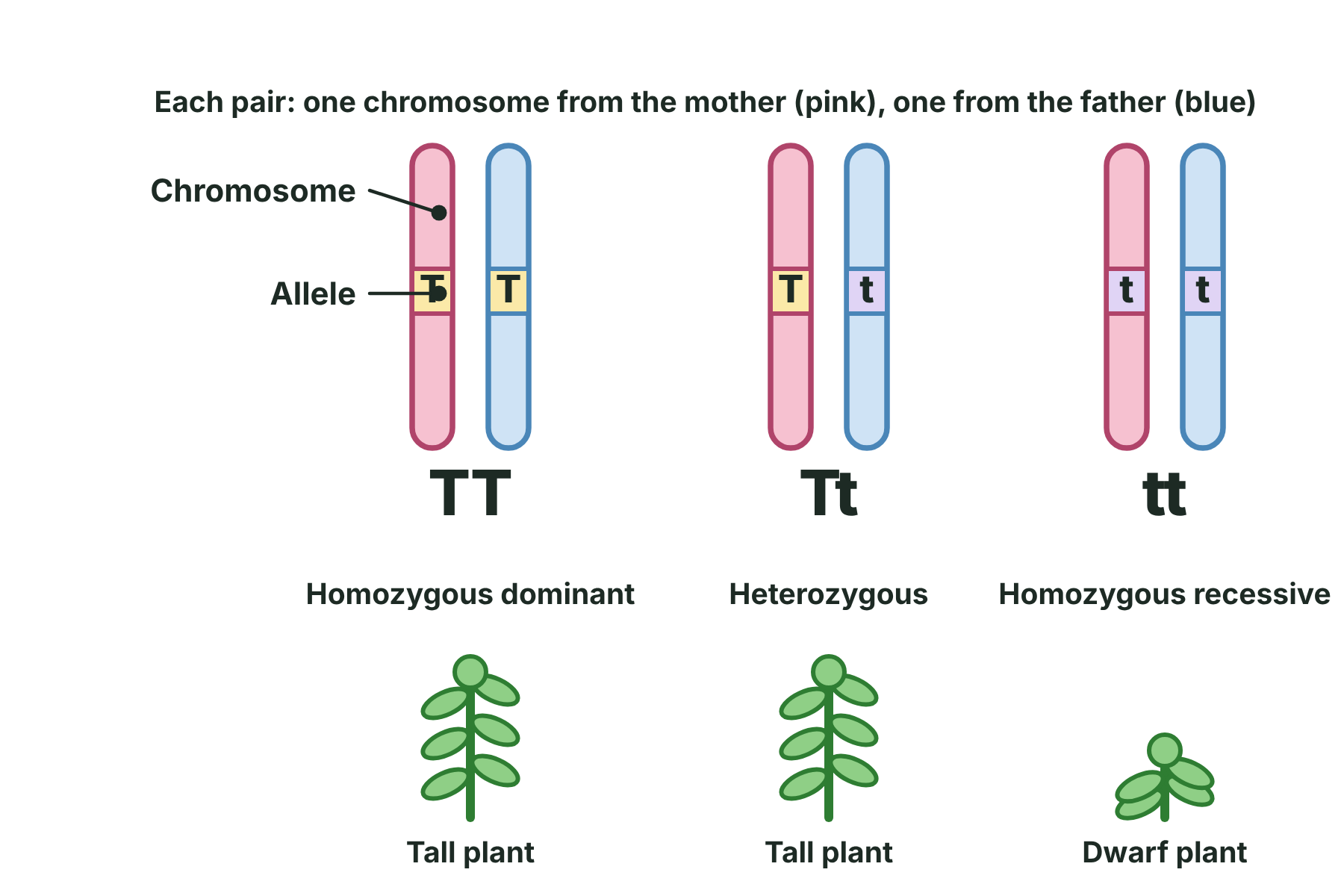
The two alleles of a gene are at the same position on a pair of chromosomes.
Homozygous and heterozygous
Homozygous
- Two identical alleles of a gene
- Written TT (dominant) or tt (recessive)
- Makes only one kind of gamete
- TT is tall, and tt is dwarf
Heterozygous
- Two different alleles of a gene
- Written Tt
- Makes two kinds of gamete, with T or t
- The dominant allele shows, so Tt is tall
The genome
The genome is all of the genetic material of an organism.
-
Definition
The genome is the entire genetic material of an organism, which means all of its DNA.
-
In the human
The human genome has about 3 billion base pairs, in 23 pairs of chromosomes, with about 20 000 genes.
-
Every cell
Almost every body cell has a copy of the whole genome, but a cell only uses the genes that it needs.
-
Different species
Different species have different genomes, and they vary in size. A bacterium has a much smaller genome than a human.
The human genome in numbers
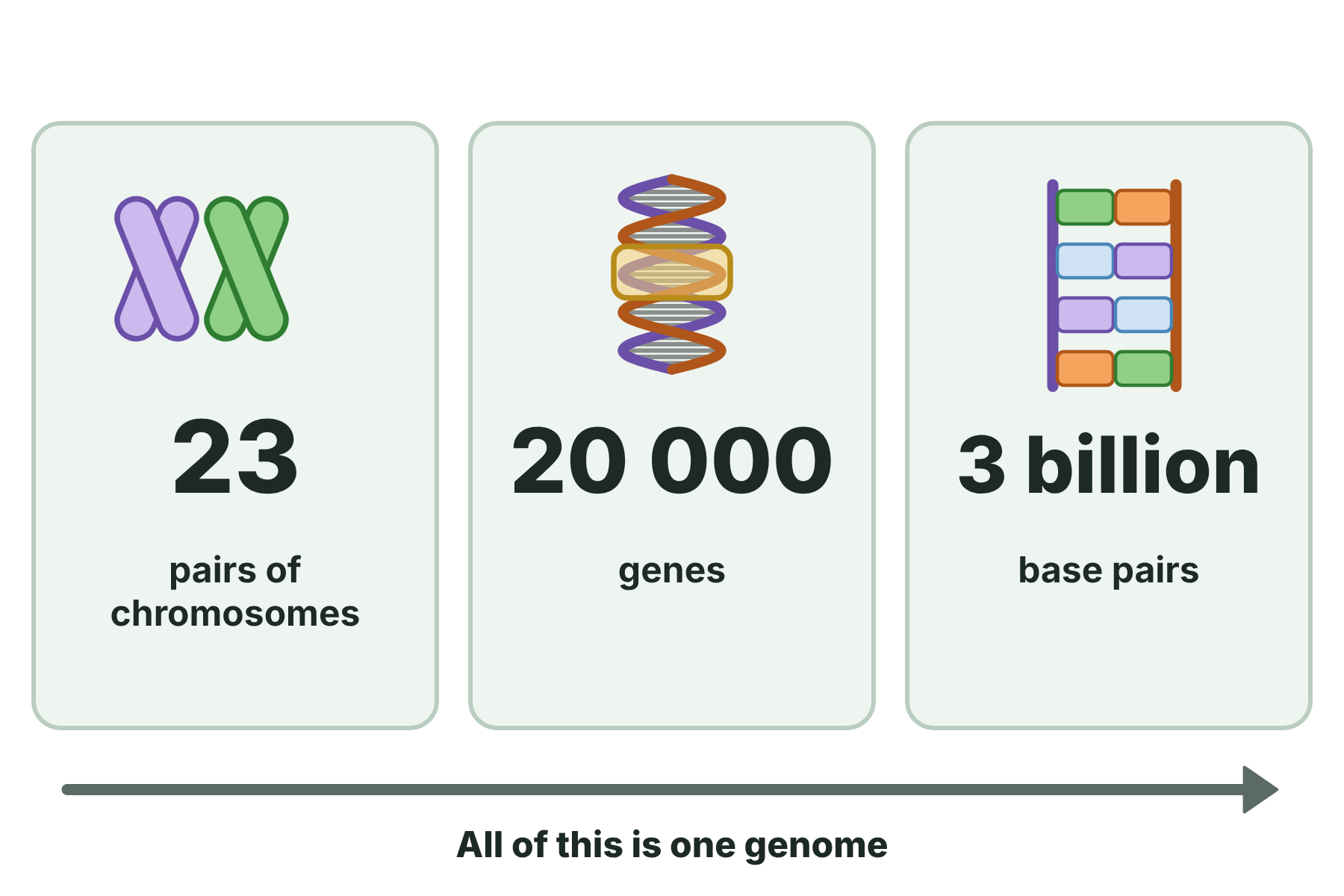
The genome is all of the genetic material of an organism.
From genome to phenotype
The phenotype is not decided by the genome alone.
-
The genome
The genome gives the instructions for the organism, through the proteins that its genes make.
-
The environment
An organism also lives in an environment, which affects how the genome is used, and how the organism grows.
-
Interaction
The phenotype is the result of the genome and its interaction with the environment. A person's genes may allow them to be tall, but whether they reach that height depends on their diet.
-
An example in plants
Two identical plants, with the same genes, can have different heights if one is grown in good soil and the other in poor soil.
-
An example in animals
Identical twins have the same genome, but they can differ in body mass if their diet and exercise are different.
Most features need many genes
Single gene inheritance is simple to study, but it is not the usual case.
-
Single gene features
A few features are controlled by one gene, such as cystic fibrosis, or the colour of the flowers of a pea plant.
-
Multiple genes
Most phenotypic features are the result of many genes, which work together, and not of a single gene. Height, skin colour and eye colour are examples.
-
Why it matters
When many genes are involved, there are many possible combinations, so the features vary in small steps, and the results of crosses are not simple ratios.
-
With the environment
The environment also has a larger effect on features that are controlled by many genes.
Naming the genotype and phenotype
In pea plants, the allele for purple flowers (P) is dominant to the allele for white flowers (p). State the phenotype of plants with the genotypes PP, Pp and pp, and say whether each genotype is homozygous or heterozygous.
Show the solutionHide the solution
- 1 Look at the letters P is dominant, so it shows when there is at least one P.
- 2 PP Two of the same allele, so it is homozygous, and the flowers are purple.
- 3 Pp Two different alleles, so it is heterozygous, and the dominant allele shows, so the flowers are purple.
- 4 pp There is no dominant allele, so the recessive phenotype shows. The flowers are white, and the plant is homozygous.
AnswerPP is purple and homozygous. Pp is purple and heterozygous. pp is white and homozygous.
Case study
Cystic fibrosis
Cystic fibrosis is an inherited disorder that causes thick, sticky mucus in the lungs and the gut. It is caused by a recessive allele of one gene, which we can write as f. A person with the genotype ff has the disorder. A person with Ff does not have it, but is a carrier who can pass the allele on to their children. About 1 in 25 people in the UK are carriers. It is a good example of a feature that is controlled by a single gene, which is why it follows a simple pattern of inheritance.
Summary and exam focus
- A gene is a section of DNA that codes for a protein, and alleles (variants) are different versions of it.
- Homozygous means two identical alleles, and heterozygous means two different alleles.
- The genotype is the alleles that an organism has, and the phenotype is the feature that it shows.
- The genome is the entire genetic material of an organism.
- The phenotype is the result of the genome and its interaction with the environment, and most features are controlled by many genes.
Exam focus
Explain the difference between genotype and phenotype, and describe how the genome and the environment influence a phenotype. (6 marks) (6 marks)
Define both terms with an example, such as Tt and tall. Then say that the genome gives the instructions, and that the environment also affects the result, and give a clear example, such as height and diet. Use the key terms correctly and spell them correctly.
Key terms
The words this lesson expects you to use. Each one is linked from the first place it appears above.
- Gene
- A section of DNA that codes for a protein.
- Allele
- A different version of a gene, also called a variant.
- Genome
- The entire genetic material of an organism.
- Genotype
- The alleles that an organism has for a gene.
- Phenotype
- The observable features of an organism, caused by the genotype and the environment.
- Dominant
- Describes an allele that shows its effect even when only one copy is present.
- Recessive
- Describes an allele whose effect only shows when there are two copies.
- Homozygous
- Having two identical alleles of a gene.
- Heterozygous
- Having two different alleles of a gene.
You've finished the notes
Check your understanding
Test yourself while it is fresh. Start with the flashcards, then try the exam questions.
Something here looks wrong?
Tell us what and we will go and look. It goes to whoever writes these pages, nobody else, and we do not ask who you are — so there is nothing to sign and nothing comes back to you.