Biology · Inheritance
Variation and Mutations
No two people are exactly alike, and neither are two peas in a pod. This lesson covers continuous and discontinuous variation, the causes of variation, and how mutations produce the variants that are the source of all of it.
Learning Objectives
- 1Describe, with examples, discontinuous variation such as eye colour and continuous variation such as height and weight.
- 2Describe the genome and the environment as causes of variation in the phenotype.
- 3Recall that all variants arise from mutations, and that most have no effect on the phenotype, some influence the phenotype and a very few determine the phenotype.
- 4Process and interpret data on variation, including histograms and bar charts.
Retrieval practice
-
1
What is a mutation?
Show answerHide answer
A change in the DNA base sequence.
-
2
What is a variant?
Show answerHide answer
A different version of a gene, also called an allele.
-
3
What does the genome interact with to influence the phenotype?
Show answerHide answer
The environment.
-
4
What is the mean?
Show answerHide answer
The sum of the values divided by the number of values.
Why individuals differ
Look at the members of your class. They are all human beings, but they differ in height, mass, eye colour, blood group and many other features. These differences between individuals of the same species are called variation. Variation may be caused by the genes that a person has inherited, by the environment in which they have lived, or, most often, by both. Whatever the cause, all of the variants that exist today arose from mutations.
Discontinuous variation
In discontinuous variation, the feature falls into distinct categories, with no values in between.
-
Examples
Eye colour is an example of discontinuous variation, as are blood group, whether you can roll your tongue, and whether a pea is round or wrinkled.
-
Controlled by
These features are often controlled by one gene, or a small number of genes, and are little affected by the environment.
-
Shown by
The data are shown by a bar chart, with gaps between the bars, or a pie chart.
Continuous variation
In continuous variation, a feature can have any value within a range.
-
Examples
Height and weight are examples of continuous variation, as are the length of a leaf and a person's heart rate.
-
Controlled by
These features are the result of many genes, together with the effect of the environment.
-
Shown by
The data are shown by a histogram, with touching bars, or a line graph. A large sample often gives a bell-shaped curve.
Two types of variation
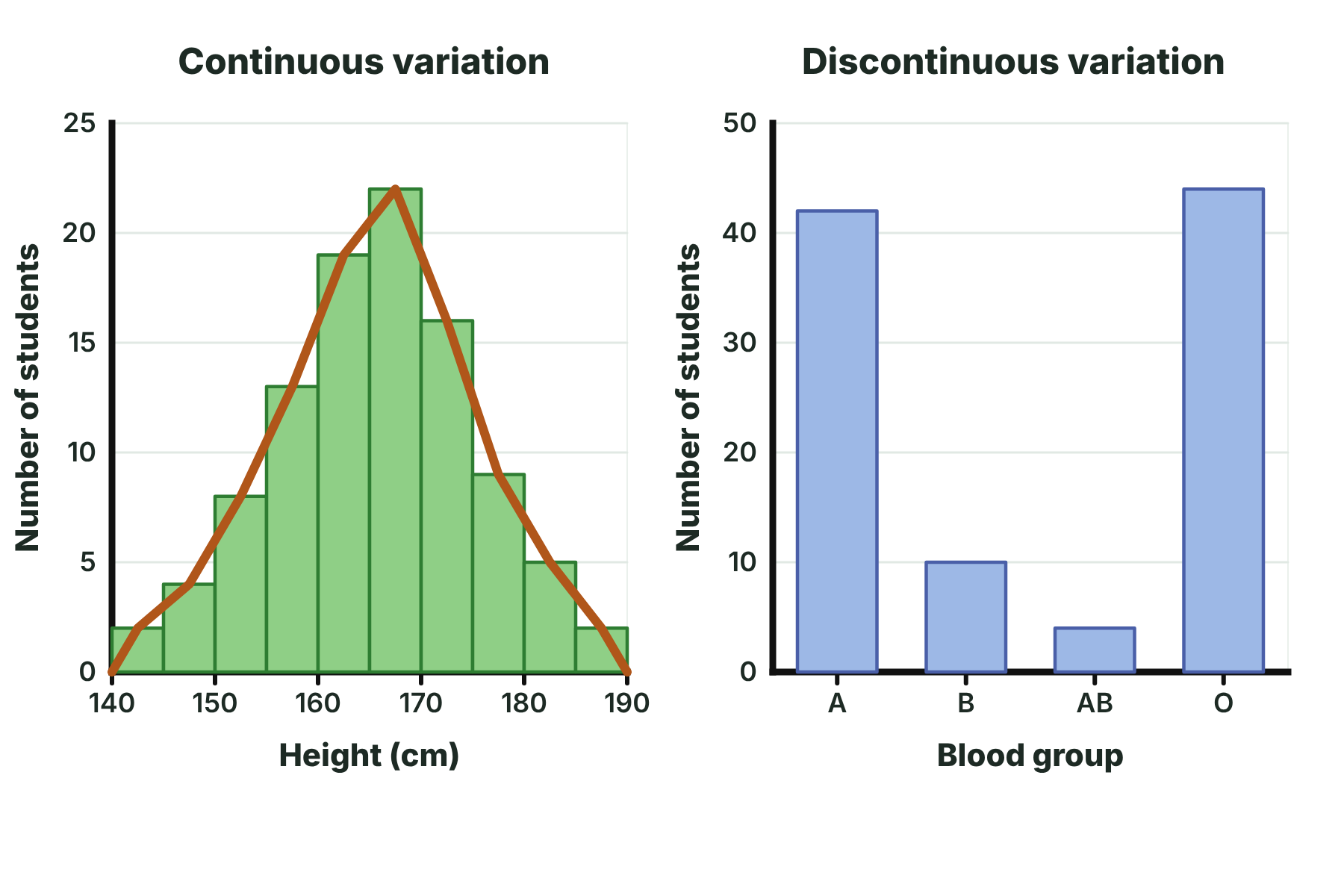
Continuous data fits a histogram. Discontinuous data fits a bar chart with gaps.
Continuous and discontinuous variation
Continuous variation
- Any value in a range, with no clear groups
- Examples: height and weight
- Many genes, and often the environment as well
- Drawn as a histogram or a line graph
Discontinuous variation
- Distinct categories, with no in-between values
- Examples: eye colour and blood group
- One or a few genes, with little effect of the environment
- Drawn as a bar chart
Genes, environment, or both
The cause of the variation in a feature can be described in three ways.
-
Genetic causes
Eye colour, blood group and natural hair colour are caused by the genes that a person inherits.
-
Environmental causes
Scars, a suntan, a person's accent and the language that they speak are caused by the environment and are not inherited.
-
Both
Many features, such as height, body mass and skin colour, are influenced by the genome and by the environment together.
-
Why it matters
The genome sets a range, and the environment decides where in the range an individual ends up. Only the genetic variation can be passed on.
Genes, environment, or both
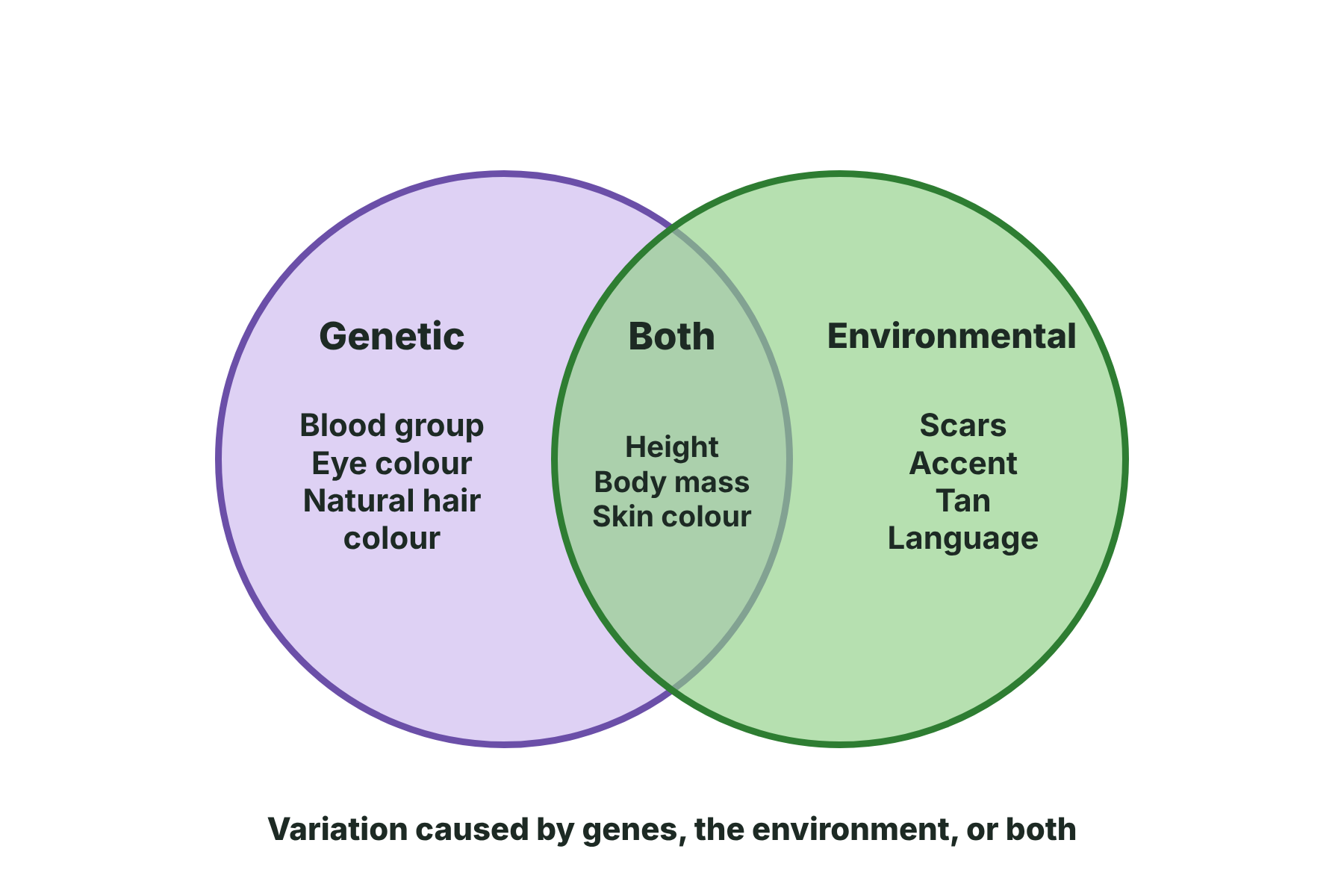
Many features, such as height, are caused by both genes and the environment.
Variants come from mutations
Every variant started as a mutation, a random change in the base sequence of DNA.
-
All variants arise from mutations
A new variant, or allele, can only be made by a mutation. Sexual reproduction mixes existing variants into new combinations, but it cannot make new ones.
-
Most have no effect
Most mutations have no effect on the phenotype. They may be in DNA that does not code for a protein, or may not change the protein that is made.
-
Some influence the phenotype
A smaller number of mutations change the protein or the amount of it, and so have a small effect on the phenotype.
-
A very few determine the phenotype
A very few mutations have a large effect, and decide the phenotype, such as the one that causes cystic fibrosis.
-
What causes mutations
They occur at random, and are more likely if cells are exposed to ionising radiation, ultraviolet light or some chemicals, which are called mutagens.
Effects of mutations
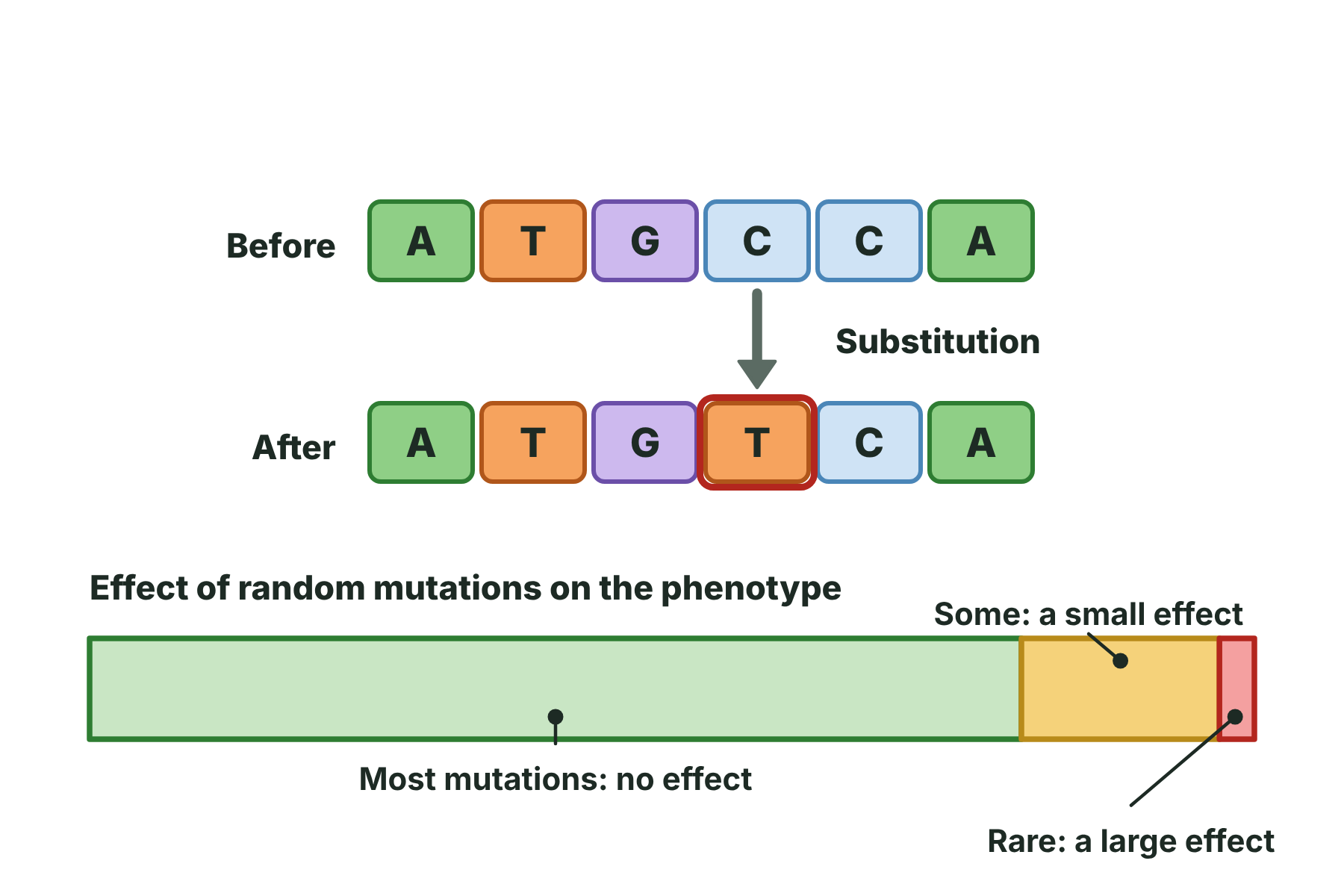
Most mutations make no difference to the organism.
Mean and mode of a sample
A student measured the length of ten leaves from the same tree: 5, 6, 6, 7, 7, 7, 8, 8, 9 and 9 cm. Calculate the mean, state the mode, and say whether this is continuous or discontinuous variation.
Show the solutionHide the solution
- 1 Add the lengths \(5 + 6 + 6 + 7 + 7 + 7 + 8 + 8 + 9 + 9 = 72\) cm.
- 2 Find the mean \(72 \div 10 = 7.2\) cm.
- 3 Find the mode The most common length is 7 cm.
- 4 Classify Leaf length can have any value in a range, so it is continuous variation.
AnswerThe mean is 7.2 cm, and the mode is 7 cm. The variation is continuous.
Investigating variation
A common investigation looks at one feature in a sample of one species.
-
Choose a feature
For example the length of leaves, or the arm span of students, which is continuous, or whether students can roll their tongues, which is discontinuous.
-
Sample
Use a random sample, of at least 30 individuals, so that the sample is not biased and the results are reliable.
-
Measure
Measure each in the same way, and record the results in a table.
-
Process
Group continuous data into classes, draw a histogram, and calculate the mean. Draw a bar chart for discontinuous data.
-
Conclude
Say which type of variation is shown, and what the likely causes are.
Case study
Identical twins
Identical twins have exactly the same genome, so any differences between them must be caused by their environment. Studies of twins who grew up in different families show which features are strongly controlled by genes, and which by the environment. Eye colour and blood group are almost always the same, but height and body mass can differ if the diet is different. They show that variation in many features is caused by a mixture of genes and the environment.
Summary and exam focus
- Discontinuous variation falls into distinct categories, such as eye colour.
- Continuous variation can take any value in a range, such as height and weight.
- Variation is caused by the genome, by the environment, or by both.
- All variants arise from mutations.
- Most mutations have no effect, some influence the phenotype, and a very few determine it.
Exam focus
Describe the difference between continuous and discontinuous variation, giving an example of each, and explain how mutations give rise to variation. (6 marks) (6 marks)
Define each type of variation, and give the OCR examples: eye colour for discontinuous, and height or weight for continuous. Then say that all variants arise from mutations, and that most have no effect, some influence the phenotype and a very few determine it.
Key terms
The words this lesson expects you to use. Each one is linked from the first place it appears above.
- Variation
- The differences between individuals of the same species.
- Discontinuous variation
- Variation in which individuals fall into distinct categories.
- Continuous variation
- Variation in which a feature can have any value within a range.
- Mutation
- A random change in the base sequence of DNA.
- Variant
- A different version of a gene, which arose from a mutation.
- Mutagen
- Something that increases the rate of mutation, such as ionising radiation.
- Histogram
- A bar chart for continuous data, in which the bars touch.
- Mode
- The value that occurs most often.
- Environment
- The surroundings and conditions in which an organism lives.
You've finished the notes
Check your understanding
Test yourself while it is fresh. Start with the flashcards, then try the exam questions.
Something here looks wrong?
Tell us what and we will go and look. It goes to whoever writes these pages, nobody else, and we do not ask who you are — so there is nothing to sign and nothing comes back to you.