Biology · Inheritance
Meiosis, Haploid and Diploid
Your body cells have 46 chromosomes, but your gametes have only 23. This lesson explains the terms haploid and diploid, and the role of meiotic cell division in halving the chromosome number to form gametes, which keeps the number steady and is a source of genetic variation.
Learning Objectives
- 1Explain the terms haploid and diploid.
- 2Explain the role of meiotic cell division in halving the chromosome number to form gametes.
- 3Explain how meiosis maintains diploid cells when gametes combine, and why it is a source of genetic variation.
- 4Compare meiosis with mitosis.
Retrieval practice
-
1
How many chromosomes are in a human body cell?
Show answerHide answer
46, in 23 pairs.
-
2
What type of cell division makes two identical cells?
Show answerHide answer
Mitosis.
-
3
What is a gamete?
Show answerHide answer
A sex cell, such as a sperm cell or an egg cell.
-
4
What is fertilisation?
Show answerHide answer
The fusion of a male gamete and a female gamete.
Cells for the next generation
Almost all of the cells in your body divide by mitosis, to give identical copies. The cells that make the next generation are different. Gametes are made in the reproductive organs, which are the ovaries and testes in humans, by a type of cell division called meiosis. A gamete carries half of the genetic information of its parent, so that when two gametes fuse, the new organism has a full set. Meiosis also shuffles the genes, so that every gamete is different, which is a major source of variation.
Haploid and diploid
Two terms describe the number of sets of chromosomes in a cell.
-
Diploid
A cell with two sets of chromosomes, which are in pairs, with one set from each parent. Human body cells are diploid, with 46 chromosomes.
-
Haploid
A cell with only one set of chromosomes. Human gametes are haploid, with 23 chromosomes.
-
Fertilisation
When a sperm and an egg fuse, the nuclei join, and the zygote is diploid again, with 46 chromosomes.
-
Why it matters
If gametes were diploid, the number of chromosomes would double in every generation. Halving the number in meiosis maintains the diploid number when gametes combine.
What happens in meiosis
You need to know the main events and the result, but not the names of the stages.
-
1
Start
A diploid cell in the ovary or the testis has pairs of chromosomes.
-
2
Copying
The DNA is copied, so each chromosome has two identical copies.
-
3
First division
The pairs of chromosomes separate, and the cell divides into two, so each new cell has one chromosome from each pair, and the number is halved.
-
4
Second division
The copies of each chromosome separate, and the cells divide again.
-
5
Result
Four haploid cells are formed, each with half the number of chromosomes, and all genetically different.
Meiosis: four different gametes from one cell
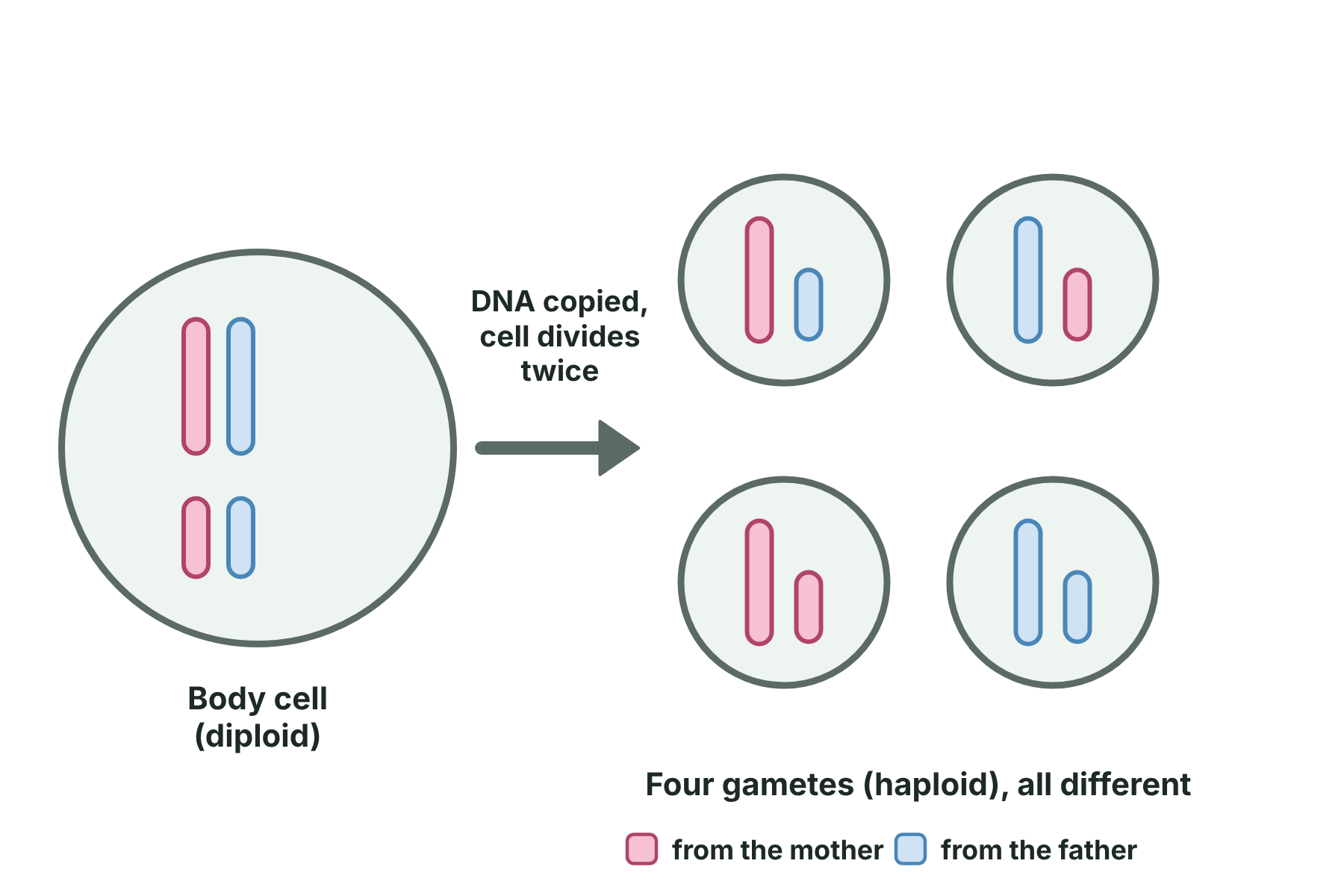
Meiosis makes four cells, each with half the chromosomes and a different mix of genes.
Meiosis and genetic variation
The four gametes from one cell are not the same as each other, or as the parent cell.
-
Random mixing
In the first division each pair of chromosomes separates independently, so each gamete gets a different mixture of the chromosomes that came from the person's mother and father.
-
Many combinations
With 23 pairs of chromosomes, one person can make over 8 million different gametes, since \(2^{23} = 8\,388\,608\).
-
Fertilisation
Which sperm fertilises which egg is also random, and this increases the variation in the offspring.
-
Source of variation
The genetic variation which meiosis and fertilisation produce is important for natural selection.
Mitosis and meiosis
Mitosis
- Makes two cells
- Each daughter cell is diploid
- Daughter cells are genetically identical
- Used for growth, repair and asexual reproduction
Meiosis
- Makes four cells
- Each daughter cell is haploid
- Daughter cells are genetically different
- Used to make gametes
Chromosome numbers
A dog body cell has 78 chromosomes. State the number of chromosomes in a sperm cell, and in the zygote.
Show the solutionHide the solution
- 1 Gametes are haploid They have half the number of chromosomes of a body cell.
- 2 Halve it \(78 \div 2 = 39\) chromosomes in a sperm cell.
- 3 Fertilisation \(39 + 39 = 78\) chromosomes in the zygote, which is diploid.
AnswerA sperm cell has 39 chromosomes, and the zygote has 78.
From gametes to a new organism
Meiosis is one step in the life cycle of an organism that reproduces sexually.
-
Gametes made
Meiosis makes haploid gametes in the reproductive organs.
-
Fertilisation
A male and a female gamete fuse, to make a diploid zygote.
-
Mitosis
The zygote divides by mitosis many times, to form an embryo.
-
Differentiation
The cells of the embryo become specialised, and the organism grows.
Case study
Why brothers and sisters are not identical
Two children of the same parents can be very different, even though they inherit their genes from the same two people. Each egg and each sperm is a different mixture of the parents' chromosomes, and any one of millions of sperm could fertilise any egg. The number of possible combinations for one couple is about 70 trillion. The exception is identical twins, who come from one fertilised egg that splits in two, and so share the same genome.
Summary and exam focus
- Diploid cells have two sets of chromosomes, and haploid cells have one set.
- Meiosis halves the chromosome number to form four genetically different haploid gametes.
- Fertilisation fuses two gametes, which maintains the diploid number.
- Meiosis and fertilisation are sources of genetic variation.
- Mitosis makes two identical diploid cells, for growth and repair.
Exam focus
Explain the role of meiosis in sexual reproduction, using the terms haploid and diploid. (6 marks) (6 marks)
Say that meiosis halves the chromosome number to make haploid gametes. Then say that fertilisation restores the diploid number, so that it stays the same from one generation to the next, and that meiosis is a source of genetic variation because the chromosomes are shared out at random.
Key terms
The words this lesson expects you to use. Each one is linked from the first place it appears above.
- Meiosis
- A type of cell division that produces four genetically different haploid gametes.
- Haploid
- Having one set of chromosomes, as in a gamete.
- Diploid
- Having two sets of chromosomes, as in a body cell.
- Gamete
- A sex cell, such as a sperm cell or an egg cell.
- Fertilisation
- The fusion of a male gamete and a female gamete.
- Zygote
- The cell formed when two gametes fuse. It is diploid.
- Embryo
- An early stage of development of an organism, formed from the zygote.
- Chromosome
- A long molecule of DNA that carries genes.
- Genetic variation
- Differences in the genes of individuals of the same species.
You've finished the notes
Check your understanding
Test yourself while it is fresh. Start with the flashcards, then try the exam questions.
Something here looks wrong?
Tell us what and we will go and look. It goes to whoever writes these pages, nobody else, and we do not ask who you are — so there is nothing to sign and nothing comes back to you.