Biology · Inheritance
Single Gene Inheritance and Punnett Squares
If you know the genotypes of two parents, you can predict what their offspring will be like. This lesson covers single gene inheritance, how to use Punnett squares to predict the results of single gene crosses with dominant and recessive alleles, and how to describe sex determination in humans using a genetic cross.
Learning Objectives
- 1Explain single gene inheritance in crosses involving homozygous and heterozygous parents, with dominant and recessive alleles.
- 2Predict the results of single gene crosses using Punnett squares.
- 3Describe sex determination in humans using a genetic cross.
- 4Recall that most phenotypic features are the result of multiple genes rather than single gene inheritance.
Retrieval practice
-
1
What is an allele?
Show answerHide answer
A different version of a gene, also called a variant.
-
2
What does heterozygous mean?
Show answerHide answer
Having two different alleles of a gene.
-
3
What is a gamete?
Show answerHide answer
A sex cell with half the number of chromosomes.
-
4
What is a genotype?
Show answerHide answer
The alleles that an organism has for a gene.
Predicting the offspring
A single gene cross looks at the inheritance of one gene. Each parent makes gametes, which carry one allele of the gene, and at fertilisation the gametes join at random. This means that we can work out the chances of each combination of alleles in the offspring, and so predict the proportions of the different phenotypes. A Punnett square is a grid that shows all of the possible combinations. The method is the same for any single gene with a dominant and a recessive allele, including the gene that decides the sex of a person.
How to draw a genetic cross
Follow the steps in order, and show each one in your answer.
-
1
Define the alleles
State the letters, for example T for tall (dominant) and t for dwarf (recessive).
-
2
Write the parents' genotypes
For example Tt and Tt.
-
3
Write the gametes
A Tt parent makes gametes with T, and gametes with t.
-
4
Draw the Punnett square
Put the gametes of one parent along the top, and of the other down the side, and fill each box with the two alleles.
-
5
Read off the results
Count the genotypes, say which phenotype each gives, and write the ratio or the probability.
A cross between two heterozygous plants
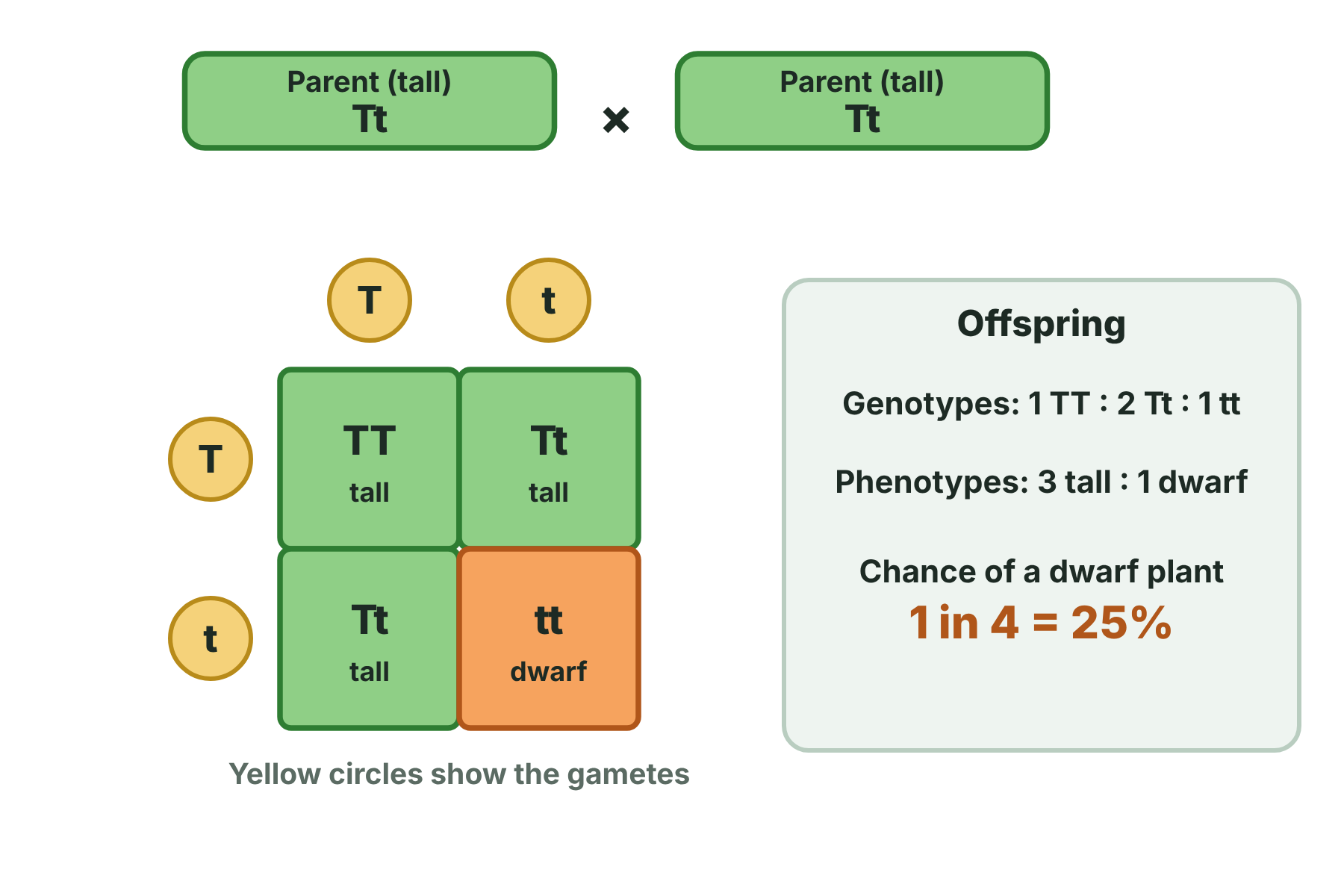
Crossing two heterozygous parents gives a 3 to 1 ratio of dominant to recessive phenotypes.
Homozygous and heterozygous crosses
The cross depends on whether the parents are homozygous or heterozygous.
-
Homozygous x homozygous (TT x tt)
All of the offspring are Tt, so all show the dominant phenotype.
-
Heterozygous x heterozygous (Tt x Tt)
The offspring are 1 TT : 2 Tt : 1 tt, and the phenotypes are 3 dominant : 1 recessive.
-
Heterozygous x homozygous recessive (Tt x tt)
The offspring are 1 Tt : 1 tt, so half show each phenotype.
-
Homozygous dominant x anything
At least one dominant allele is always passed on, so all of the offspring show the dominant phenotype.
Reading the result
The same cross can be given as a ratio, a probability or a number.
-
Genotype ratio
Count the boxes of each genotype, such as 1 TT : 2 Tt : 1 tt.
-
Phenotype ratio
Combine the genotypes which give the same phenotype, so TT and Tt give 3 tall : 1 dwarf.
-
Probability
The chance of a dwarf plant is 1 in 4, which is \(\frac{1}{4}\), 0.25 or 25%.
-
Expected numbers
In 200 offspring we would expect about 150 tall and 50 dwarf, but the real result may differ, as fertilisation is random.
Sex determination in humans
The sex of a person is also decided by a single pair of chromosomes, and it can be shown in a genetic cross.
-
Sex chromosomes
Of the 23 pairs of chromosomes, one pair are the sex chromosomes. Females have two X chromosomes, XX, and males have one X and one Y, XY.
-
Gametes
Every egg carries an X chromosome. Half of the sperm carry an X, and half carry a Y.
-
Fertilisation
If a sperm with an X fertilises the egg, the baby is XX, which is a girl. If a sperm with a Y fertilises the egg, the baby is XY, which is a boy.
-
The result
The ratio is 1 girl : 1 boy, so the probability of each is 50%.
How sex is inherited
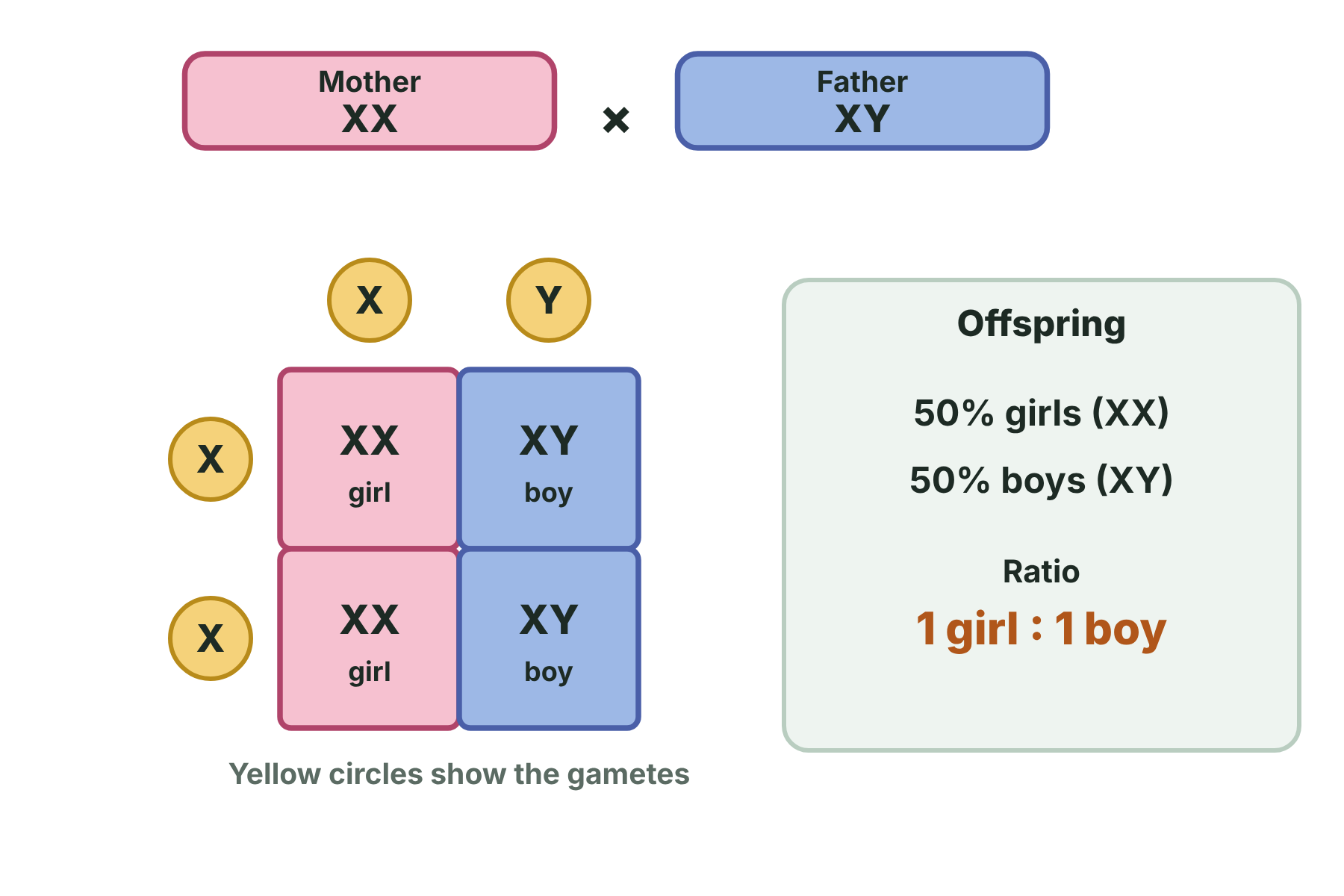
The sex of a child depends on whether the sperm that fertilises the egg carries an X or a Y.
When single gene inheritance is not enough
Genetic crosses with one gene are useful, but real life is more complicated.
-
Most features
Most phenotypic features are the result of multiple genes, rather than a single gene, so the offspring do not fall into simple ratios.
-
Environment
The environment also affects the phenotype, so the genotype does not always decide the phenotype.
-
Chance
The ratios are probabilities, so a small number of offspring may not match them.
-
Large numbers
With a large number of offspring, the results get closer to the predicted ratio.
A cross between two carriers
Cystic fibrosis is caused by a recessive allele, f. Two parents are both carriers, Ff. Draw a Punnett square, and work out the probability that their child has cystic fibrosis.
Show the solutionHide the solution
- 1 Parents Both are Ff.
- 2 Gametes Each makes F gametes and f gametes.
- 3 Punnett square The four boxes are FF, Ff, Ff and ff.
- 4 Which has the disorder Only ff has cystic fibrosis, which is 1 box out of 4.
- 5 Probability \(\frac{1}{4} = 25\%\).
AnswerThe probability is 1 in 4, or 25%.
Using a ratio to predict numbers
Two heterozygous black guinea pigs (Bb, with black dominant to white) have 48 offspring. How many white offspring would you expect?
Show the solutionHide the solution
- 1 Predict the ratio Bb x Bb gives 3 black : 1 white, so \(\frac{1}{4}\) are white.
- 2 Work out one quarter \(48 \div 4 = 12\).
- 3 Check 36 black and 12 white make 48.
AnswerAbout 12 white offspring.
Case study
A test cross
A gardener has a tall pea plant, but does not know if it is TT or Tt. To find out, the plant is crossed with a dwarf plant, tt. If the unknown plant is TT, all of the offspring will be tall. If it is Tt, about half of the offspring will be dwarf. The result of a cross can therefore be used to work out a genotype that cannot be seen from the phenotype.
Summary and exam focus
- A Punnett square predicts the results of single gene crosses.
- Two heterozygous parents give a 3 : 1 phenotype ratio, with a 1 in 4 chance of the recessive phenotype.
- Females are XX and males are XY, so the chance of a boy or a girl is 50%.
- The results are probabilities, so real numbers may differ.
- Most phenotypic features are the result of multiple genes.
Exam focus
Two parents are both heterozygous for a recessive disorder. Draw a genetic cross to predict the genotypes of their children, and state the probability that a child has the disorder. (4 marks) (4 marks)
State the alleles you are using, write the parents' genotypes and gametes, and draw a Punnett square with the four outcomes. Then read off the probability. For sex determination, use XX and XY in the same way.
Key terms
The words this lesson expects you to use. Each one is linked from the first place it appears above.
- Single gene cross
- A cross that looks at the inheritance of one gene.
- Punnett square
- A grid that shows the possible combinations of gametes in a cross.
- Genotype
- The alleles that an organism has for a gene.
- Phenotype
- The feature that an organism shows.
- Carrier
- A person who has a recessive allele but does not show the disorder.
- Probability
- The chance that an event will happen.
- Sex chromosomes
- The pair of chromosomes that decides the sex of a person: XX in a female and XY in a male.
- Ratio
- A comparison of numbers, such as 3 : 1.
- Test cross
- A cross with a homozygous recessive individual to find an unknown genotype.
You've finished the notes
Check your understanding
Test yourself while it is fresh. Start with the flashcards, then try the exam questions.
Something here looks wrong?
Tell us what and we will go and look. It goes to whoever writes these pages, nobody else, and we do not ask who you are — so there is nothing to sign and nothing comes back to you.