Biology · Transport in Cells
Viewing as
Teaching this? The teacher view opens every answer and mark scheme.
Active Transport
Diffusion and osmosis only move things down a gradient. Sometimes a cell has to move a substance the other way, and that costs energy. This lesson covers active transport, where it happens in plants and in the gut, and how to tell the three transport processes apart.
Learning Objectives
- 1Describe active transport and state what it needs.
- 2Explain why root hair cells and the cells of the gut use active transport.
- 3Explain why cells that carry out active transport contain many mitochondria.
- 4Describe how substances are transported into and out of cells by diffusion, osmosis and active transport, and explain the differences between them.
Retrieval practice
-
1
What is diffusion?
Show answerHide answer
The net movement of particles from a higher to a lower concentration.
-
2
What is osmosis?
Show answerHide answer
The diffusion of water from a dilute solution to a concentrated solution through a partially permeable membrane.
-
3
What does a mitochondrion do?
Show answerHide answer
It releases energy from respiration.
-
4
How is a root hair cell adapted?
Show answerHide answer
It has a long thin extension, which gives a large surface area.
Moving things the hard way
Diffusion and osmosis are like a ball rolling downhill: they happen on their own, and they only go in one direction. But sometimes a cell needs more of a substance than there is outside, so it has to pull it in from a place where the concentration is lower than it already is inside. That is like pushing a ball uphill, and it needs energy. This is active transport, and without it a plant could not feed and a human could not absorb all the sugar from their food.
What is active transport?
Active transport moves substances from a more dilute solution to a more concentrated solution, which is against a concentration gradient. This requires energy from respiration.
-
Against the gradient
The substance moves from where there is less of it to where there is more, the opposite of diffusion.
-
Needs energy
The cell has to use energy released by respiration. If respiration stops, active transport stops.
-
Carrier proteins
In the cell membrane there are carrier proteins that pick up a particular substance and move it across.
-
Many mitochondria
Cells that do a lot of active transport contain many mitochondria, which release the energy.
Active transport across a cell membrane
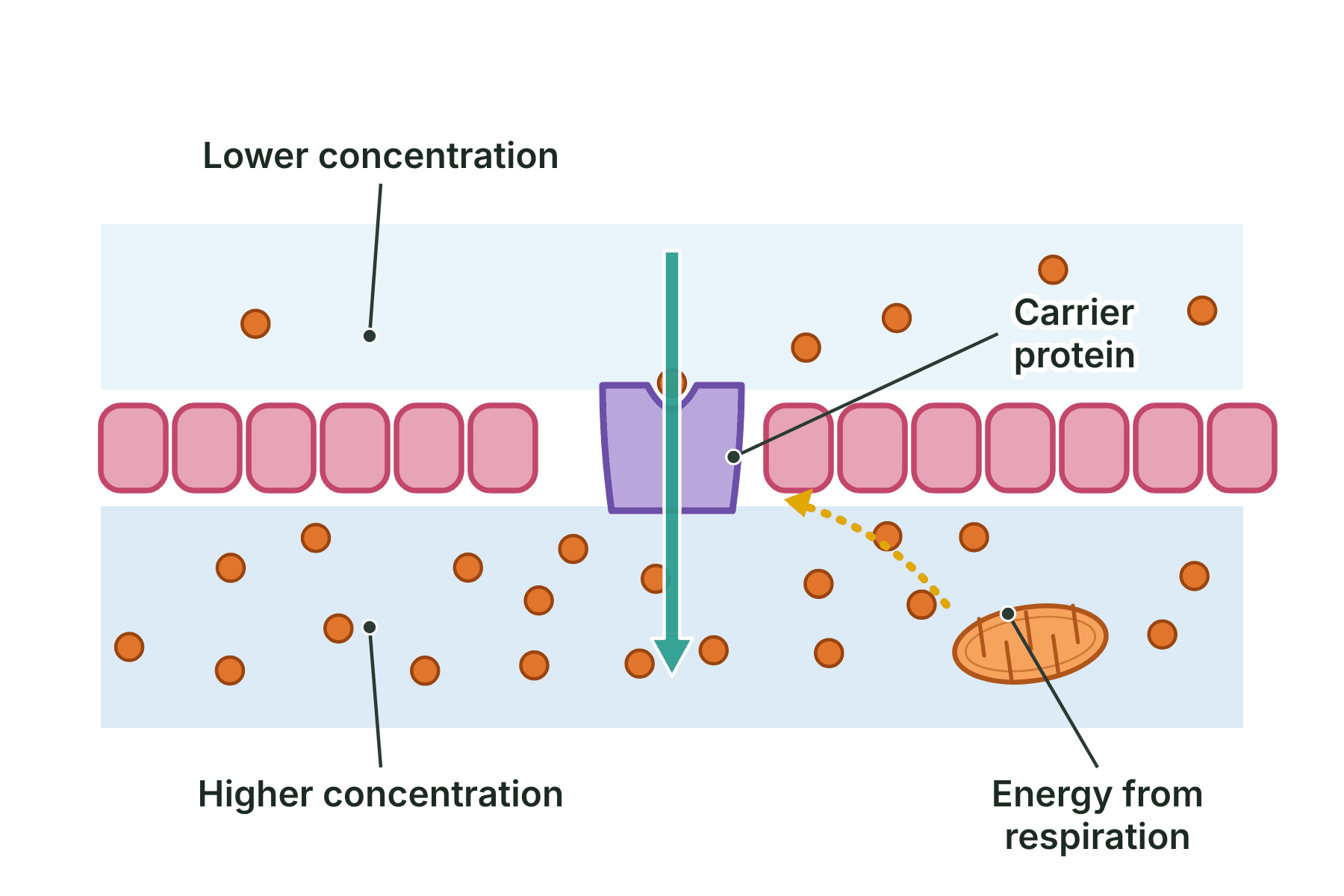
Active transport moves substances against the concentration gradient, using energy from respiration.
Active transport in plants
Plants need mineral ions for healthy growth. The soil solution is very dilute, and the cells of the root hairs hold the ions at a higher concentration.
-
The problem
The ions are at a lower concentration in the soil than in the root hair cell. Diffusion would move them out of the plant, not in.
-
The solution
Active transport takes mineral ions into the root hair cells from the very dilute soil solution, against the concentration gradient.
-
Why plants need them
Nitrate ions are used to make proteins, and magnesium ions are used to make chlorophyll, so a plant that cannot take them up grows poorly.
-
Adaptations
Root hair cells have a large surface area, and contain many mitochondria to release the energy for active transport.
Active transport in the gut
Active transport also allows sugar molecules to be absorbed from lower concentrations in the gut into the blood, which has a higher sugar concentration.
-
After a meal
The concentration of sugar in the gut is high, so some sugar can diffuse into the blood.
-
Later
The concentration in the gut falls below the concentration in the blood, so diffusion cannot take any more in.
-
Active transport
The cells lining the gut carry on moving sugar against the gradient, so nearly all of it is absorbed.
-
Why it matters
Sugar molecules are used for cell respiration, so the body cannot afford to lose them.
Two places where active transport happens
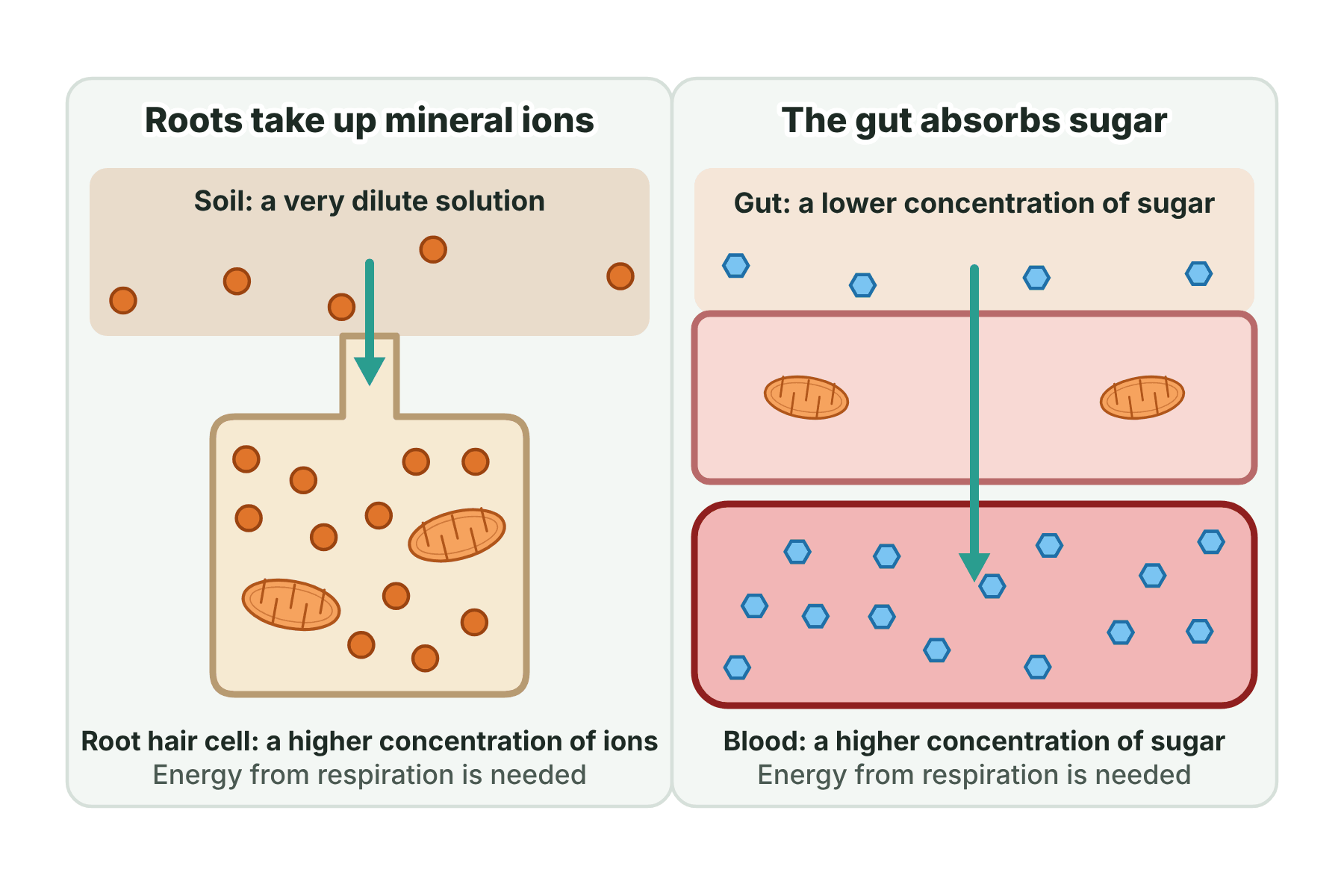
In both examples the substance moves from a lower concentration to a higher concentration.
Diffusion and active transport
Diffusion
- From a higher to a lower concentration
- Down the concentration gradient
- No energy needed from the cell
- Carries on until the concentrations are equal
Active transport
- From a lower to a higher concentration
- Against the concentration gradient
- Needs energy from respiration
- Can keep going until the substance is all absorbed
Diffusion, osmosis and active transport
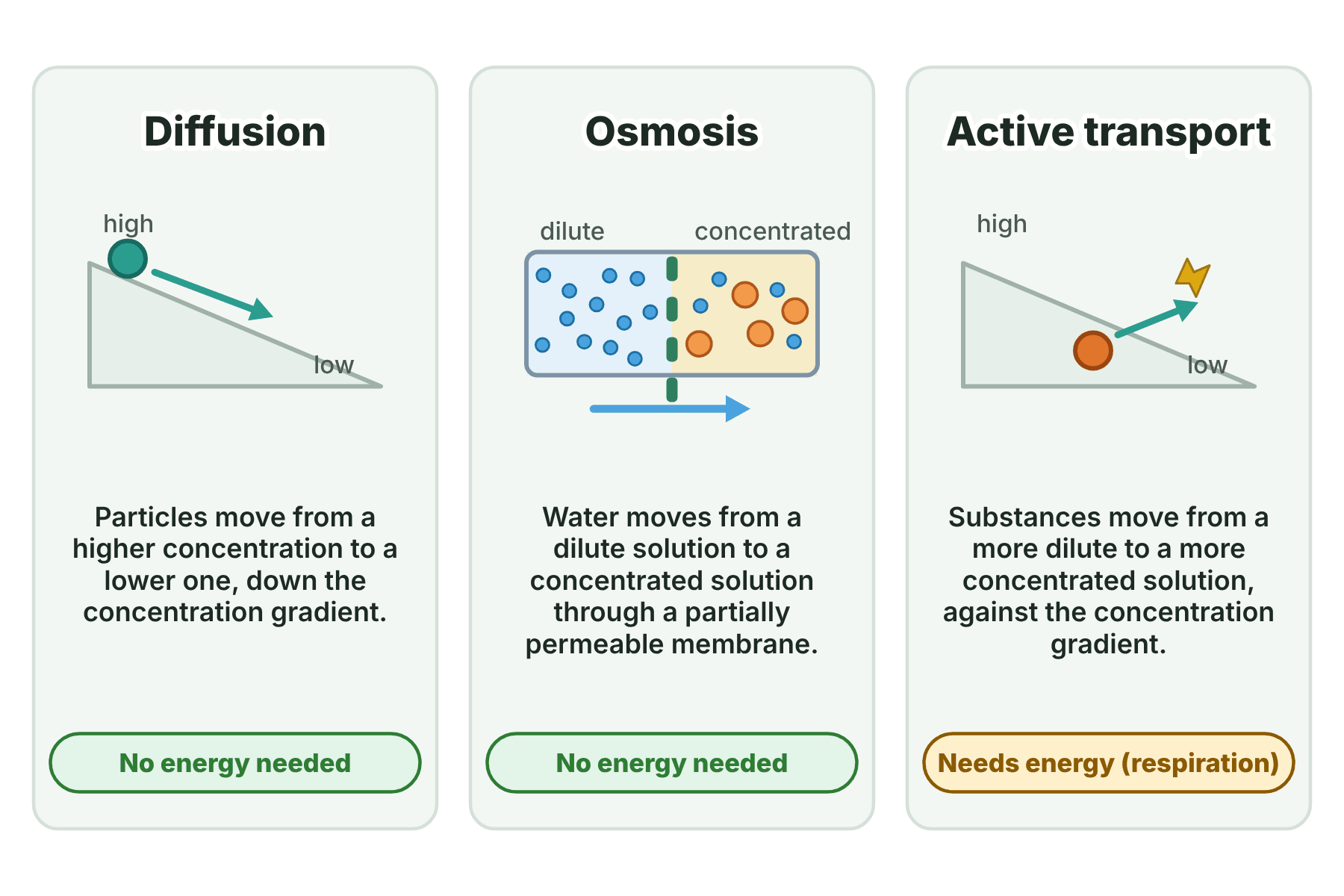
Diffusion and osmosis go downhill and need no energy. Active transport goes uphill and does.
Telling the three processes apart
In an exam question, ask three things about what is moving.
-
Is it water crossing a partially permeable membrane?
Then it is osmosis, and it goes from the dilute solution to the concentrated one.
-
Is the substance moving from low concentration to high, or does the question mention energy or respiration?
Then it is active transport.
-
Is it simply moving from high to low concentration, with no energy?
Then it is diffusion.
-
Check the clues
Words such as "against the concentration gradient", "very dilute solution" and "mitochondria" point to active transport.
Which process is it?
Nitrate ions are at a concentration of 0.01 mol/dm³ in the soil and 0.10 mol/dm³ inside a root hair cell. The cell takes up nitrate ions, and uptake stops when the cell is given a poison that stops respiration. Name the process, and explain how you know.
Show the solutionHide the solution
- 1 Compare the concentrations The ions are at a lower concentration outside (0.01) than inside (0.10).
- 2 Work out the direction They move from low concentration to high concentration, which is against the gradient. Diffusion could not do this.
- 3 Use the clue about respiration When respiration stops, uptake stops, so the process needs energy from respiration.
- 4 Name it The process is active transport.
AnswerActive transport, because the ions move against the concentration gradient and the process needs energy from respiration.
Case study
Why waterlogged soil harms plants
In waterlogged soil, the spaces between soil particles are full of water, and the roots cannot get enough oxygen. Without oxygen the root cells cannot release as much energy by respiration, so active transport slows down. The plant takes up fewer mineral ions, even though they are in the soil, and its growth suffers.
The definition to learn
Active transport moves substances from a more dilute solution to a more concentrated solution, and it needs energy from respiration.
Against a concentration gradient, using energy. That is what makes it "active".
Active transport
Active transport
-
Definition
- from dilute to concentrated
- against the gradient
-
Needs
- energy from respiration
- mitochondria
-
In plants
- mineral ions into root hair cells from dilute soil solution
-
In the gut
- sugar into the blood from lower concentration
-
Compare
- diffusion and osmosis go down the gradient and need no energy
Summary and exam focus
- Active transport moves substances from a more dilute solution to a more concentrated one, against a concentration gradient.
- It needs energy from respiration.
- Mineral ions are taken into root hair cells by active transport from the very dilute soil solution.
- Sugar is absorbed from the gut into the blood by active transport when the gut concentration is lower.
- Diffusion and osmosis need no energy, and go from high to low concentration (of particles, or of water).
Exam focus
Compare diffusion, osmosis and active transport. (6 marks) (6 marks)
Write about direction, what moves and energy for each of the three. A clear way is a sentence on each: diffusion is any particles from high to low with no energy, osmosis is water only through a partially permeable membrane, active transport is against the gradient with energy.
Key terms
The words this lesson expects you to use. Each one is linked from the first place it appears above.
- Active transport
- The movement of substances from a more dilute solution to a more concentrated solution, against a concentration gradient, using energy from respiration.
- Against the concentration gradient
- From a lower concentration to a higher concentration.
- Respiration
- The process in cells that releases energy from glucose.
- Mineral ions
- Dissolved substances, such as nitrate ions, that plants take up from the soil for healthy growth.
- Carrier protein
- A protein in the cell membrane that picks up a particular substance and moves it across.
- Root hair cell
- A root cell with a long thin extension, adapted to take up water and mineral ions from the soil.
- Mitochondria
- The sub-cellular structures where aerobic respiration releases energy.
- Absorption
- Taking a substance in, for example sugar moving from the gut into the blood.
- Passive
- Not needing energy from the cell. Diffusion and osmosis are passive.
You've finished the notes
Check your understanding
Test yourself while it is fresh. Start with the flashcards, then try the exam questions.
Something here looks wrong?
Tell us what and we will go and look. It goes to whoever writes these pages, nobody else, and we do not ask who you are — so there is nothing to sign and nothing comes back to you.