Viewing as
Teaching this? The teacher view adds 2 files, the mark schemes and the model answers.
Business · Enterprise and entrepreneurship
Risk and reward
Starting a business means risking business failure, financial loss and the security of a regular wage. Entrepreneurs take those risks for the rewards of success, profit and independence.
Last Lesson
Answer from memory before the answers appear.
-
Give the three reasons why new business ideas come about.
Changes in technology, changes in consumer wants, and products or services becoming obsolete.
-
What does obsolete mean?
Out of date and no longer wanted, because something better has replaced it.
-
Give the two ways new business ideas come about.
Original ideas, and adapting existing products, services or ideas.
-
Why is adapting an idea less risky than an original idea?
Customers already understand and want the product.
Learning Objectives
- 1Explain the risks of starting a business: business failure, financial loss and lack of security.
- 2Explain the rewards of starting a business: business success, profit and independence.
- 3Explain how risk and reward affect the decisions entrepreneurs make.
- 4Weigh up risk against reward in the context of a business.
What Is an Entrepreneur?
An entrepreneur is someone who sets up a business, taking a risk in the hope of a reward.
-
Spots an opportunity
Sees a gap in the market or a way to do something better.
-
Organises resources
Brings together the money, people, equipment and premises the business needs.
-
Makes decisions
Decides what to sell, at what price and to whom.
-
Takes risks
Puts their own time and money into an idea that might not work.
Day One
Every entrepreneur on their first day has taken a risk. They may have spent their savings, taken out a loan and given up a job with a regular wage. Whether that risk pays off - in success, profit and the freedom of being their own boss - is what the rest of this lesson is about.

Opening day: the savings are spent, and the risks and the rewards both begin.
Business Failure
The business may not survive.
-
What it is
The business closes because it cannot make enough money to cover its costs.
-
How common
Many new businesses close within their first few years; official UK figures show fewer than half are still trading after five years.
-
Why it happens
Not enough customers, strong competitors, costs higher than expected, poor planning, or running out of cash.
-
The impact
The entrepreneur loses the business they have built and the time and money they put into it.
Financial Loss
The entrepreneur could lose money - sometimes more than they put in.
-
Their own money
Most entrepreneurs use their savings to start the business. If it fails, those savings may be lost.
-
Borrowed money
Loans still have to be repaid, with interest, even if the business fails.
-
Personal belongings
For some types of business, such as a sole trader, the owner can be made to pay the business's debts from personal belongings, even their home.
-
Impact on decisions
The fear of losing money may stop people starting a business at all, or make them borrow less and start smaller.
Lack of Security
Working for yourself means giving up the security of employment.
-
No regular income
An employee is paid the same wage every month. An entrepreneur's income depends on how well the business does, and in the early months it may be nothing at all.
-
No paid holiday or sick pay
If an entrepreneur is ill or takes time off, the business may earn nothing.
-
Uncertainty
It is hard to plan ahead - for example to get a mortgage - without a predictable income.
-
Long hours
Many entrepreneurs work far longer hours than they did as employees, especially at the start.
The Risk Is Real
What keeps new owners awake
- Paying the bills Rent, stock and wages are due whether customers come or not.
- Repaying loans The bank must be paid back even if the business fails.
- No safety net No regular wage, no sick pay, no paid holiday.
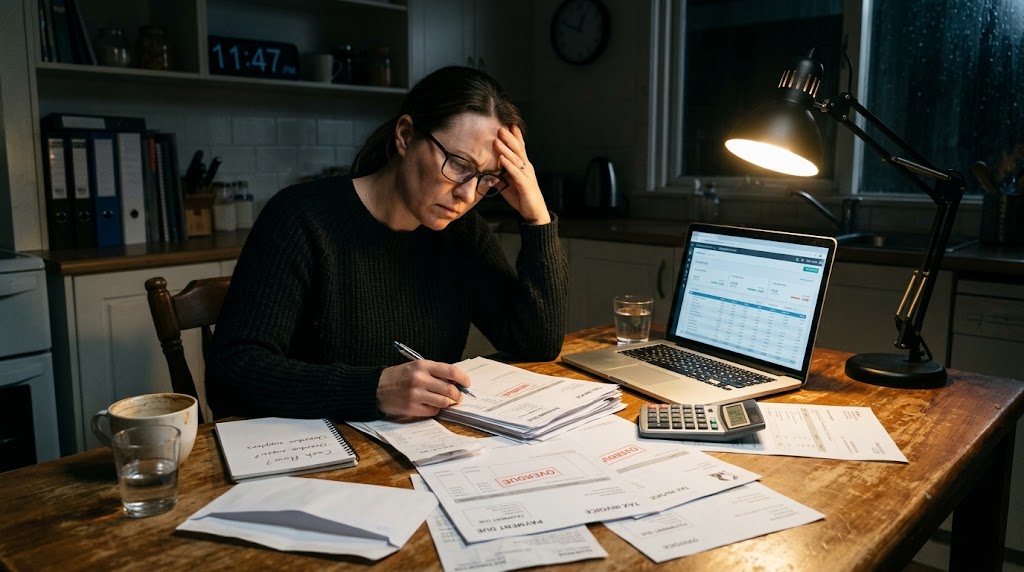
Financial loss and lack of security: the side of enterprise that rarely makes the news.
The Three Rewards
-
Business success
Achieving what they set out to do: a business that survives, grows and is respected. Many entrepreneurs value the satisfaction and recognition as much as the money.
-
Profit
The money left when all the costs have been taken away from revenue. The owner can keep it, or reinvest it to grow the business. It is the reward for taking the risk.
-
Independence
Being your own boss: choosing what to do, when to work and how the business is run, and doing something you enjoy.
Business Success
Success means different things to different entrepreneurs.
-
Survival
For a new business, simply lasting the first year or two is a success.
-
Growth
Opening more branches, taking on staff or selling to more customers.
-
Satisfaction
Pride in having built something from nothing, and in doing something the entrepreneur cares about.
-
Recognition
A good reputation, loyal customers and respect in the local community.
Profit
Profit = total revenue - total costs.
-
What it is
The money the business makes after all its costs have been paid.
-
Reward for risk
Profit is what an entrepreneur receives in return for risking their own money.
-
Choices
The owner can keep the profit as income, or reinvest it in the business to help it grow.
-
Potentially unlimited
An employee's pay is fixed; an entrepreneur whose business does well can earn far more.
Independence
Being your own boss.
-
Control
The entrepreneur makes the decisions and does not have to follow someone else's orders.
-
Flexibility
They can choose their own working hours and where they work.
-
Doing what they enjoy
Many people start a business to turn a hobby or passion into a job.
-
The trade-off
Independence also means responsibility: when things go wrong there is nobody else to blame.
Weighing Risk Against Reward
Risks
- Business failure: the business may close.
- Financial loss: savings and borrowed money may be lost.
- Lack of security: no regular income, sick pay or holiday pay.
- Can put people off starting a business at all.
Rewards
- Business success: the business survives and grows.
- Profit: money earned as a reward for taking the risk.
- Independence: being your own boss.
- Encourage people to start and grow businesses.
How Risky Is It?
Generally, the higher the risk, the higher the possible reward. Place each business idea on the line.
-
1
Dog walking from home
Almost no start-up costs; if it fails, little is lost
-
2
Selling on Etsy
Small stock costs, no premises
-
3
Opening a café
Rent, equipment and staff before a single sale
-
4
Inventing a new product
Years of costly development before any income
How Entrepreneurs Reduce Risk
Entrepreneurs cannot remove risk, but they can reduce it.
-
Market research
Checking that customers actually want the product before spending money on it.
-
A business plan
Thinking through costs, revenue and cash before starting.
-
Starting small
Beginning part-time, from home or online, while keeping a job.
-
Limiting borrowing
Using savings the owner can afford to lose rather than large loans.
Case study
James Dyson: Risk Before Reward
In the late 1970s James Dyson set out to build a vacuum cleaner that did not lose suction as its bag filled up. Over about five years he built 5,127 prototypes before he had a design that worked, and he fell deeply into debt doing it. Existing manufacturers were not interested in his idea, so in 1993 he launched the DC01 under his own name. The risk paid off: the business succeeded, made him one of the richest people in Britain, and let him run the company his own way.
Would You Take the Risk?
Amira earns £28,000 a year as a hairdresser in a salon. She is thinking of leaving to open her own salon, using £15,000 of savings and a £10,000 bank loan. Write a paragraph advising her whether to go ahead.
1. Identify two risks Amira faces, using the figures.
2. Identify two rewards she could gain.
3. Decide: should she go ahead? Give your main reason.
A good answer shows: At least one risk and one reward, each explained using Amira's situation (her savings, loan and wage), and a clear decision with a reason.
Can I...?
- 1Explain the three risks: business failure, financial loss and lack of security.
- 2Explain the three rewards: business success, profit and independence.
- 3Explain why higher risk often brings the chance of higher reward.
- 4Suggest ways an entrepreneur can reduce risk.
- 5Apply risk and reward to a named business or person.
Summary & Exam Focus
- The risks of starting a business are business failure, financial loss and lack of security.
- The rewards are business success, profit and independence.
- Entrepreneurs weigh up risk against reward before starting a business.
- The higher the risk, the higher the possible reward - and the bigger the possible loss.
Exam focus
Explain one risk an entrepreneur might face when starting a business. (3 marks) (3 marks)
Explain questions are worth 3 marks: 1 for identifying the risk, then 2 for a chain of reasoning - use "because" and "this means that" to link each step.
Key terms
The vocabulary this lesson expects you to use. Each one is linked from the first place it appears above.
- Entrepreneur
- Someone who sets up a business, organising resources and taking risks in the hope of a reward.
- Risk
- The chance that something will go wrong, such as the business failing or the owner losing money.
- Reward
- What an entrepreneur gains from running a business: success, profit and independence.
- Business failure
- When a business closes because it cannot cover its costs.
- Financial loss
- Losing money, for example savings invested in a business that fails.
- Lack of security
- Having no guaranteed income, sick pay or holiday pay, as an employee would.
- Profit
- Total revenue minus total costs.
- Independence
- Being your own boss and making your own decisions.
Downloads
Free to keep, print and annotate.
- Risk and reward.pptx Built from the lesson script on 24 September 2026. View
- Risk and reward - Completed Notes.docx The full notes for the lesson, to revise from. Built from the lesson script on 24 September 2026. View
- Risk and reward - Exam Questions.docx Built from the lesson script on 24 September 2026. View
Something here looks wrong?
Tell us what and we will go and look. It goes to whoever writes these pages, nobody else, and we do not ask who you are — so there is nothing to sign and nothing comes back to you.