Viewing as
Teacher view: planning notes, the answers to every question, and the teacher copies of the files.
Business · Making the business effective
Business location
Where a business locates can decide whether it succeeds. Owners weigh up how close they are to customers, workers, materials and competitors - and the internet means some businesses no longer need premises at all.
Teacher resources
The teacher copies: slides with the questions built in, the answers, and anything else attached to this lesson for whoever is teaching it.
- Business location - Teacher Slides.pptx Teacher The lesson slides with the teacher's notes on each slide, and every question and mark scheme built in. Built from the lesson script on 25 September 2026. View
- Business location - Teacher Notes.docx Teacher The complete notes with the teacher's notes and every model answer in full. Built from the lesson script on 25 September 2026. View
Student handouts
The same files the students see, to print or hand out.
- Business location.pptx Built from the lesson script on 25 September 2026. View
- Business location - Completed Notes.docx The full notes for the lesson, to revise from. Built from the lesson script on 25 September 2026. View
- Business location - Exam Questions.docx Built from the lesson script on 25 September 2026. View
Last Lesson
Answer from memory before the answers appear.
-
What is unlimited liability?
The owner is personally responsible for all the business's debts.
-
Which types of business have unlimited liability?
Sole traders and ordinary partnerships.
-
What is a franchisee?
The business that buys the right to trade under a franchisor's brand.
-
Give one disadvantage of franchising for the franchisee.
Fees, royalties, lack of independence, or damage from other franchisees.
Learning Objectives
- 1Explain the factors that influence where a business locates: proximity to the market, labour, materials and competitors.
- 2Explain how the importance of each factor depends on the type of business.
- 3Explain the impact of the internet and e-commerce on location decisions.
- 4Weigh up fixed premises against selling online.
Why Location Matters
The right location brings in customers and keeps costs down; the wrong one can sink a business.
-
Customers
A shop or café that customers cannot easily reach will struggle to make sales.
-
Costs
Rent, wages and delivery costs all depend on where the business is.
-
Hard to change
Moving is expensive and disruptive, so a new business needs to choose well the first time.
-
Different needs
A café, a factory and an online shop all need very different locations.
The Four Location Factors
-
Proximity to the market
Being close to customers. Vital for shops, cafés and services that customers visit.
-
Proximity to labour
Being close to enough workers with the right skills, at a wage the business can afford.
-
Proximity to materials
Being close to suppliers of raw materials, especially if they are heavy, bulky or perishable.
-
Proximity to competitors
Staying away from rivals to avoid competition - or locating near them where customers already go.
Proximity to the Market
How close the business is to its customers.
-
Footfall
The number of people walking past. High footfall on a busy high street brings in passing customers.
-
Services and shops
A hairdresser, café or corner shop must be where its customers live, work or travel.
-
The trade-off
Busy locations have the highest rents, so the extra sales must be worth the extra cost.
-
Delivery
Businesses that deliver to customers want to be close enough to keep delivery quick and cheap.
Where the Customers Are
For a café or a small shop, being where customers already walk past can matter more than anything else. But landlords know it too, so the busiest streets charge the highest rents.
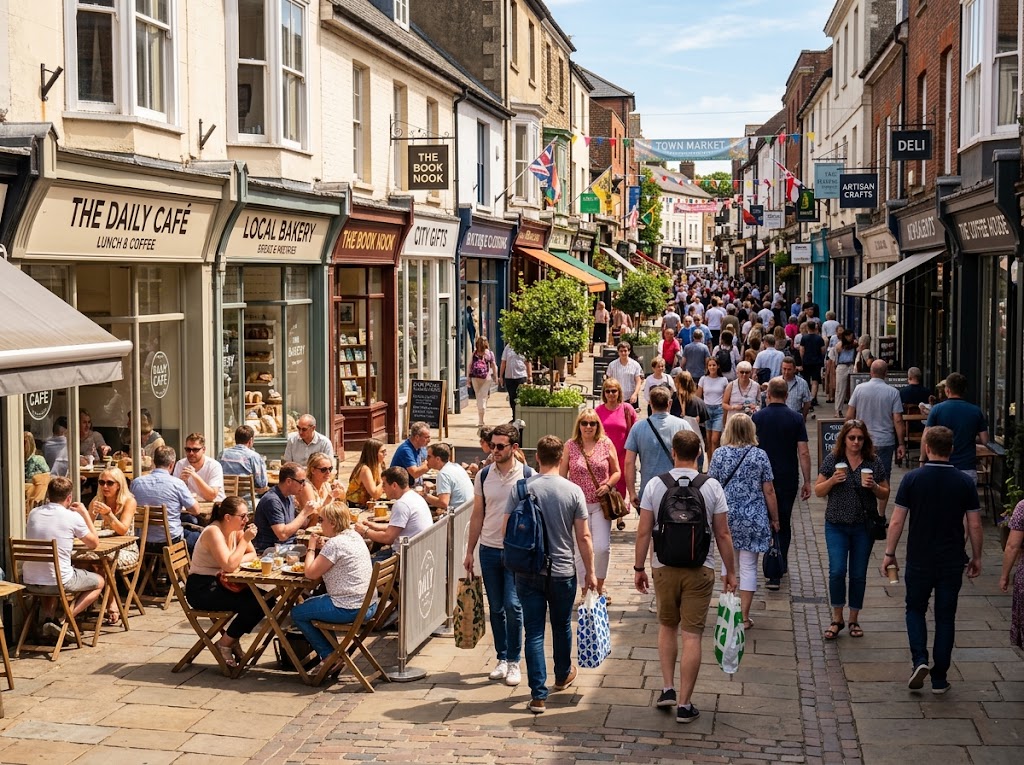
High footfall brings passing customers - and high rents.
Proximity to Labour
How close the business is to the workers it needs.
-
Skilled workers
A business needing specialist skills - software developers, chefs, engineers - must be where those people live.
-
Wage costs
Wages are usually higher in big cities, especially London, and lower in other areas.
-
Enough workers
A business that needs many staff must be somewhere with enough people looking for work.
-
Less important for some
A sole trader working alone barely needs to think about it.
Proximity to Materials
How close the business is to its suppliers.
-
Heavy or bulky materials
Transporting them is expensive, so it makes sense to be near the supplier.
-
Perishable materials
Fresh food must be used quickly, so food producers may locate near farms or markets.
-
Reliable supply
Being close to suppliers means deliveries arrive quickly and reliably.
-
Example
A sawmill locates near forests; a farm shop is on the farm.
Proximity to Competitors
Near rivals, or far away from them?
-
Away from competitors
A business may choose an area with no rivals, so it gets all the local customers.
-
Near competitors
Some businesses gain from being close together, because customers come to that area to compare and choose - restaurants on a food street, or shops in a shopping centre.
-
Research first
A market map and a look at the local area show where competitors already are.
-
Example
A second fish and chip shop on the same small street would struggle; a new restaurant on a busy restaurant street might thrive.
E-commerce and Location
E-commerce means buying and selling goods and services online.
-
No shop needed
A business selling online can run from home, a small unit or a cheap warehouse instead of an expensive high-street shop.
-
Lower costs
Without a shop, rent and staff costs are much lower, so prices can be lower too.
-
A bigger market
An online business can sell to customers anywhere in the country, or the world, not just those nearby.
-
Location still matters
An online business still needs to be near good roads and delivery services, and near the workers who pack and send the orders.
Fixed Premises or Online?
Two ways to reach customers: a shop they walk into, or a website that sends the goods to them.
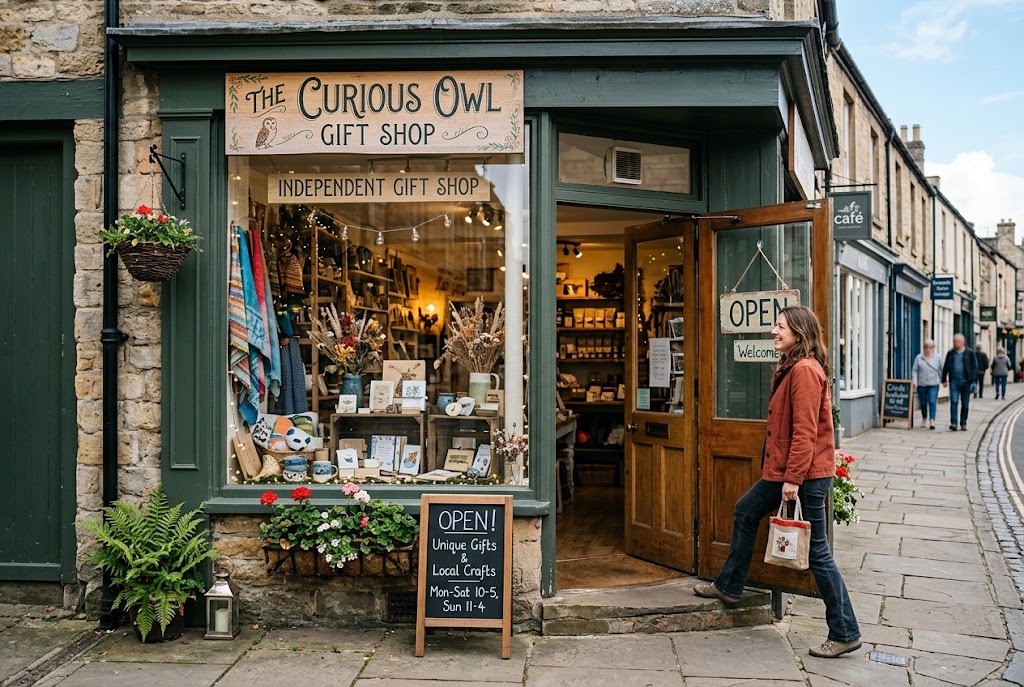
Fixed premises: customers come to the business.

E-commerce: the business goes to the customers.
Fixed Premises or E-commerce?
Fixed premises
- Customers can see, touch and try products before buying.
- Face-to-face service builds loyalty.
- Essential for services customers must visit, such as hairdressers and cafés.
- But: high rent and staff costs, and only reaches local customers.
- Limited opening hours.
E-commerce
- Much lower costs - no expensive shop.
- Can reach customers anywhere in the country or the world.
- Open 24 hours a day.
- But: customers cannot try products, and delivery costs and returns must be managed.
- Strong online competition and the need to be found on search engines and social media.
Case study
Gymshark: From a Garage to the World
Gymshark was started in 2012 by Ben Francis, then a 19-year-old student, and his friend Lewis Morgan. They made and sold gym clothing online from Ben's parents' garage near Birmingham. Because the business sold only through its website, it did not need a shop on a high street: location mattered far less than it would have for a traditional clothing shop, and customers anywhere could buy from it. By selling online, a business run from a garage could reach customers all over the world.
Choose the Location
For each business, rank the four location factors from most to least important and explain your top choice: a sandwich shop; a bakery making bread for local cafés; a small software company; an online shop selling handmade jewellery.
1. Rank the four factors for each business.
2. Explain why the top factor matters most.
3. Say whether it needs fixed premises at all.
A good answer shows: A ranking for each business, with the most important factor explained using the type of business - customers for the sandwich shop, labour for the software company, delivery links for the online shop.
Can I...?
- 1Explain proximity to the market.
- 2Explain proximity to labour.
- 3Explain proximity to materials.
- 4Explain proximity to competitors.
- 5Explain how e-commerce affects location decisions.
- 6Compare fixed premises with selling online.
Summary & Exam Focus
- Location factors: proximity to the market, labour, materials and competitors.
- Which factor matters most depends on the type of business.
- E-commerce lets businesses sell without expensive premises and reach customers anywhere.
- Services that customers must visit still need fixed premises in the right place.
Exam focus
Explain one reason why the internet has reduced the importance of location for some businesses. (3 marks) (3 marks)
Name the business type in your answer - e-commerce changes location for a shop selling goods, not for a hairdresser whose customers must visit.
Key terms
The vocabulary this lesson expects you to use. Each one is linked from the first place it appears above.
- Location
- Where a business is based.
- Proximity
- How close something is.
- Footfall
- The number of people who walk past or into a business.
- Labour
- The workers a business employs.
- E-commerce
- Buying and selling goods and services online.
- Fixed premises
- A physical building a business operates from, such as a shop, office or factory.
Questions and answers
9 questions set on this lesson, with the mark schemes and model answers open.
Define the term 'e-commerce'.
Mark scheme — 1 mark available
- Buying / selling online — 1 mark
Model answer
Buying and selling goods and services using the internet.
State one factor that might influence where a business locates.
Mark scheme — 1 mark available
- Any one of: proximity to the market / customers; labour; materials; competitors — 1 mark
Model answer
Proximity to the market.
Outline one reason why a café might choose to locate close to its market.
Mark scheme — 2 marks available
- A reason identified, e.g. footfall / convenience for customers / more sales — 1 mark
- Developed in the context of a café — 1 mark
Model answer
To attract passing customers (1), because a café relies on high footfall from people who are already nearby, such as shoppers and office workers (1).
Explain one reason why the internet has reduced the importance of location for some businesses.
Mark scheme — 3 marks available
- A reason identified, e.g. e-commerce / customers do not need to visit / can reach customers anywhere — 1 mark
- First linked point of explanation — 1 mark
- Second linked point of explanation — 1 mark
Model answer
Businesses can sell to customers through e-commerce (1). Customers order online, so they do not need to visit the business in person (1). This means the business can run from a cheaper location, such as a small unit or the owner's home, without losing sales (1).
Source: Priti makes and sells scented candles. She currently sells them from a small rented shop on a busy high street, where the rent has just risen by 30%. About half her sales now come through her website. She is thinking of closing the shop and selling only online from a unit on an industrial estate. Analyse the impact on Priti's business of moving from the high street to selling only online.
Mark scheme — 6 marks available
- AO2 (Application, 3 marks): uses the context - candles, the 30% rent rise, half of sales online, the industrial estate — Level 1-3
- AO3a (Analysis, 3 marks): chains of reasoning about the impact on costs, sales and profit — Level 1-3
Model answer
Moving online would cut Priti's costs. High-street rent is expensive and has just risen by 30%, while a unit on an industrial estate is much cheaper, so her fixed costs would fall and her profit on each candle could rise. Because half her sales already come from her website, she knows customers are willing to buy online, and she could reach customers across the country rather than only those who walk past. However, she would lose the footfall of the high street. Candles are a product customers like to smell before buying, so some shoppers who buy on impulse when passing would no longer buy from her. This means she could lose part of the half of her sales that come from the shop, unless she spends more on online promotion to replace them.
A sawmill is built next to a forest. Which location factor is most important to it?
Why: Wood is heavy and bulky, so being near the supply of materials keeps transport costs down.
What is footfall?
Why: Footfall is the number of people who walk past or into a business - vital for shops and cafés.
Which business most NEEDS fixed premises near its customers?
Why: Customers must visit a hairdresser in person, so it needs premises close to where they live or work.
Why might a new restaurant choose to open on a street full of other restaurants?
Why: Customers go to that street to choose somewhere to eat, so being there brings footfall from diners already in the area.