Viewing as
Teaching this? The teacher view adds 2 files, the mark schemes and the model answers.
Business · Making the business effective
Business options
A new business owner must choose how to own the business - as a sole trader, a partnership or a private limited company - and whether to start from scratch or buy a franchise. The biggest difference between them is liability.
Last Chapter
Answer from memory before the answers appear.
-
Name two financial aims of a business.
Any two of: survival, profit, sales, market share, financial security.
-
How do you calculate break-even output?
Fixed costs ÷ (sales price - variable cost per unit).
-
What is the difference between cash and profit?
Cash is money available now; profit is revenue minus costs over a period.
-
Name two long-term sources of finance.
Any two of: personal savings, loans, share capital, venture capital, retained profit, crowdfunding.
Learning Objectives
- 1Explain the difference between limited and unlimited liability, and what it means for an owner.
- 2Explain the features, advantages and disadvantages of sole traders, partnerships and private limited companies.
- 3Explain what a franchise is, and the roles of the franchisor and the franchisee.
- 4Explain the advantages and disadvantages of starting a business as a franchise.
Unlimited or Limited Liability?
Unlimited liability
- The owner is personally responsible for all the business's debts.
- If the business cannot pay, the owner's own possessions - savings, car, even their home - can be taken to pay them.
- There is no legal difference between the owner and the business.
- Applies to sole traders and ordinary partnerships.
Limited liability
- The owners can only lose the money they have invested in the business.
- Their personal possessions are safe if the business fails.
- The business is a separate legal body from its owners.
- Applies to private limited companies (Ltd).
Why Liability Matters to an Entrepreneur
Liability decides how much an owner stands to lose.
-
Risk
With unlimited liability, a failed business could cost the owner their home. Limited liability caps what they can lose.
-
Willingness to start
Limited liability encourages people to start a business, because the worst that can happen is losing what they put in.
-
Borrowing
Banks know a limited company's owners are protected, so they may ask the owners for a personal guarantee before lending to a small company.
-
Choice of ownership
A business with big debts or risky activities has a stronger reason to become a limited company.
Sole Trader
A business owned and run by one person. The sole trader can still employ staff.
-
Advantages
Quick, cheap and simple to set up. The owner keeps all the profit, makes all the decisions and keeps the accounts private.
-
Disadvantages
Unlimited liability. Hard to raise finance, because there is only one owner's money and credit to rely on.
-
Workload
The owner may work long hours, with nobody to share decisions, ideas or cover when they are ill or on holiday.
-
Examples
Plumbers, hairdressers, window cleaners, market traders and freelance designers.
Partnership
A business owned by two or more people who share the running of it and its profits.
-
Partnership agreement
A written agreement (a deed of partnership) sets out how much each partner invests, their roles, and how profit is shared.
-
Advantages
More money to invest, the workload is shared, and partners bring different skills and ideas.
-
Disadvantages
Unlimited liability, and each partner is responsible for the debts caused by the others' decisions. Profit must be shared, and partners can disagree.
-
Examples
Dentists, vets, accountants, solicitors and small family businesses.
One Owner, or Two?
Many small businesses are run by one person on their own, or by two or three partners.
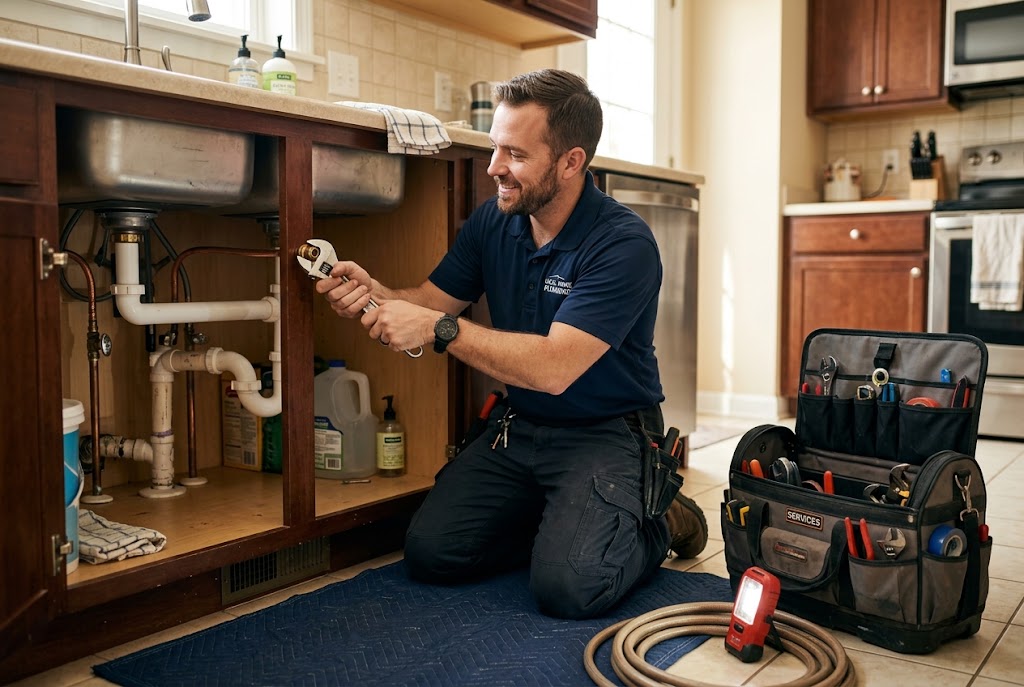
A sole trader: one owner, all the profit, all the risk.

A partnership: the work, the money and the profit shared.
Private Limited Company (Ltd)
A business owned by shareholders, with "Ltd" after its name.
-
Shareholders
The owners buy shares in the company. Shares can only be sold privately - often to family and friends - and not to the general public.
-
Limited liability
The owners can only lose the money they invested. The company is a separate legal body, so it can own property, sign contracts and be sued in its own name.
-
Advantages
Limited liability, easier to raise finance by selling shares, and the business continues even if an owner leaves or dies.
-
Disadvantages
It must be registered with Companies House, which costs time and money, and its accounts are published so anyone can see them. Profit is shared among the shareholders.
Comparing the Three Options
-
Owned by
Sole trader: One person. Partnership: Two or more partners. Private limited company: Shareholders
-
Liability
Sole trader: Unlimited. Partnership: Unlimited. Private limited company: Limited
-
Setting up
Sole trader: Quick and cheap. Partnership: Fairly simple, with an agreement. Private limited company: Registered with Companies House
-
Raising finance
Sole trader: Hardest. Partnership: Easier: more owners. Private limited company: Easiest: can sell shares privately
-
Profit
Sole trader: Kept by the owner. Partnership: Shared by the partners. Private limited company: Shared by the shareholders
-
Privacy
Sole trader: Accounts private. Partnership: Accounts private. Private limited company: Accounts published
What Is a Franchise?
A franchise is the right to run a business using another business's name, products and methods.
-
Franchisor
The business that owns the brand and sells the right to use it, such as a fast-food chain.
-
Franchisee
The person or business that buys the right to trade under the franchisor's name.
-
What the franchisee pays
An initial fee to join, and then royalties - usually a percentage of revenue - every month or year.
-
What the franchisee gets
The brand, the products, training, equipment, national advertising and ongoing support.
How a Franchise Works
A franchise is a deal between two businesses. The franchisor lets the franchisee trade under its name and gives it everything it needs to start. In return, the franchisee pays to join and then hands over a share of its revenue for as long as the agreement lasts.
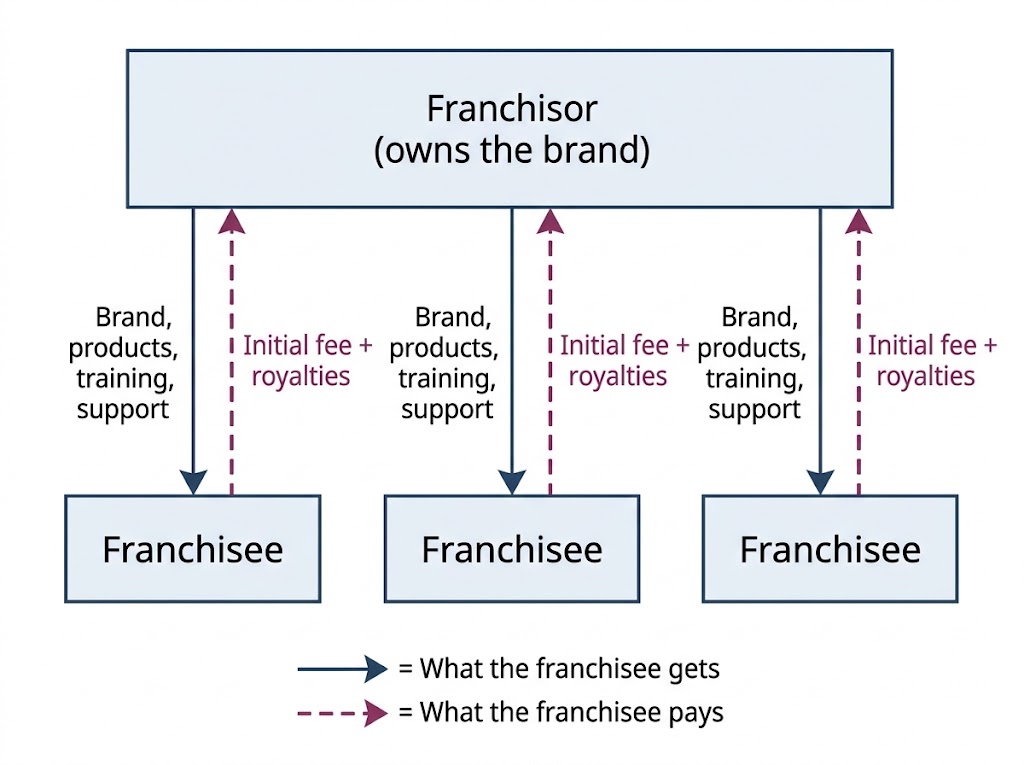
The franchisor supplies the brand and support; each franchisee pays a fee and royalties.
Franchising for the Franchisee
Advantages
- A proven business idea, so less risk of failure.
- A well-known brand that customers already trust.
- Training, equipment and support from the franchisor.
- National advertising paid for by the franchisor.
- Banks are more willing to lend to a known franchise.
Disadvantages
- An initial fee to buy the franchise, which can be expensive.
- Royalties to pay on revenue, even when profit is low.
- Little independence: must follow the franchisor's rules on products, prices and appearance.
- Its reputation can be damaged by other franchisees.
- The franchisor can end or refuse to renew the agreement.
Franchising for the Franchisor
Franchising also suits the business that owns the brand.
-
Fast growth
The franchisor can open many outlets quickly, using the franchisees' money rather than its own.
-
Steady income
It receives fees and royalties from every franchisee.
-
Motivated managers
Franchisees own their outlet, so they work hard to make it succeed.
-
Less control
A poorly run outlet can damage the whole brand's reputation.
Case study
Domino's: A Business Built on Franchises
Domino's Pizza has more than 1,200 stores across the UK and Ireland, and almost all of them are run by franchisees rather than by the company itself. Each franchisee pays to open a store and pays royalties on its sales. In return they get a brand customers know, recipes, training, supplies delivered from central kitchens, a national online ordering system and national TV advertising. The franchisees take on the day-to-day risk of running each store, while Domino's grows across the country without paying for every new shop itself.
Advise the Owner
Recommend a type of ownership for each person and explain why: Ali, who wants to start a one-person window-cleaning round with a £300 ladder and bucket; Beth and Kai, two vets opening a practice together; Sian, who needs £80,000 to open a soft-play centre and is worried about losing her house; and Tom, who has no business experience but wants to run a coffee shop.
1. Decide on a type of ownership.
2. Link it to the person's situation.
3. Mention liability where it matters.
A good answer shows: A sensible choice for each - sole trader, partnership, private limited company, franchise - with a reason linked to liability, finance, workload or experience.
Can I...?
- 1Explain unlimited liability.
- 2Explain limited liability.
- 3Explain why liability matters to an owner.
- 4Explain the features of a sole trader.
- 5Explain the features of a partnership.
- 6Explain the features of a private limited company.
- 7Explain what a franchise is.
- 8Explain the franchisor and franchisee roles.
- 9Give advantages and disadvantages of franchising.
Summary & Exam Focus
- Unlimited liability puts the owner's personal possessions at risk; limited liability does not.
- Sole traders and partnerships have unlimited liability; private limited companies have limited liability.
- Each type of ownership has advantages and disadvantages for control, profit, finance and risk.
- A franchisee pays a fee and royalties to use a franchisor's proven brand, in return for less independence.
Exam focus
Explain one benefit to an entrepreneur of setting up a private limited company rather than operating as a sole trader. (3 marks) (3 marks)
Liability answers must go all the way to the owner's personal possessions: "limited liability, so if the business fails her home cannot be taken to pay its debts".
Key terms
The vocabulary this lesson expects you to use. Each one is linked from the first place it appears above.
- Unlimited liability
- When the owner is personally responsible for all the business's debts.
- Limited liability
- When the owners can only lose the money they have invested in the business.
- Sole trader
- A business owned by one person, with unlimited liability.
- Partnership
- A business owned by two or more partners, usually with unlimited liability.
- Private limited company (Ltd)
- A business owned by shareholders, whose shares are not sold to the public, with limited liability.
- Franchise
- The right to run a business using another business's brand, products and methods.
- Franchisor
- The business that sells the right to use its brand.
- Franchisee
- The business that buys the right to trade under the franchisor's brand.
- Royalty
- A regular payment from franchisee to franchisor, usually a percentage of revenue.
Downloads
Free to keep, print and annotate.
- Business options.pptx Built from the lesson script on 25 September 2026. View
- Business options - Completed Notes.docx The full notes for the lesson, to revise from. Built from the lesson script on 25 September 2026. View
- Business options - Exam Questions.docx Built from the lesson script on 25 September 2026. View
Something here looks wrong?
Tell us what and we will go and look. It goes to whoever writes these pages, nobody else, and we do not ask who you are — so there is nothing to sign and nothing comes back to you.