Exam questions · Biology
Defence Against Disease
- 28 exam questions
- 75 marks
- 32 quick checks
Human Defence Systems
Just this lesson-
1 State [1 mark]
Name the acid made in the stomach that kills pathogens.
Show answerHide answer
Model answer
Hydrochloric acid.
Mark scheme
- Hydrochloric acid — 1 mark
-
2 Name [3 marks]
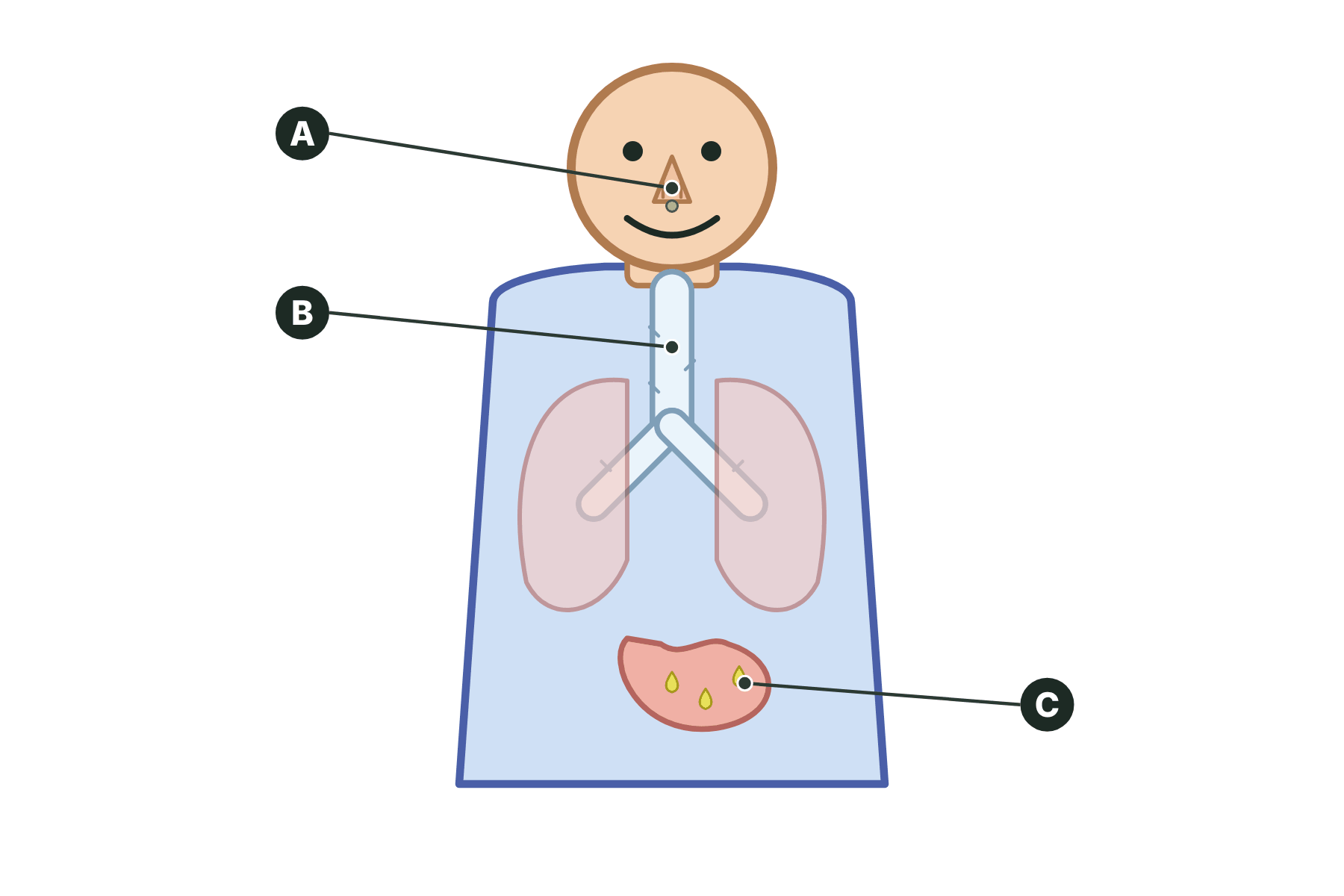
Figure 1 shows the body's defences. Name the parts labelled A, B and C.
Show answerHide answer
Model answer
A is the nose. B is the trachea. C is the stomach.
Mark scheme
- A: nose — 1 mark
- B: trachea — 1 mark
- C: stomach — 1 mark
-
3 Describe [2 marks]
Describe how the nose helps to defend the body against pathogens.
Show answerHide answer
Model answer
Hairs and mucus in the nose trap pathogens (and dust) in the air as it is breathed in, so they cannot reach the lungs.
Mark scheme
- Hairs / mucus — 1 mark
- Trap pathogens — 1 mark
-
4 Explain [3 marks]
Explain how the trachea and bronchi protect the lungs from pathogens.
Show answerHide answer
Model answer
The cells lining the airways make mucus, which traps pathogens. Cilia on the surface move the mucus up the airways to the throat. The mucus is then swallowed, and the acid in the stomach kills the pathogens.
Mark scheme
- Mucus traps pathogens — 1 mark
- Cilia move the mucus — 1 mark
- Swallowed and killed by acid — 1 mark
-
5 Describe [3 marks]
Describe three ways that white blood cells help to defend the body against pathogens.
Show answerHide answer
Model answer
Phagocytes engulf and digest pathogens. Lymphocytes produce antibodies that stick to the antigens on pathogens. White blood cells also produce antitoxins, which neutralise toxins.
Mark scheme
- Phagocytosis — 1 mark
- Antibody production — 1 mark
- Antitoxin production — 1 mark
-
6 Explain [2 marks]
Explain why an antibody that kills one type of bacterium does not kill another type.
Show answerHide answer
Model answer
Antibodies are specific. The shape of an antibody fits only the antigen on one type of pathogen, so it cannot stick to a different one.
Mark scheme
- Antibodies are specific to one antigen — 1 mark
- Shape does not fit a different pathogen's antigen — 1 mark
-
7 Describe [6 marks]
Describe how the human body defends itself against pathogens.
Show answerHide answer
Model answer
The skin is a barrier that most pathogens cannot get through, and platelets seal cuts with a scab. The nose traps pathogens in hairs and mucus. The trachea and bronchi make mucus that traps pathogens, and cilia move it to the throat to be swallowed. The stomach makes hydrochloric acid, which kills the pathogens. If pathogens do get in, white blood cells destroy them. Phagocytes engulf and digest them. Lymphocytes produce antibodies that stick to the antigens on the pathogen. Other white blood cells produce antitoxins to neutralise the toxins.
Mark scheme
- Skin barrier and scab — 1 mark
- Nose hairs / mucus — 1 mark
- Trachea and bronchi: mucus and cilia — 1 mark
- Stomach acid kills pathogens — 1 mark
- Phagocytosis — 1 mark
- Antibodies and antitoxins — 1 mark
Quick check
-
1
Which part of the body makes hydrochloric acid to kill pathogens?
Show answerHide answer
C: The stomach
The stomach makes hydrochloric acid, which kills pathogens that are swallowed.
-
2
What do cilia in the airways do?
Show answerHide answer
A: Move mucus upwards
Cilia move mucus, with trapped pathogens, up the airways.
-
3
What is phagocytosis?
Show answerHide answer
B: Engulfing and digesting a pathogen
In phagocytosis a white blood cell engulfs and digests a pathogen.
-
4
What are antibodies?
Show answerHide answer
D: Proteins that stick to specific antigens
Antibodies are proteins made by lymphocytes that stick to the antigens of a pathogen.
-
5
Which cells make antibodies?
Show answerHide answer
C: Lymphocytes
Lymphocytes, a type of white blood cell, produce antibodies.
-
6
What do antitoxins do?
Show answerHide answer
A: Neutralise toxins
Antitoxins neutralise the toxins released by bacteria.
-
7
Why is an antibody specific?
Show answerHide answer
B: Its shape fits one type of antigen
Its shape fits the antigen of only one type of pathogen.
-
8
What forms at a cut to seal the wound?
Show answerHide answer
D: A scab
Platelets help the blood clot, and the clot dries to form a scab.
Vaccination
Just this lesson-
1 State [1 mark]
State what a vaccine contains.
Show answerHide answer
Model answer
Small quantities of dead or inactive forms of a pathogen.
Mark scheme
- Dead or inactive pathogens — 1 mark
-
2 Explain [3 marks]
Explain how a vaccination against measles prevents a child from catching measles.
Show answerHide answer
Model answer
The vaccine contains a dead or inactive form of the virus. This stimulates the white blood cells to produce antibodies. If the real virus enters the body later, the white blood cells quickly produce the correct antibodies, so the virus is destroyed before it makes the child ill.
Mark scheme
- Dead or inactive virus stimulates antibody production — 1 mark
- Quick response on re-infection — 1 mark
- Virus destroyed before illness — 1 mark
-
3 Explain [2 marks]
Explain why vaccinating most of the population protects people who have not been vaccinated.
Show answerHide answer
Model answer
The pathogen cannot spread easily, because most of the people it meets are immune. This means unvaccinated people are less likely to come into contact with it.
Mark scheme
- Most people immune so the pathogen cannot spread — 1 mark
- Fewer chances for unvaccinated people to be infected — 1 mark
-
4 Explain [2 marks]
Explain why a person who has been vaccinated against a disease does not become ill if they are later infected by the same pathogen.
Show answerHide answer
Model answer
Memory cells respond quickly and make the correct antibodies. The pathogen is destroyed before it can cause the disease.
Mark scheme
- Fast production of the correct antibodies — 1 mark
- Pathogen destroyed before illness — 1 mark
-
5 Suggest [3 marks]
The percentage of children vaccinated against measles in one town fell from 95% to 80%. Suggest what might happen to the number of measles cases and explain why.
Show answerHide answer
Model answer
The number of measles cases is likely to rise. With fewer children immune, the virus can spread more easily from person to person. There is no longer enough herd immunity to protect those who are not vaccinated.
Mark scheme
- Cases are likely to increase — 1 mark
- Fewer immune people so easier spread — 1 mark
- Loss of herd immunity — 1 mark
-
6 Evaluate [4 marks]
Evaluate the use of vaccination to control the spread of disease around the world.
Show answerHide answer
Model answer
Vaccination has saved millions of lives and has wiped out smallpox. It is cheaper than treating a disease, and it protects people who cannot be vaccinated. However, some viruses, such as flu, change, so new vaccines are needed. A small number of people have a reaction to a vaccine, and fear of this can reduce the number vaccinated. Overall the benefits outweigh the risks.
Mark scheme
- Saves lives / eradication — 1 mark
- Cheaper than treatment — 1 mark
- Some pathogens change / limits — 1 mark
- A reasoned conclusion — 1 mark
-
7 Describe [4 marks]
Describe how a vaccine causes the immune system to be ready for a later infection.
Show answerHide answer
Model answer
The vaccine contains a dead or inactive form of the pathogen, with its antigens. The white blood cells recognise the antigens and make antibodies. Some of them remain as memory cells. When the real pathogen enters later, the correct antibodies are made very quickly.
Mark scheme
- Dead or inactive pathogen with antigens — 1 mark
- Antibodies are made — 1 mark
- Memory cells remain — 1 mark
- Fast response to the real pathogen — 1 mark
Quick check
-
1
What does a vaccine contain?
Show answerHide answer
B: Dead or inactive pathogens
A vaccine contains dead or inactive pathogens, so it cannot cause the disease.
-
2
What does a vaccine stimulate the white blood cells to do?
Show answerHide answer
C: Produce antibodies
Vaccines stimulate the production of antibodies.
-
3
Why is a second infection dealt with more quickly after vaccination?
Show answerHide answer
A: Memory cells respond quickly
Memory cells quickly make the correct antibodies.
-
4
What is herd immunity?
Show answerHide answer
D: Protection of a population when most are immune
When most people are immune, the disease cannot spread, and the unvaccinated are protected.
-
5
Which disease has been eradicated by vaccination?
Show answerHide answer
B: Smallpox
Smallpox has been wiped out by a world-wide vaccination programme.
-
6
What happens to the spread of a disease if fewer people are vaccinated?
Show answerHide answer
A: It increases
There are more people who can catch and pass on the disease, so it spreads more.
-
7
Why can flu vaccines need updating?
Show answerHide answer
C: The virus changes
The antigens on flu viruses change, so old vaccines no longer work.
-
8
Why are babies who cannot be vaccinated still protected when most other people are vaccinated?
Show answerHide answer
D: The pathogen is unlikely to reach them
The pathogen cannot spread easily when most people are immune, so the babies are unlikely to meet it.
Antibiotics and Painkillers
Just this lesson-
1 State [1 mark]
Name an antibiotic.
Show answerHide answer
Model answer
Penicillin (accept any named antibiotic).
Mark scheme
- Penicillin — 1 mark
-
2 Explain [2 marks]
Explain why antibiotics cannot be used to treat a cold.
Show answerHide answer
Model answer
A cold is caused by a virus, and antibiotics do not kill viruses. Viruses live inside body cells, so an antibiotic cannot reach them without harming the cells.
Mark scheme
- Cold caused by a virus — 1 mark
- Antibiotics only kill bacteria — 1 mark
-
3 Describe [2 marks]
Describe the difference between how an antibiotic and a painkiller treat a bacterial infection.
Show answerHide answer
Model answer
An antibiotic kills the bacteria in the body, so it cures the disease. A painkiller only reduces the symptoms, such as pain, and does not kill the bacteria.
Mark scheme
- Antibiotic kills bacteria — 1 mark
- Painkiller treats symptoms only — 1 mark
-
4 Explain [4 marks]
Explain how a strain of bacteria can become resistant to an antibiotic.
Show answerHide answer
Model answer
By chance, a mutation produces a bacterium that is resistant to the antibiotic. When the antibiotic is used, it kills the non-resistant bacteria but not the resistant one. The resistant bacterium survives and reproduces, passing on its resistance. The population soon contains mainly resistant bacteria.
Mark scheme
- A mutation gives resistance — 1 mark
- Non-resistant bacteria killed — 1 mark
- Resistant bacteria survive and reproduce — 1 mark
- A resistant population — 1 mark
-
5 Suggest [3 marks]
Suggest three ways in which the development of antibiotic-resistant bacteria could be slowed down.
Show answerHide answer
Model answer
Doctors should not prescribe antibiotics for viral infections or minor illnesses. Patients should finish the whole course of antibiotics. Good hygiene should be used in hospitals to stop resistant strains spreading.
Mark scheme
- Do not overuse / only when needed — 1 mark
- Complete the course — 1 mark
- Hygiene to stop spread — 1 mark
-
6 Explain [3 marks]
Explain why it is difficult to develop drugs that kill viruses.
Show answerHide answer
Model answer
Viruses live and reproduce inside the body's own cells. A drug that kills the virus has to get into the cell. It is difficult to do this without also damaging the body's tissues.
Mark scheme
- Viruses live inside cells — 1 mark
- Drug must reach the virus — 1 mark
- Risk of damaging the body's tissues — 1 mark
-
7 Explain [4 marks]
A patient with a sore throat asks their doctor for antibiotics. The doctor says the infection is caused by a virus. Explain why the doctor does not prescribe antibiotics and what the doctor may suggest instead.
Show answerHide answer
Model answer
Antibiotics do not kill viruses, so they would not cure the infection. Taking them would give bacteria in the body a chance to develop resistance. The doctor may suggest rest and painkillers to reduce the symptoms while the immune system fights the virus.
Mark scheme
- Antibiotics do not kill viruses — 1 mark
- Risk of resistance — 1 mark
- Painkillers treat the symptoms — 1 mark
- The immune system deals with the virus — 1 mark
Quick check
-
1
Which medicine kills bacteria inside the body?
Show answerHide answer
C: Penicillin
Antibiotics kill bacteria. Painkillers only reduce symptoms.
-
2
Do antibiotics work against viruses?
Show answerHide answer
B: No
Antibiotics only work against bacteria, not against viruses.
-
3
What do painkillers do?
Show answerHide answer
A: Treat symptoms
They reduce symptoms such as pain but do not kill pathogens.
-
4
What does resistance to an antibiotic mean?
Show answerHide answer
D: The bacteria are not killed by it
Resistant bacteria are not killed by the antibiotic.
-
5
What happens when antibiotics kill most of the bacteria in a population?
Show answerHide answer
B: The resistant ones survive and reproduce
Any resistant bacteria survive and reproduce, so the population becomes resistant.
-
6
Which action helps to reduce antibiotic resistance?
Show answerHide answer
C: Finishing the course
Finishing the whole course makes sure all the bacteria are killed.
-
7
Why do antibiotics not work against viruses?
Show answerHide answer
A: Viruses live inside cells
Viruses live inside cells and do not have the structures that antibiotics attack.
-
8
What is MRSA?
Show answerHide answer
D: An antibiotic-resistant bacterium
MRSA is a strain of bacteria that is resistant to many antibiotics.
Discovery and Development of Drugs
Just this lesson-
1 State [1 mark]
Name the plant from which the heart drug digitalis originates.
Show answerHide answer
Model answer
Foxglove.
Mark scheme
- Foxglove — 1 mark
-
2 State [2 marks]
State what is meant by the toxicity and the efficacy of a drug.
Show answerHide answer
Model answer
Toxicity is how harmful the drug is. Efficacy is how well the drug works.
Mark scheme
- Toxicity: harmful effects — 1 mark
- Efficacy: how well it works — 1 mark
-
3 Describe [2 marks]
Describe what happens in preclinical testing of a new drug.
Show answerHide answer
Model answer
The drug is tested in a laboratory on cells and tissues, and then on live animals, to see if it is safe and effective.
Mark scheme
- Tested on cells and tissues — 1 mark
- Tested on live animals — 1 mark
-
4 Explain [2 marks]
Explain why very low doses of a drug are given at the start of a clinical trial.
Show answerHide answer
Model answer
The drug may be harmful to people. A low dose reduces the risk of serious side effects while its safety is checked.
Mark scheme
- The drug may be harmful — 1 mark
- A low dose reduces the risk — 1 mark
-
5 Explain [3 marks]
Explain why some patients in a clinical trial are given a placebo.
Show answerHide answer
Model answer
A placebo contains no drug. Patients may feel better just because they believe they are being treated. Comparing the group that has the drug with the group that has the placebo shows whether the drug itself has an effect.
Mark scheme
- A placebo has no drug — 1 mark
- Patients may feel better just by believing — 1 mark
- Comparison shows the effect of the drug — 1 mark
-
6 Explain [3 marks]
Explain why clinical trials are double-blind.
Show answerHide answer
Model answer
Neither the patients nor the doctors know who is receiving the drug and who is receiving the placebo. This stops the patients' or doctors' expectations changing how the patients report their symptoms or how the doctors judge the results, so the results are not biased.
Mark scheme
- Neither patients nor doctors know — 1 mark
- Expectations could affect the results — 1 mark
- Results are less biased — 1 mark
-
7 Explain [4 marks]
Explain why the results of a clinical trial are not accepted until they have been through peer review.
Show answerHide answer
Model answer
Other scientists in the same field check the methods and the conclusions of the trial for mistakes or bias. This stops false or careless claims being accepted. The work can also be repeated by other scientists to see if they get the same results, which makes the findings more reliable.
Mark scheme
- Checked by other scientists — 1 mark
- Looks for mistakes or bias — 1 mark
- Stops false claims — 1 mark
- Results can be repeated — 1 mark
Quick check
-
1
Which painkiller originates from willow?
Show answerHide answer
A: Aspirin
Aspirin originates from the bark of the willow tree.
-
2
Who discovered penicillin?
Show answerHide answer
C: Alexander Fleming
Alexander Fleming discovered penicillin from the Penicillium mould.
-
3
What is a placebo?
Show answerHide answer
B: A treatment containing no drug
A placebo is a dummy treatment that contains no active drug.
-
4
Where are drugs first tested?
Show answerHide answer
D: In the laboratory on cells, tissues and animals
Preclinical testing uses cells, tissues and live animals in the laboratory.
-
5
What does efficacy mean?
Show answerHide answer
A: How well a drug works
Efficacy is how well a drug works.
-
6
In a double-blind trial, who does not know who has the drug?
Show answerHide answer
C: Both the patients and the doctors
Neither the patients nor the doctors know, which prevents bias.
-
7
What is the purpose of peer review?
Show answerHide answer
B: To check the work before it is published
Other scientists check the work for mistakes before it is published.
-
8
Why are the first trials in healthy volunteers done at a very low dose?
Show answerHide answer
D: To check it is safe
The drug might be harmful, so the lowest safe dose is used first to check safety.