Exam questions · Biology · Defence Against Disease
Human Defence Systems
- 7 exam questions
- 20 marks
- 8 quick checks
-
1 State [1 mark]
Name the acid made in the stomach that kills pathogens.
Show answerHide answer
Model answer
Hydrochloric acid.
Mark scheme
- Hydrochloric acid — 1 mark
-
2 Name [3 marks]
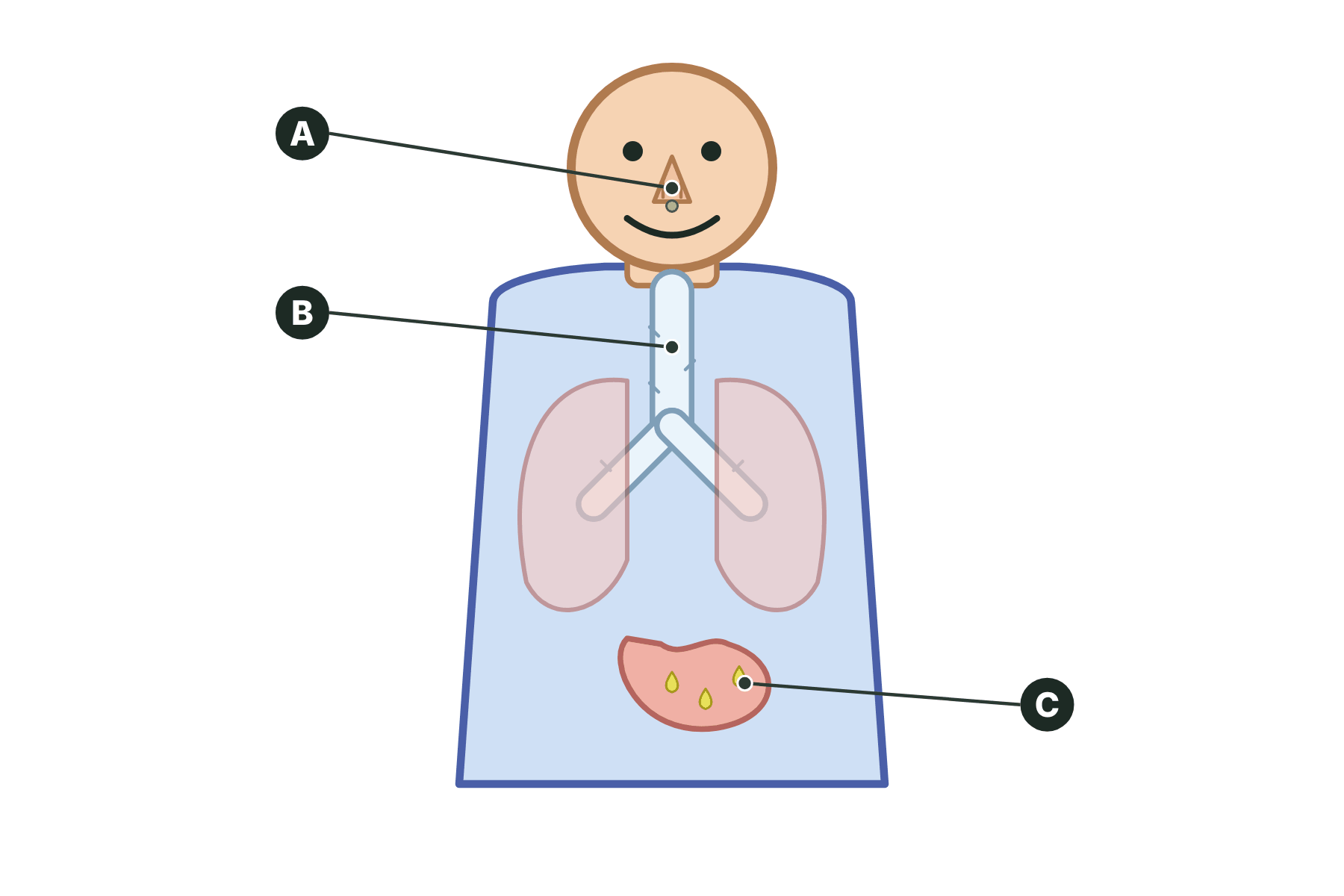
Figure 1 shows the body's defences. Name the parts labelled A, B and C.
Show answerHide answer
Model answer
A is the nose. B is the trachea. C is the stomach.
Mark scheme
- A: nose — 1 mark
- B: trachea — 1 mark
- C: stomach — 1 mark
-
3 Describe [2 marks]
Describe how the nose helps to defend the body against pathogens.
Show answerHide answer
Model answer
Hairs and mucus in the nose trap pathogens (and dust) in the air as it is breathed in, so they cannot reach the lungs.
Mark scheme
- Hairs / mucus — 1 mark
- Trap pathogens — 1 mark
-
4 Explain [3 marks]
Explain how the trachea and bronchi protect the lungs from pathogens.
Show answerHide answer
Model answer
The cells lining the airways make mucus, which traps pathogens. Cilia on the surface move the mucus up the airways to the throat. The mucus is then swallowed, and the acid in the stomach kills the pathogens.
Mark scheme
- Mucus traps pathogens — 1 mark
- Cilia move the mucus — 1 mark
- Swallowed and killed by acid — 1 mark
-
5 Describe [3 marks]
Describe three ways that white blood cells help to defend the body against pathogens.
Show answerHide answer
Model answer
Phagocytes engulf and digest pathogens. Lymphocytes produce antibodies that stick to the antigens on pathogens. White blood cells also produce antitoxins, which neutralise toxins.
Mark scheme
- Phagocytosis — 1 mark
- Antibody production — 1 mark
- Antitoxin production — 1 mark
-
6 Explain [2 marks]
Explain why an antibody that kills one type of bacterium does not kill another type.
Show answerHide answer
Model answer
Antibodies are specific. The shape of an antibody fits only the antigen on one type of pathogen, so it cannot stick to a different one.
Mark scheme
- Antibodies are specific to one antigen — 1 mark
- Shape does not fit a different pathogen's antigen — 1 mark
-
7 Describe [6 marks]
Describe how the human body defends itself against pathogens.
Show answerHide answer
Model answer
The skin is a barrier that most pathogens cannot get through, and platelets seal cuts with a scab. The nose traps pathogens in hairs and mucus. The trachea and bronchi make mucus that traps pathogens, and cilia move it to the throat to be swallowed. The stomach makes hydrochloric acid, which kills the pathogens. If pathogens do get in, white blood cells destroy them. Phagocytes engulf and digest them. Lymphocytes produce antibodies that stick to the antigens on the pathogen. Other white blood cells produce antitoxins to neutralise the toxins.
Mark scheme
- Skin barrier and scab — 1 mark
- Nose hairs / mucus — 1 mark
- Trachea and bronchi: mucus and cilia — 1 mark
- Stomach acid kills pathogens — 1 mark
- Phagocytosis — 1 mark
- Antibodies and antitoxins — 1 mark
Quick check
-
1
Which part of the body makes hydrochloric acid to kill pathogens?
Show answerHide answer
C: The stomach
The stomach makes hydrochloric acid, which kills pathogens that are swallowed.
-
2
What do cilia in the airways do?
Show answerHide answer
A: Move mucus upwards
Cilia move mucus, with trapped pathogens, up the airways.
-
3
What is phagocytosis?
Show answerHide answer
B: Engulfing and digesting a pathogen
In phagocytosis a white blood cell engulfs and digests a pathogen.
-
4
What are antibodies?
Show answerHide answer
D: Proteins that stick to specific antigens
Antibodies are proteins made by lymphocytes that stick to the antigens of a pathogen.
-
5
Which cells make antibodies?
Show answerHide answer
C: Lymphocytes
Lymphocytes, a type of white blood cell, produce antibodies.
-
6
What do antitoxins do?
Show answerHide answer
A: Neutralise toxins
Antitoxins neutralise the toxins released by bacteria.
-
7
Why is an antibody specific?
Show answerHide answer
B: Its shape fits one type of antigen
Its shape fits the antigen of only one type of pathogen.
-
8
What forms at a cut to seal the wound?
Show answerHide answer
D: A scab
Platelets help the blood clot, and the clot dries to form a scab.