Exam questions · Biology · Photosynthesis
Rate of Photosynthesis and Limiting Factors
- 7 exam questions
- 19 marks
- 8 quick checks
-
1 State [1 mark]
Name two factors that can limit the rate of photosynthesis.
Show answerHide answer
Model answer
Any two of: light intensity, carbon dioxide concentration, temperature, amount of chlorophyll.
Mark scheme
- Two factors named — 1 mark
-
2 Explain [3 marks]
Explain why the rate of photosynthesis falls when the temperature rises above about 45 °C.
Show answerHide answer
Model answer
Photosynthesis is controlled by enzymes. At high temperatures the enzymes are denatured, because their shape changes, so they can no longer catalyse the reactions. The rate therefore falls.
Mark scheme
- Controlled by enzymes — 1 mark
- Enzymes are denatured at high temperatures — 1 mark
- So the rate falls — 1 mark
-
3 Calculate [2 marks]
A plant produces 36 cm³ of oxygen in 6 minutes. Calculate the rate of photosynthesis in cm³ of oxygen per minute.
Show answerHide answer
Model answer
36 ÷ 6 = 6 cm³ per minute.
Mark scheme
- 36 ÷ 6 — 1 mark
- 6 cm³ per minute — 1 mark
-
4 Explain [3 marks]
The rate of photosynthesis in a plant rises as the carbon dioxide concentration rises, then levels off. Explain why the graph levels off.
Show answerHide answer
Model answer
At first carbon dioxide is the limiting factor, so more carbon dioxide gives a higher rate. When the graph levels off, carbon dioxide is no longer limiting. Another factor, such as light intensity or temperature, is now limiting the rate.
Mark scheme
- Carbon dioxide limiting at first — 1 mark
- No longer limiting on the flat part — 1 mark
- Another factor is now limiting — 1 mark
-
5 Explain [3 marks]
A plant has pale leaves because it is short of magnesium ions. Explain why its rate of photosynthesis is lower than that of a healthy plant.
Show answerHide answer
Model answer
Magnesium ions are needed to make chlorophyll. The pale leaves have less chlorophyll, so they absorb less light. There is less energy for photosynthesis, so the rate is lower.
Mark scheme
- Magnesium needed for chlorophyll — 1 mark
- Less light absorbed — 1 mark
- Less energy so lower rate — 1 mark
-
6 Explain [3 marks]
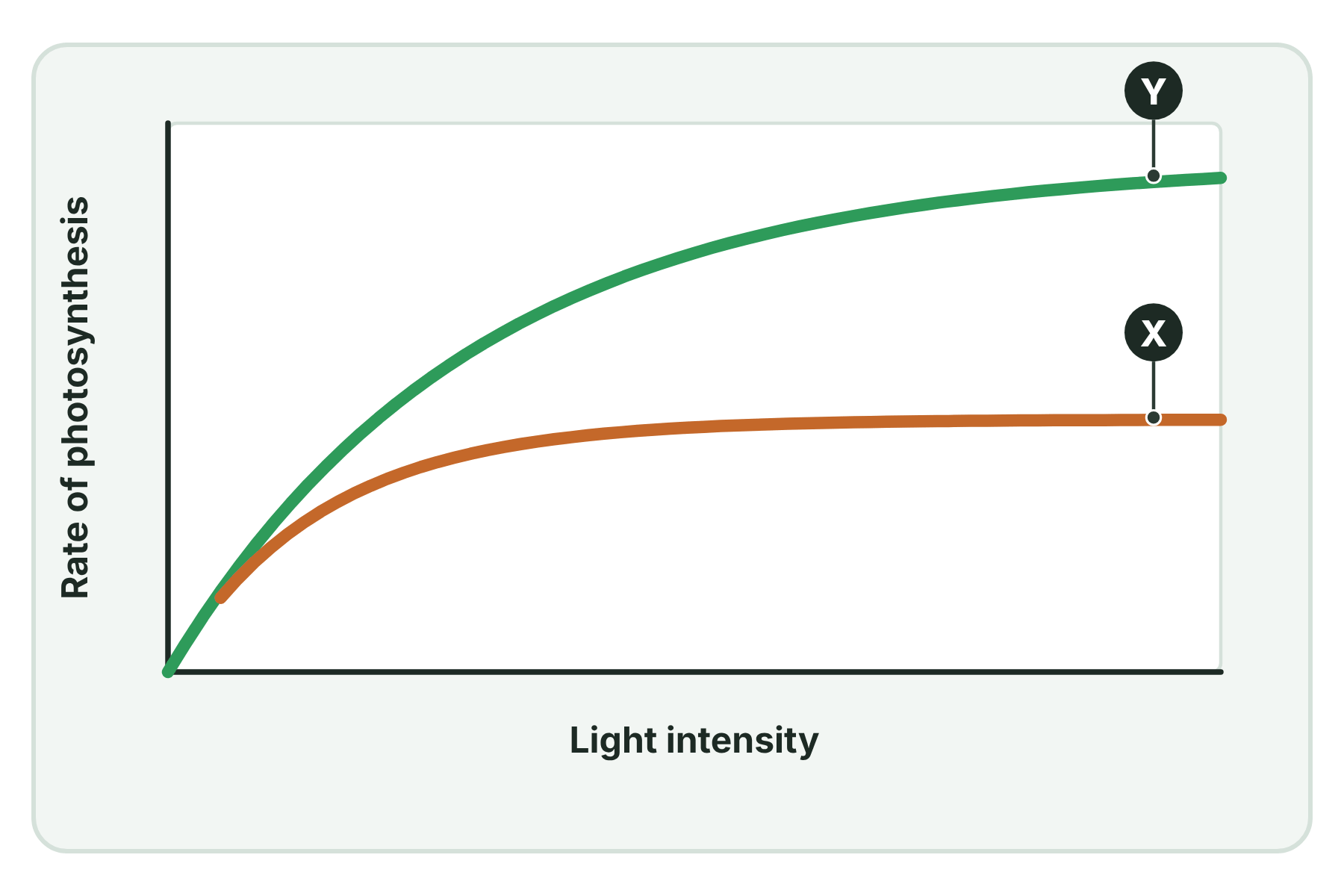
Figure 1 shows the rate of photosynthesis at different light intensities for line X at a low carbon dioxide concentration, and line Y at a higher carbon dioxide concentration. Explain why the two lines are the same at low light intensities but different at high light intensities.
Show answerHide answer
Model answer
At low light intensities, light is the limiting factor for both, so the rate is the same whatever the carbon dioxide concentration. At high light intensities, light is no longer limiting. At the lower carbon dioxide concentration, carbon dioxide is limiting so line X levels off, but at the higher carbon dioxide concentration the rate can keep rising, so line Y is higher.
Mark scheme
- Light limiting at low intensity for both — 1 mark
- Light no longer limiting at high intensity — 1 mark
- Carbon dioxide limits line X — 1 mark
-
7 Evaluate [4 marks]
A grower is deciding whether to add extra carbon dioxide to a greenhouse. Evaluate whether this is cost effective.
Show answerHide answer
Model answer
Adding carbon dioxide will only increase the rate of photosynthesis if carbon dioxide is the limiting factor. If light or temperature is limiting, the extra carbon dioxide will not increase the rate and the money is wasted. If it is limiting, the extra crop that is grown has to be worth more than the cost of the carbon dioxide. The grower should use data to check what is limiting before deciding.
Mark scheme
- Only worthwhile if CO₂ is limiting — 1 mark
- Wasted if another factor is limiting — 1 mark
- Compare the cost with the value of the extra crop — 1 mark
- Use data / conclusion — 1 mark
Quick check
-
1
Which factor provides the energy for photosynthesis?
Show answerHide answer
C: Light
Light energy is absorbed by chlorophyll and used to make glucose.
-
2
Why does a very high temperature slow photosynthesis?
Show answerHide answer
B: The enzymes are denatured
The enzymes are denatured at high temperatures.
-
3
What does the flat part of a rate graph show?
Show answerHide answer
D: Another factor is limiting
The factor on the x axis is no longer limiting, because another factor is.
-
4
Which of these is a limiting factor for photosynthesis?
Show answerHide answer
A: Carbon dioxide concentration
Carbon dioxide concentration can limit the rate.
-
5
What is the rate if 40 cm³ of oxygen is produced in 5 minutes?
Show answerHide answer
B: 8 cm³ per minute
40 ÷ 5 = 8 cm³ per minute.
-
6
Why do plants short of magnesium photosynthesise more slowly?
Show answerHide answer
C: They make less chlorophyll
They make less chlorophyll, so absorb less light.
-
7
(Higher tier) Why might a grower not add extra heat to a greenhouse on a hot, sunny day?
Show answerHide answer
A: Temperature may not be limiting
Temperature may not be the limiting factor, so extra heat would be a waste of money.
-
8
(Higher tier) What can happen to a plateau on a graph if the limiting factor is increased?
Show answerHide answer
D: It rises
Raising the limiting factor raises the plateau until another factor limits.