Biology · Photosynthesis
Rate of Photosynthesis and Limiting Factors
A plant does not always photosynthesise as fast as it could. This lesson explains how temperature, light intensity, carbon dioxide concentration and chlorophyll affect the rate of photosynthesis, and how to read graphs showing a limiting factor.
Learning Objectives
- 1Explain the effects of temperature, light intensity, carbon dioxide concentration and the amount of chlorophyll on the rate of photosynthesis.
- 2Extract and interpret graphs of photosynthesis rate involving one limiting factor.
- 3Measure and calculate rates of photosynthesis.
- 4(Higher tier) Explain graphs with two or three factors, and explain how limiting factors affect the economics of greenhouses.
Retrieval practice
-
1
What are the reactants of photosynthesis?
Show answerHide answer
Carbon dioxide and water.
-
2
What does chlorophyll do?
Show answerHide answer
Absorbs light for photosynthesis.
-
3
What happens to an enzyme at a very high temperature?
Show answerHide answer
It is denatured.
-
4
What is a rate?
Show answerHide answer
A measure of how much something changes in a given time.
What controls the speed?
Photosynthesis is a chemical reaction made of many steps, and it can only go as fast as its slowest-limited step allows. The factor in shortest supply sets the speed, and this is called the limiting factor. Increasing a factor that is not limiting makes no difference. The four things you need to know about are temperature, light intensity, the concentration of carbon dioxide and the amount of chlorophyll.
The four factors
Each factor affects the rate of photosynthesis in a different way.
-
Light intensity
Light provides the energy for photosynthesis. In dim light there is less energy, so the rate is slow. As the light gets brighter the rate rises, until another factor becomes limiting.
-
Carbon dioxide concentration
Carbon dioxide is a reactant. More of it speeds up photosynthesis, until another factor becomes limiting.
-
Temperature
Photosynthesis is controlled by enzymes. A higher temperature gives faster reactions up to the optimum, and above that the enzymes are denatured and the rate falls.
-
Amount of chlorophyll
Chlorophyll absorbs the light. A plant with less chlorophyll, because of a disease or a lack of magnesium, photosynthesises more slowly.
How each factor changes the rate
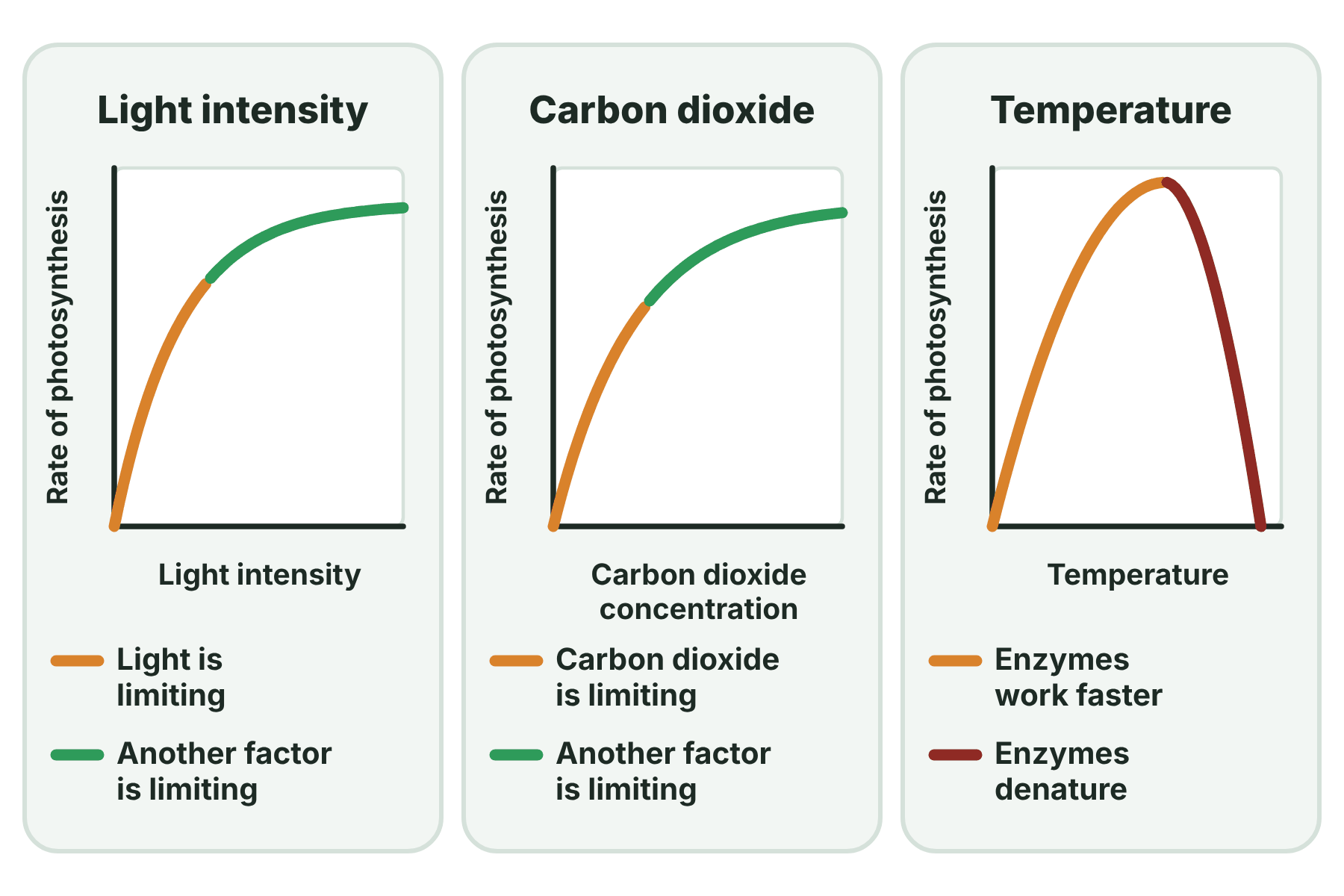
Rate rises and then levels off for light and carbon dioxide, but falls at high temperature.
Reading a limiting factor graph
In the exam you may be given a graph and asked what is limiting the rate at different points.
-
The rising part
The factor on the x axis is limiting, because increasing it increases the rate.
-
The flat part
The factor on the x axis is no longer limiting. Another factor, such as carbon dioxide or temperature, is now limiting.
-
Temperature graphs
The rate rises to an optimum, then falls because the enzymes are denatured, so there is no plateau.
-
Reading values
Draw a line up from a value on the x axis to the curve and across to the y axis to read the rate.
Calculating a rate of photosynthesis
A piece of pondweed produces 24 cm³ of oxygen in 8 minutes. Calculate the rate of photosynthesis in cm³ of oxygen per minute.
Show the solutionHide the solution
- 1 Write the formula Rate = amount of product ÷ time
- 2 Substitute \(24\text{ cm}^3 \div 8\text{ min}\)
- 3 Calculate and give the unit \(= 3\text{ cm}^3\text{ per minute}\)
AnswerThe rate is 3 cm³ of oxygen per minute.
When factors interact (Higher tier)
At the same time, several factors can affect the rate, and any one of them can be the limiting factor.
-
Two or three factors
Graphs may show the rate against light intensity at two different concentrations of carbon dioxide, or at two temperatures.
-
Which is limiting
At low light, both curves are the same, because light is limiting. At high light, the curve with more carbon dioxide is higher, because carbon dioxide is limiting the other one.
-
Higher plateau
Raising the limiting factor raises the plateau, so a different factor takes over as limiting.
Two factors at once
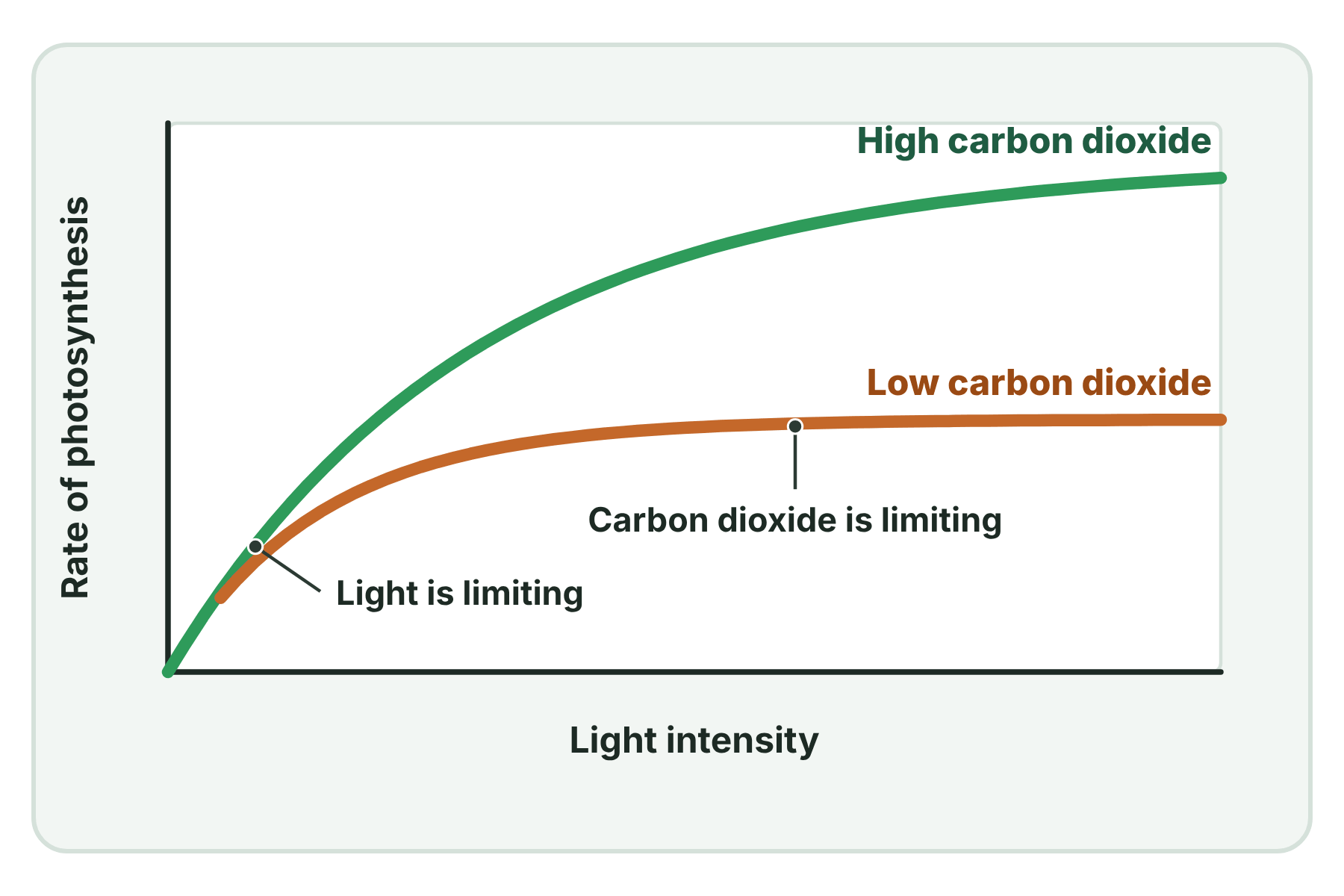
At high light intensity, carbon dioxide concentration limits the rate of the lower curve.
Limiting factors and greenhouses (Higher tier)
Growers can control the conditions in a greenhouse to get the maximum rate of photosynthesis, while still making a profit.
-
Adding light
Lamps can extend the day length and increase the light intensity.
-
Adding carbon dioxide
Burning paraffin or using a gas supply raises the carbon dioxide level.
-
Adding heat
Heaters raise the temperature to the optimum for photosynthesis.
-
Cost effectiveness
Each addition costs money. It is only worthwhile if the extra crop sells for more than it costs. Increasing a factor that is not limiting wastes money.
Case study
A tomato grower's choices
A grower finds that tomato plants in a greenhouse photosynthesise faster when the greenhouse is warmed, but there is no increase when she adds extra light on a sunny day. On sunny days the light is already in plentiful supply, so it is no longer the limiting factor. Spending money on lamps would be a waste, whereas raising the carbon dioxide concentration gives a real increase in yield.
The big idea
The rate of photosynthesis is set by whichever factor is in shortest supply: the limiting factor.
Rate of photosynthesis
Rate of photosynthesis
-
Light intensity
- energy for the reaction
- rate rises then levels off
-
Carbon dioxide
- a reactant
- rate rises then levels off
-
Temperature
- enzymes
- optimum
- denatured when too hot
-
Chlorophyll
- absorbs light
- less means slower
-
Higher tier
- interacting factors
- greenhouses and cost
Summary and exam focus
- Temperature, light intensity, carbon dioxide concentration and the amount of chlorophyll affect the rate of photosynthesis.
- A limiting factor is the one in shortest supply, and it sets the rate.
- A graph rises while a factor is limiting and flattens when another factor is limiting.
- Too high a temperature denatures the enzymes and the rate falls.
- Higher tier: factors interact, and growers add light, heat or carbon dioxide only when it is cost effective.
Exam focus
Explain why the rate of photosynthesis stops increasing when light intensity is increased above a certain value. (3 marks) (3 marks)
Say that light is no longer the limiting factor, then name another factor, such as carbon dioxide concentration or temperature, which is now limiting. Do not say the plant "runs out of light".
Key terms
The words this lesson expects you to use. Each one is linked from the first place it appears above.
- Limiting factor
- A factor that is in short supply and so limits the rate of a reaction.
- Light intensity
- How bright the light is.
- Carbon dioxide concentration
- The amount of carbon dioxide in the air around a plant.
- Optimum temperature
- The temperature at which the rate of reaction is greatest.
- Denatured
- Having a changed shape so an enzyme can no longer work.
- Rate of reaction
- How fast a reaction happens.
- Plateau
- A flat part of a graph, where the rate has stopped rising.
- Greenhouse
- A glass building used for growing plants in controlled conditions.
You've finished the notes
Check your understanding
Test yourself while it is fresh. Start with the flashcards, then try the exam questions.
Something here looks wrong?
Tell us what and we will go and look. It goes to whoever writes these pages, nobody else, and we do not ask who you are — so there is nothing to sign and nothing comes back to you.