Flashcards · Biology · Photosynthesis
Rate of Photosynthesis and Limiting Factors
-
What is a limiting factor?
A factor in short supply that sets the rate of a reaction.
-
Name four factors that affect the rate of photosynthesis.
Temperature, light intensity, carbon dioxide concentration and the amount of chlorophyll.
-
Why does more light increase photosynthesis?
Light provides the energy for the reaction.
-
Why does more carbon dioxide increase photosynthesis?
It is a reactant, so more is available.
-
Why does the rate fall at high temperatures?
The enzymes are denatured.
-
What does a flat part on a rate graph show?
Another factor is now limiting.
-
What does a rising part of the graph show?
The factor on the x axis is limiting.
-
Why does a lack of magnesium slow photosynthesis?
The plant makes less chlorophyll, so absorbs less light.
-
How do you calculate a rate?
Amount of product or reactant ÷ time.
-
What is a plateau?
A flat part of a graph where the rate stops changing.
-
(HT) What does it mean if factors interact?
Any one of them might be the limiting factor.
-
(HT) Why add lamps to a greenhouse?
To raise the light intensity when it is limiting.
-
(HT) Why add carbon dioxide to a greenhouse?
To raise the rate when carbon dioxide is limiting.
-
(HT) Why might adding extra heat be a waste of money?
If temperature is not the limiting factor, the rate does not increase.
-
(HT) What is cost effectiveness?
Whether the extra crop is worth more than the cost of adding heat, light or carbon dioxide.
-
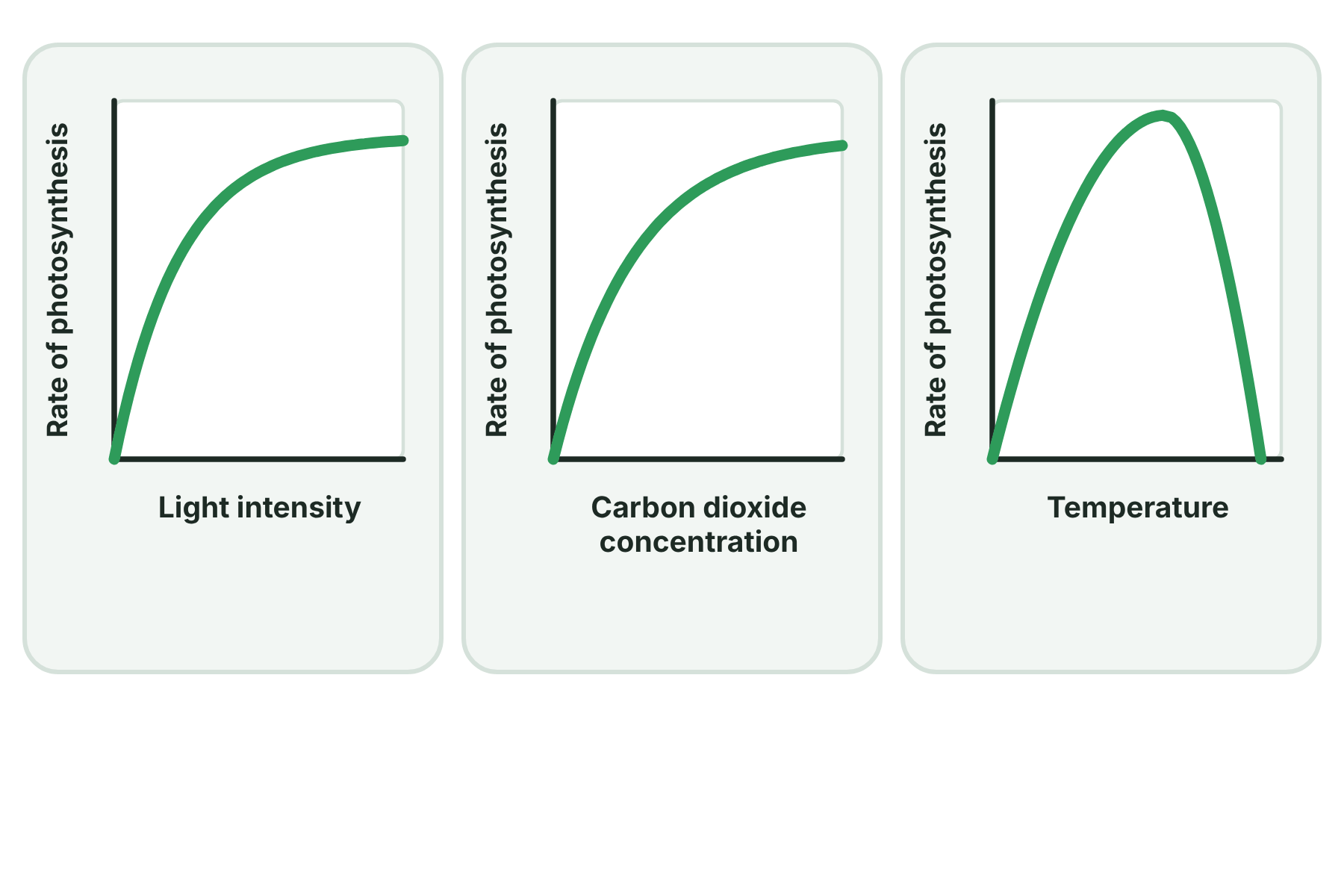 Describe the shape of each graph and say what is limiting.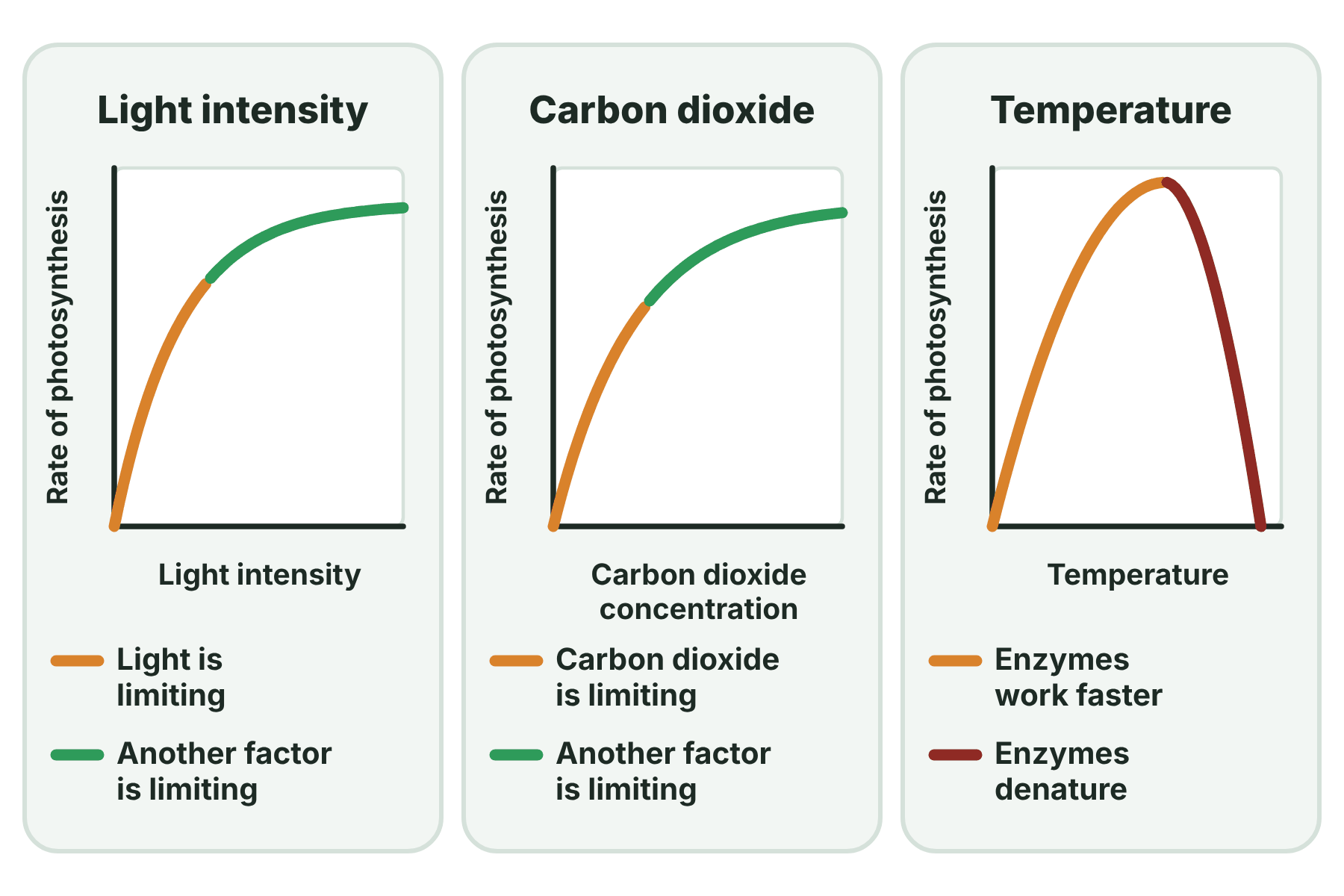
Light and carbon dioxide: the rate rises then levels off, and another factor is limiting on the flat part. Temperature: it rises to an optimum, then falls because enzymes are denatured.