Exam questions · Biology · Photosynthesis
Uses of Glucose from Photosynthesis
- 7 exam questions
- 20 marks
- 8 quick checks
-
1 State [1 mark]
Name the substance that plants make from glucose to strengthen their cell walls.
Show answerHide answer
Model answer
Cellulose.
Mark scheme
- Cellulose — 1 mark
-
2 Name [3 marks]
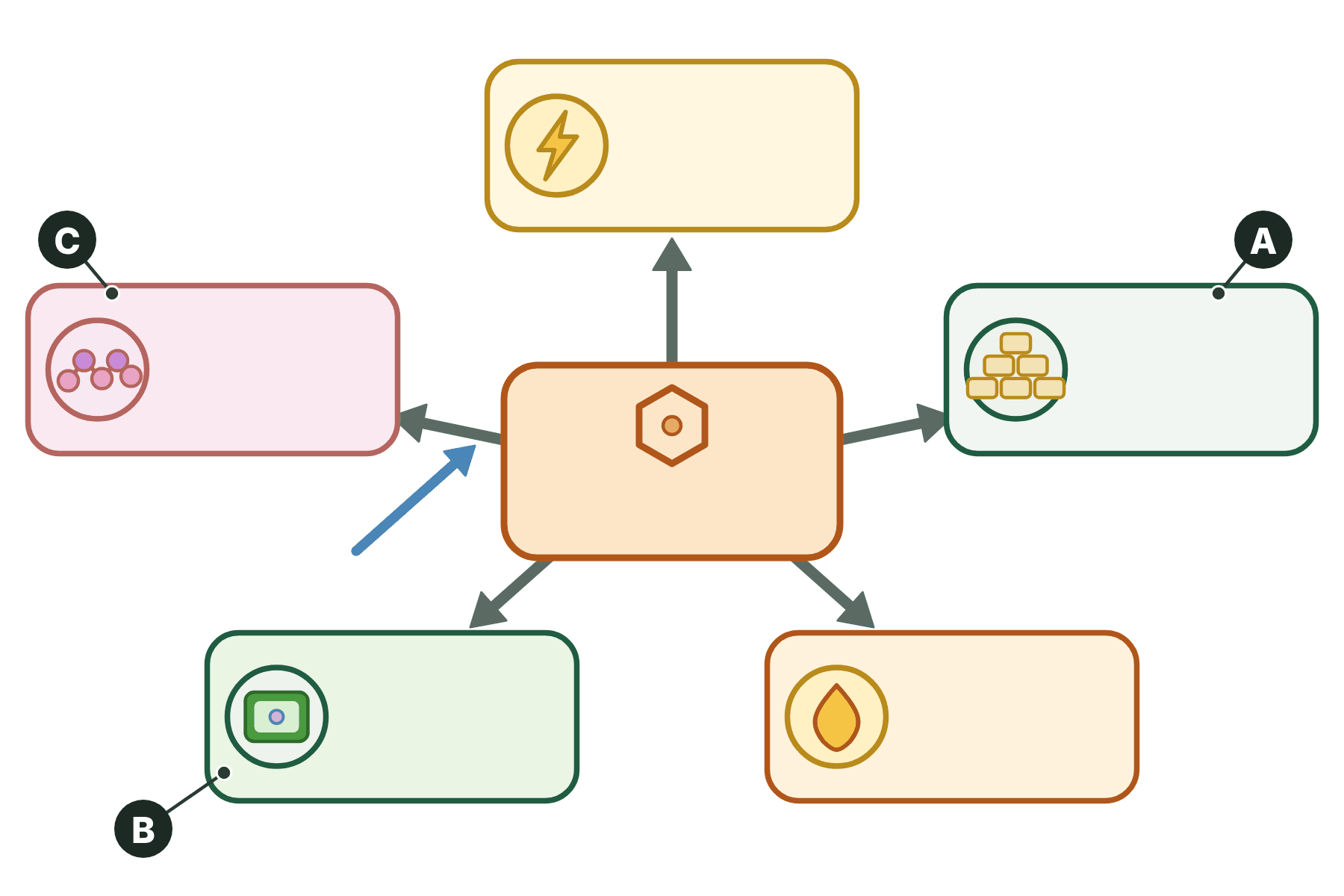
Figure 1 shows some uses of glucose in a plant. Name the substances made at A, B and C.
Show answerHide answer
Model answer
A is starch. B is cellulose. C is amino acids (proteins).
Mark scheme
- A: starch — 1 mark
- B: cellulose — 1 mark
- C: amino acids / proteins — 1 mark
-
3 Explain [3 marks]
Explain why plants store glucose as starch.
Show answerHide answer
Model answer
Starch is insoluble, so it does not dissolve in water and does not affect osmosis in the cells. It is also a large molecule, so a lot of energy can be stored in a small space. It can be broken down to glucose when needed.
Mark scheme
- Insoluble, so no effect on osmosis — 1 mark
- Compact store — 1 mark
- Can be converted back to glucose — 1 mark
-
4 Explain [2 marks]
Explain why plants need nitrate ions to make proteins.
Show answerHide answer
Model answer
Nitrate ions provide nitrogen, which is needed to make amino acids. The amino acids are joined together to make proteins.
Mark scheme
- Nitrate used to make amino acids — 1 mark
- Amino acids joined to make proteins — 1 mark
-
5 Describe [4 marks]
Describe how you would test a food sample for starch, for sugar and for protein.
Show answerHide answer
Model answer
For starch, add iodine solution, which turns blue-black if starch is present. For sugar, add Benedict's reagent and heat it in a water bath, and it turns green, yellow, orange or brick red if sugar is present. For protein, add Biuret reagent, which turns purple if protein is present.
Mark scheme
- Starch: iodine turns blue-black — 1 mark
- Sugar: Benedict's reagent — 1 mark
- Sugar: heat, colour change — 1 mark
- Protein: Biuret turns purple — 1 mark
-
6 Explain [3 marks]
A farmer finds that a crop is growing very slowly and the plants are small. Explain how adding a nitrate fertiliser could help.
Show answerHide answer
Model answer
Plants use nitrate ions with glucose to make amino acids and then proteins. A shortage of nitrate means the plants cannot make enough protein to grow, so they are stunted. Adding nitrate fertiliser gives them the missing ions, so they make more protein and grow faster.
Mark scheme
- Nitrate needed for amino acids and protein — 1 mark
- Shortage gives stunted growth — 1 mark
- Fertiliser supplies the ions so growth improves — 1 mark
-
7 Describe [4 marks]
A potato plant makes glucose in its leaves. Describe what happens to this glucose and why it is useful to the plant.
Show answerHide answer
Model answer
The glucose is carried in the phloem. Some is used for respiration, to release energy for growth. Some is converted into starch and stored in the tubers (potatoes). The stored starch provides the plant with food to grow the next year.
Mark scheme
- Carried in the phloem — 1 mark
- Used in respiration for energy — 1 mark
- Converted into starch and stored in tubers — 1 mark
- Stored food for later growth — 1 mark
Quick check
-
1
Which substance is made from glucose to strengthen cell walls?
Show answerHide answer
B: Cellulose
Cellulose makes up the cell walls of plants.
-
2
What is the test for starch?
Show answerHide answer
C: Iodine solution
Iodine solution turns blue-black when starch is present.
-
3
Why is starch a good storage substance?
Show answerHide answer
A: It is insoluble
It is insoluble, so it does not affect osmosis.
-
4
What do plants combine with glucose to make amino acids?
Show answerHide answer
D: Nitrate ions
Plants use nitrate ions from the soil, together with glucose, to make amino acids.
-
5
What colour does Biuret reagent turn when protein is present?
Show answerHide answer
B: Purple
Biuret reagent turns purple in the presence of protein.
-
6
Where can plants store fats and oils?
Show answerHide answer
C: In the seeds
Seeds often store fats and oils as an energy store.
-
7
Which of these substances is NOT made by a plant from the glucose it makes in photosynthesis?
Show answerHide answer
A: Haemoglobin
Haemoglobin is the protein that carries oxygen in the red blood cells of animals, so plants do not make it. Plants use glucose to make cellulose, starch and, with nitrate ions, amino acids for proteins.
-
8
How is glucose transported around a plant?
Show answerHide answer
D: In the phloem
Glucose is carried in the phloem.