Biology · Photosynthesis
Uses of Glucose from Photosynthesis
Glucose is only the start. This lesson shows how a plant uses the glucose it makes: for respiration, and to make starch, fats and oils, cellulose and proteins. It also covers the tests for starch, glucose and protein.
Learning Objectives
- 1Describe the ways in which plants use the glucose made in photosynthesis.
- 2Explain why plants store glucose as starch.
- 3Explain why plants need nitrate ions to make proteins.
- 4Describe the tests for starch, glucose and protein.
Retrieval practice
-
1
What are the products of photosynthesis?
Show answerHide answer
Glucose and oxygen.
-
2
What is cellulose?
Show answerHide answer
The material that makes up plant cell walls.
-
3
What are proteins made of?
Show answerHide answer
-
4
What is respiration?
Show answerHide answer
The reaction that releases energy from glucose in cells.
Where the glucose goes
The glucose made in a leaf is not only a food for the plant itself. It is the starting point for all the other substances that the plant needs to grow, and for the energy it uses. Some glucose is used at once, and the rest is turned into other substances, some of which are stored. The glucose is carried to wherever it is needed in the phloem.
Five uses of glucose
The glucose produced in photosynthesis may be used in several ways.
-
For respiration
Glucose is broken down to release energy, which the plant uses for growth and all other life processes.
-
Converted into starch
Glucose is converted into insoluble starch for storage, for example in roots and seeds.
-
Used to make fat or oil
Fats and oils are used for storage, and many seeds are rich in them.
-
Used to make cellulose
Cellulose strengthens the cell walls.
-
Used to make amino acids
Glucose is combined with nitrate ions from the soil to make amino acids, which are joined to make proteins.
What a plant does with glucose
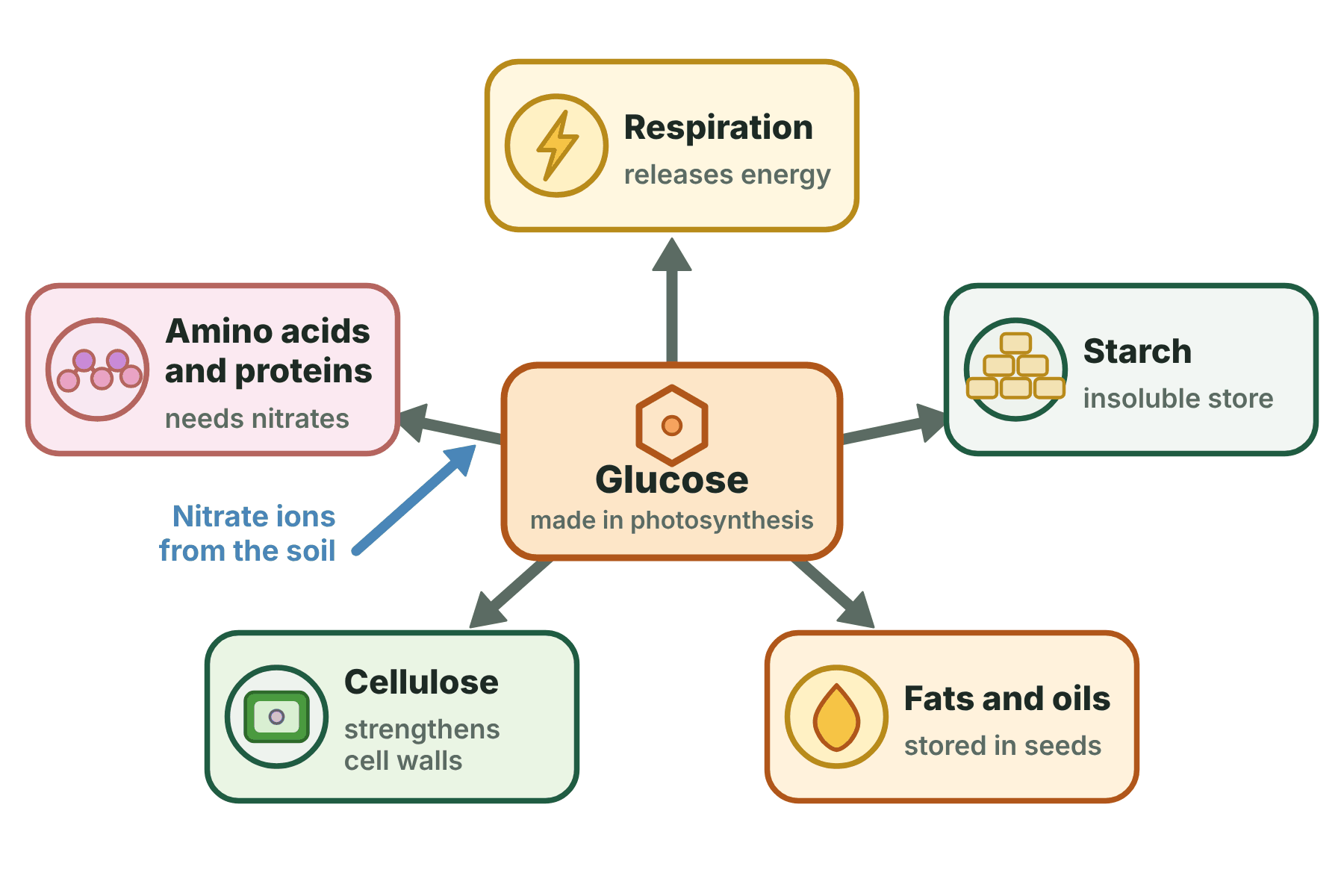
Plants make all of these substances from glucose.
Why starch?
Plants store glucose as starch rather than as glucose itself.
-
Insoluble
Starch does not dissolve in water, so it does not affect the movement of water into and out of cells by osmosis.
-
Compact
Many glucose molecules are joined to form one large starch molecule, so a lot of energy can be stored in a small space.
-
Easy to convert
When the plant needs glucose, enzymes break starch down again.
-
Where it is stored
In roots, tubers, seeds and fruits.
Proteins and nitrate ions
Proteins are made of amino acids, and amino acids contain nitrogen.
-
The raw materials
Plants use glucose and nitrate ions that they absorb from the soil to make amino acids.
-
Proteins
The amino acids are joined in a particular order to make proteins, which are used for growth and for enzymes.
-
Why nitrate matters
Without nitrate ions the plant cannot make enough protein, and shows stunted growth.
-
Fertilisers
Farmers add fertilisers containing nitrate to supply this need.
Testing for starch, glucose and protein
Simple qualitative reagents show which of the substances are present.
-
1
Starch
Add iodine solution. It turns from orange-brown to blue-black if starch is present.
-
2
Glucose
Add Benedict's reagent and heat in a water bath. It turns from blue to green, yellow, orange or brick red if sugar is present.
-
3
Protein
Add Biuret reagent. It turns from blue to purple if protein is present.
Glucose and starch compared
Glucose
- A small sugar molecule
- Soluble in water
- Used for respiration and to make other substances
- Would affect osmosis if stored in large amounts
Starch
- A large molecule made of many glucose units
- Insoluble in water
- Used for storage
- Does not affect osmosis
Case study
Why potatoes are good to eat
A potato plant makes glucose in its leaves by photosynthesis. The glucose is carried down to the underground stems, called tubers, where it is converted into starch for storage. The starch is stored in the potato tuber so the plant can use it to grow next spring. When we eat a potato, we are eating this stored starch, which our digestive system turns back into glucose.
The big idea
Glucose can be used for energy, or built up into starch, fats and oils, cellulose and proteins.
Uses of glucose
Uses of glucose
-
Respiration
- energy for life processes
-
Starch
- insoluble
- storage
-
Fats and oils
- storage in seeds
-
Cellulose
- strengthens cell walls
-
Proteins
- glucose and nitrate ions make amino acids
-
Tests
- iodine
- Benedict's
- Biuret
Summary and exam focus
- Glucose is used for respiration.
- It is converted into insoluble starch for storage.
- It is used to make fats and oils for storage, and cellulose for cell walls.
- It is combined with nitrate ions to make amino acids for proteins.
- Starch is tested with iodine, sugars with Benedict's reagent and protein with Biuret reagent.
Exam focus
Describe three ways in which plants use the glucose made in photosynthesis. (3 marks) (3 marks)
Choose three of the five uses and give a short reason: respiration for energy, starch for storage, fat or oil for storage, cellulose for the cell walls, or amino acids to make protein with nitrate ions.
Key terms
The words this lesson expects you to use. Each one is linked from the first place it appears above.
- Starch
- An insoluble carbohydrate that plants use to store glucose.
- Insoluble
- Does not dissolve in water.
- Cellulose
- A carbohydrate that makes up plant cell walls.
- Amino acid
- A small molecule that is joined with others to make proteins.
- Protein
- A large molecule made of amino acids, used for growth and as enzymes.
- Nitrate ion
- A mineral ion that plants take from the soil, needed to make amino acids.
- Fat
- A lipid used for storage of energy.
- Tuber
- An underground part of a plant where food is stored.
You've finished the notes
Check your understanding
Test yourself while it is fresh. Start with the flashcards, then try the exam questions.
Something here looks wrong?
Tell us what and we will go and look. It goes to whoever writes these pages, nobody else, and we do not ask who you are — so there is nothing to sign and nothing comes back to you.