Exam questions · Biology · Plant Disease
Detecting and Identifying Plant Diseases
- 7 exam questions
- 18 marks
- 8 quick checks
-
1 State [1 mark]
Name one insect pest that harms plants.
Show answerHide answer
Model answer
Aphids.
Mark scheme
- Aphid — 1 mark
-
2 Name [3 marks]
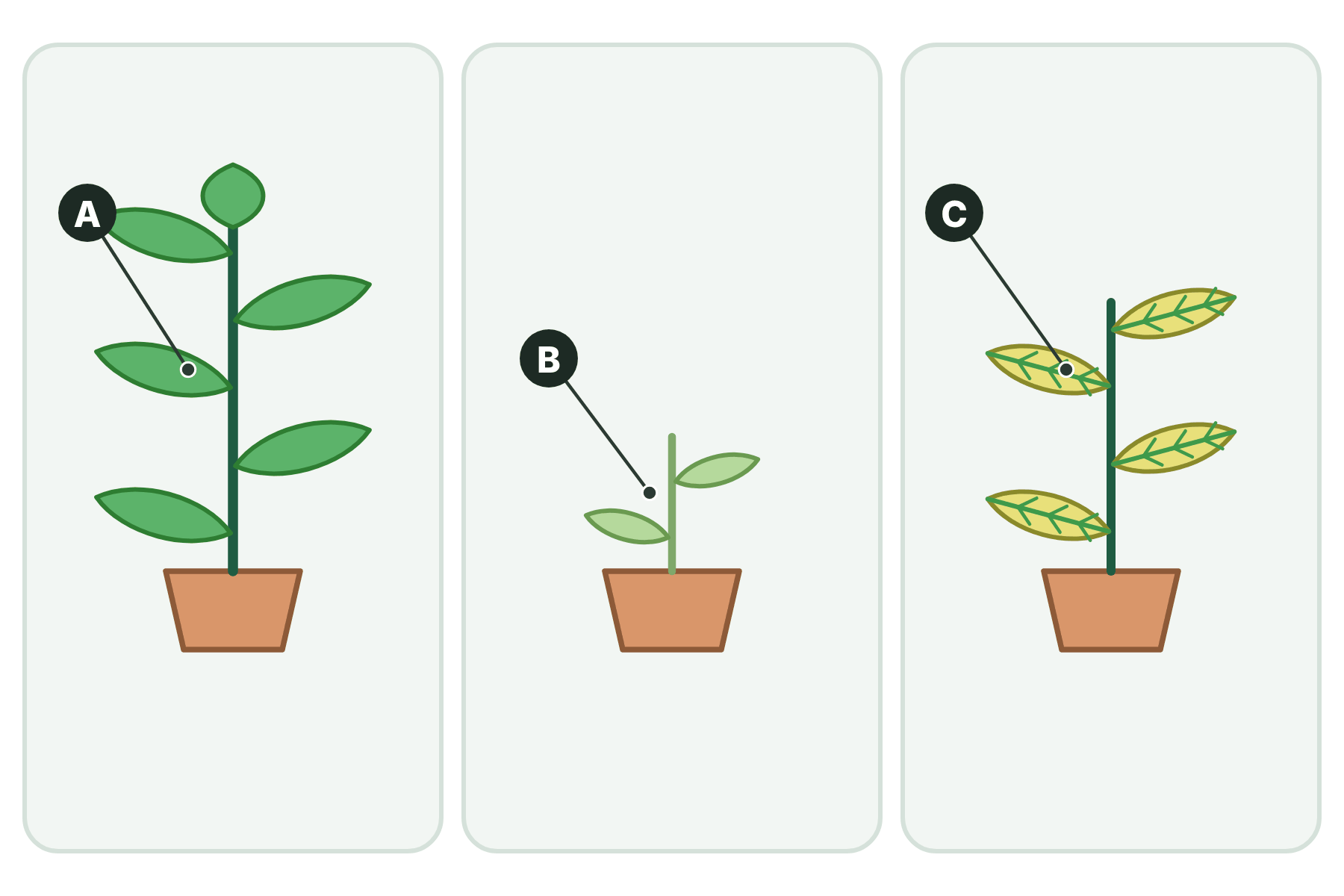
Figure 1 shows three plants. Plant A is healthy. State which ion plant B and plant C are short of, and name the symptom of plant C.
Show answerHide answer
Model answer
Plant B is short of nitrate ions. Plant C is short of magnesium ions. The symptom of plant C is chlorosis (yellow leaves).
Mark scheme
- B: nitrate — 1 mark
- C: magnesium — 1 mark
- Chlorosis / yellow leaves — 1 mark
-
3 Explain [2 marks]
Explain why a plant that is short of nitrate ions shows stunted growth.
Show answerHide answer
Model answer
Nitrate ions are needed to make amino acids, which are used to make proteins. Without enough protein the plant cannot make new cells, so it cannot grow properly.
Mark scheme
- Nitrate needed for protein — 1 mark
- Cannot grow / stunted — 1 mark
-
4 Explain [3 marks]
Explain why the leaves of a plant that is short of magnesium ions turn yellow.
Show answerHide answer
Model answer
Magnesium ions are needed to make chlorophyll. Without enough magnesium, less chlorophyll is made, so the leaves are yellow (chlorosis). The plant also photosynthesises less.
Mark scheme
- Magnesium needed for chlorophyll — 1 mark
- Less chlorophyll so yellow leaves — 1 mark
- Less photosynthesis — 1 mark
-
5 Describe [3 marks]
Describe three signs that could show a plant has a disease.
Show answerHide answer
Model answer
Spots on leaves, such as those of rose black spot. Stunted growth, where the plant is smaller than it should be. Discolouration, such as the mosaic pattern on the leaves in tobacco mosaic virus. (Also accept: areas of decay, growths, malformed stems or leaves, the presence of pests.)
Mark scheme
- A first correct sign — 1 mark
- A second correct sign — 1 mark
- A third correct sign — 1 mark
-
6 Describe [3 marks]
Describe three ways in which a plant disease can be identified.
Show answerHide answer
Model answer
By comparing the symptoms with a gardening manual or website. By taking an infected plant to a laboratory to identify the pathogen. By using a testing kit that contains monoclonal antibodies.
Mark scheme
- Manual or website — 1 mark
- Laboratory — 1 mark
- Monoclonal antibody testing kit — 1 mark
-
7 Explain [3 marks]
Explain how a testing kit containing monoclonal antibodies can identify a plant pathogen.
Show answerHide answer
Model answer
The monoclonal antibody is specific to one antigen on the pathogen. If the pathogen is present in a sample from the plant, the antibody binds to it. The kit then shows a colour change, which shows the pathogen is present.
Mark scheme
- Antibody specific to the pathogen's antigen — 1 mark
- Binds if the pathogen is present — 1 mark
- Colour change shows it — 1 mark
Quick check
-
1
Which ion is needed to make chlorophyll?
Show answerHide answer
B: Magnesium
Magnesium ions are needed to make chlorophyll.
-
2
Which ion is needed to make proteins?
Show answerHide answer
A: Nitrate
Nitrate ions provide the nitrogen needed for amino acids and proteins.
-
3
What is chlorosis?
Show answerHide answer
D: Yellowing of the leaves
Chlorosis is the yellowing of leaves, which happens when a plant lacks magnesium.
-
4
Which symptom is caused by a lack of nitrate?
Show answerHide answer
C: Stunted growth
A shortage of nitrate causes stunted growth, because the plant cannot make enough protein.
-
5
Which of these is an insect pest of plants?
Show answerHide answer
B: An aphid
Aphids are insects that feed on the sap of plants.
-
6
How can a testing kit identify a plant pathogen?
Show answerHide answer
A: It uses monoclonal antibodies
The monoclonal antibodies in it bind to the pathogen and give a colour change.
-
7
Which would a horticulturist add to treat stunted growth caused by a lack of nitrate?
Show answerHide answer
D: A nitrate fertiliser
A fertiliser containing nitrate provides the missing ions.
-
8
Which disease would give a leaf a mosaic pattern?
Show answerHide answer
C: Tobacco mosaic virus
Tobacco mosaic virus causes a mosaic pattern of discolouration.