Biology · Plant Disease
Detecting and Identifying Plant Diseases
Plants can be harmed by pathogens, pests and shortages of minerals. This lesson covers how gardeners and scientists detect and identify plant disease, and how a shortage of nitrate or magnesium ions affects a plant.
Learning Objectives
- 1State the pathogens and pests that you need to know about in plants.
- 2Describe the signs by which plant diseases can be detected.
- 3Describe how plant diseases can be identified, including with monoclonal antibody testing kits.
- 4Explain the effects of nitrate and magnesium ion deficiency on plants.
Retrieval practice
-
1
What does tobacco mosaic virus do to a leaf?
Show answerHide answer
It gives it a mosaic pattern of discolouration, which reduces photosynthesis.
-
2
What causes rose black spot?
Show answerHide answer
A fungus.
-
3
What is a monoclonal antibody?
Show answerHide answer
An antibody from a single clone of cells that is specific to one antigen.
-
4
What do plants need nitrate ions for?
Show answerHide answer
To make proteins.
Looking after plants
Plants can be infected by a range of viral, bacterial and fungal pathogens as well as by insects. If a farmer or gardener can spot the problem early and name it correctly, it can be treated before it spreads. This is an everyday use of scientific knowledge. For the exam, your knowledge of plant diseases is restricted to tobacco mosaic virus as a viral disease, rose black spot as a fungal disease, and aphids as insects.
The three named plant problems
You already know two of them from the communicable diseases chapter.
-
Tobacco mosaic virus
A viral disease that gives leaves a mosaic of discolouration, and reduces photosynthesis and growth.
-
Rose black spot
A fungal disease that causes purple or black spots on leaves, which turn yellow and drop early.
-
Aphids
Small insects that feed on the sugary sap in a plant's phloem. They weaken the plant, and the large number of tiny insects on the stems and leaves is a sign of their presence.
Detecting plant disease
A plant can show several signs that something is wrong. This part is for the Higher tier.
-
Stunted growth
The plant is smaller than it should be.
-
Spots on leaves
For example the spots of rose black spot.
-
Areas of decay (rot)
Soft, brown areas on stems, roots or leaves.
-
Growths
Lumps or swellings on the plant.
-
Malformed stems or leaves
Twisted, curled or misshapen parts.
-
Discolouration
Patches of yellow or other colours, as in the mosaic of TMV.
-
The presence of pests
Insects such as aphids.
Signs of plant disease
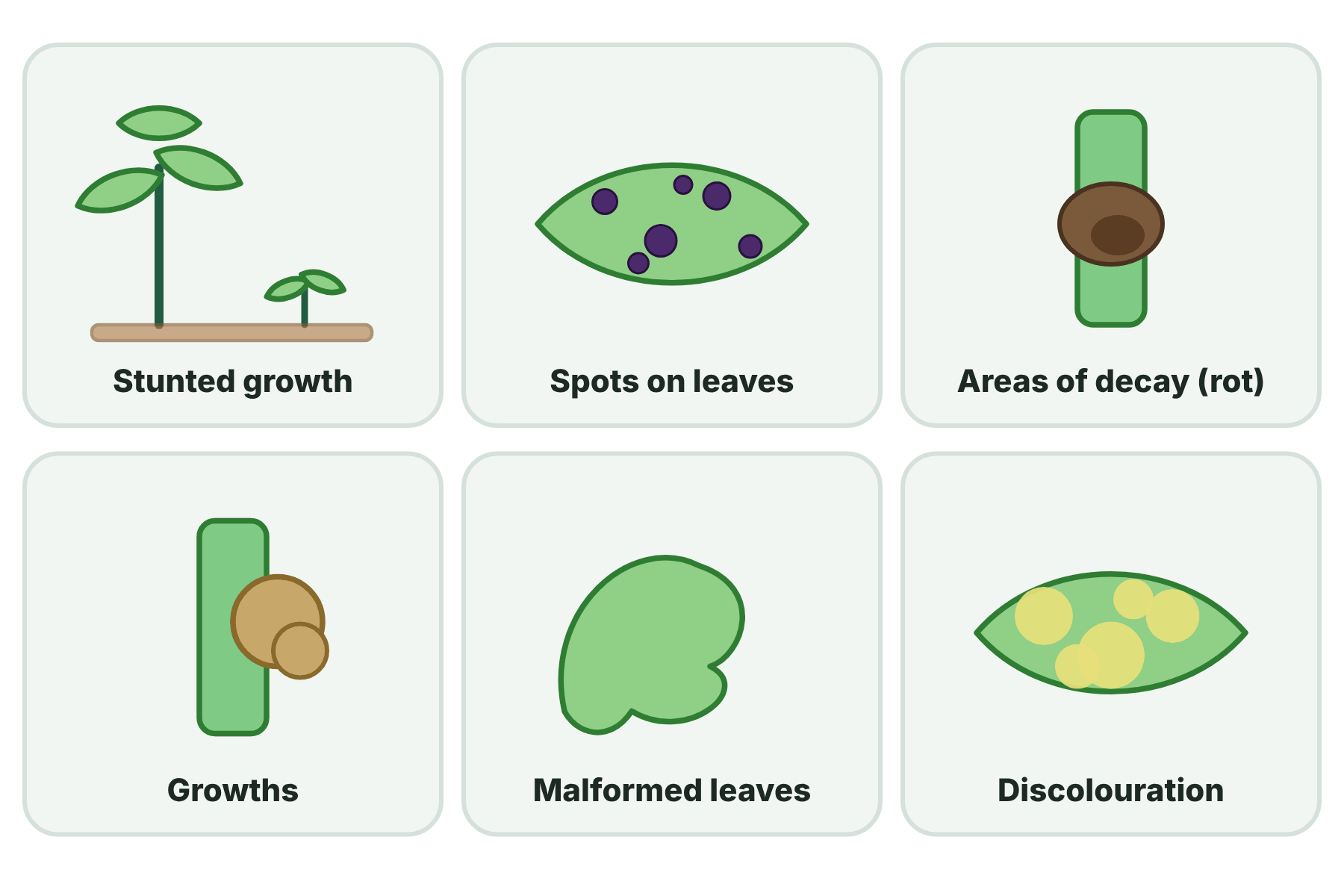
Several different signs can show that a plant has a problem.
Identifying the cause
Spotting a problem is not the same as knowing its cause. This part is also for the Higher tier.
-
A gardening manual or website
The signs are compared with descriptions and pictures of known diseases.
-
A laboratory
An infected plant can be sent to a laboratory, where scientists identify the pathogen.
-
Testing kits
A kit that contains monoclonal antibodies binds to a particular pathogen and shows a colour change if it is present.
Mineral ion deficiency
Plants can also be damaged by a lack of the mineral ions they take up from the soil. Knowledge of ions is limited to nitrate and magnesium.
-
Nitrate
Nitrate ions are needed to make amino acids and so proteins. A shortage causes stunted growth.
-
Magnesium
Magnesium ions are needed to make chlorophyll. A shortage causes chlorosis, in which the leaves turn yellow.
-
Why it matters
Understanding ion deficiencies allows horticulturists to give plants the right conditions for the best growth, for example by adding fertiliser.
Mineral ion deficiency
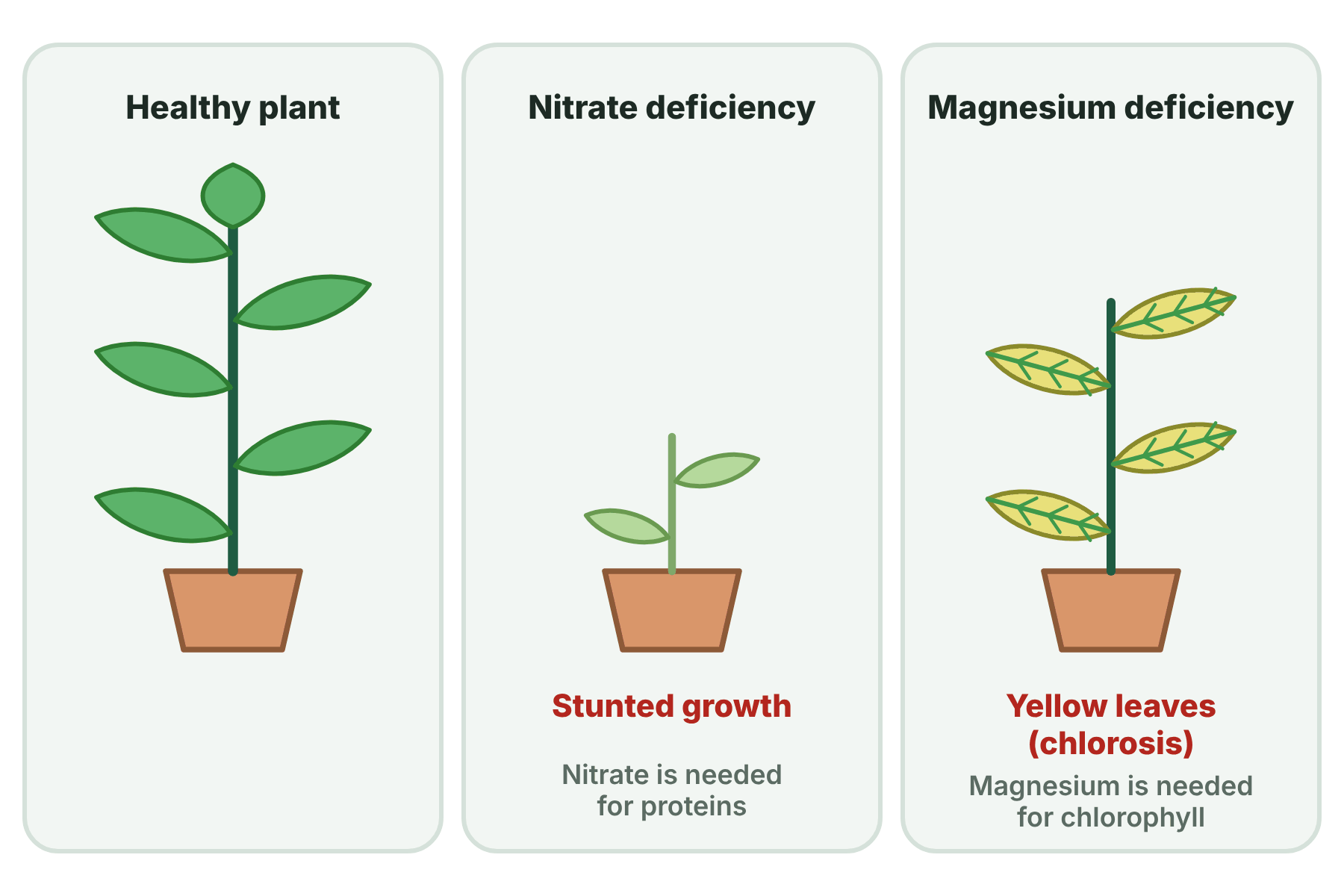
The ions that a plant lacks decide the symptoms it shows.
Nitrate and magnesium deficiency compared
Nitrate deficiency
- Nitrate is needed to make amino acids and proteins
- The plant cannot make enough protein to grow
- Symptom: stunted growth
- Fix: add a fertiliser with nitrate
Magnesium deficiency
- Magnesium is needed to make chlorophyll
- The leaves cannot make enough chlorophyll
- Symptom: yellow leaves (chlorosis)
- Fix: add a fertiliser with magnesium
Case study
A gardener's tomato plants
A gardener notices that the leaves of her tomato plants have a pale and dark green mosaic pattern and the plants are small. She looks the symptoms up on a website, which suggests tobacco mosaic virus. To be certain, she sends a leaf to a laboratory, where a test with monoclonal antibodies shows the virus is present. She removes and burns the infected plants and disinfects her tools so that the virus does not spread.
The big idea
To treat a plant problem you must first detect it, and then work out whether it is a disease, a pest or a missing mineral.
Plant disease
Plant disease
-
Named problems
- tobacco mosaic virus
- rose black spot
- aphids
-
Detection
- stunted growth
- spots
- rot
- growths
- malformed
- discolouration
- pests
-
Identification
- manual or website
- laboratory
- monoclonal antibody kit
-
Ion deficiency
- nitrate and stunted growth
- magnesium and chlorosis
Summary and exam focus
- TMV is a viral disease, rose black spot is a fungal disease and aphids are pests.
- Plant diseases can be detected by stunted growth, spots, rot, growths, malformed parts, discolouration and pests.
- They can be identified using a manual or website, a laboratory, or a testing kit containing monoclonal antibodies.
- A lack of nitrate causes stunted growth.
- A lack of magnesium causes chlorosis, which is yellow leaves.
Exam focus
Explain how a gardener could identify the cause of yellow leaves on a plant. (4 marks) (4 marks)
Name the possible causes, such as a magnesium deficiency, a disease or aphids, and the ways to decide between them: look for pests and spots, use a gardening manual, send a sample to a laboratory, or use a testing kit with monoclonal antibodies.
Key terms
The words this lesson expects you to use. Each one is linked from the first place it appears above.
- Aphid
- A small insect that feeds on plant sap and can damage plants.
- Pest
- An animal that damages plants or crops.
- Stunted growth
- Poor growth, so a plant is smaller than normal.
- Chlorosis
- A yellowing of leaves, caused by too little chlorophyll.
- Nitrate ion
- A mineral ion that plants need to make amino acids and proteins.
- Magnesium ion
- A mineral ion that plants need to make chlorophyll.
- Ion deficiency
- A shortage of a mineral ion that a plant needs.
- Horticulturist
- A person who grows and looks after plants.
You've finished the notes
Check your understanding
Test yourself while it is fresh. Start with the flashcards, then try the exam questions.
Something here looks wrong?
Tell us what and we will go and look. It goes to whoever writes these pages, nobody else, and we do not ask who you are — so there is nothing to sign and nothing comes back to you.