Exam questions · Biology · The Circulatory System
Coronary Heart Disease and Its Treatment
- 7 exam questions
- 19 marks
- 8 quick checks
-
1 State [1 mark]
State what is meant by coronary heart disease.
Show answerHide answer
Model answer
Fatty deposits build up in the coronary arteries and narrow them, reducing the blood flow to the heart muscle.
Mark scheme
- Fatty deposits narrow the coronary arteries — 1 mark
-
2 Name [3 marks]
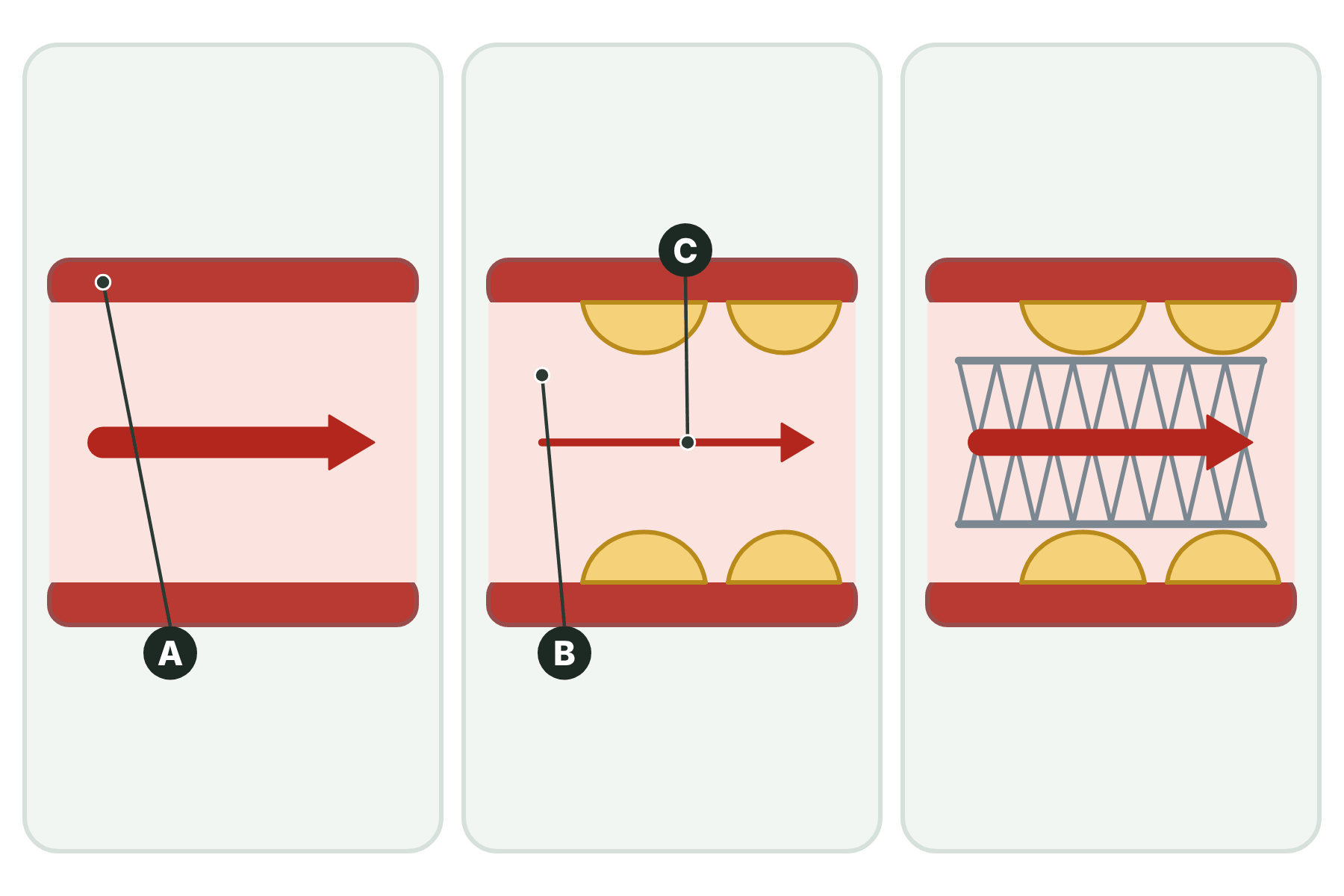
Figure 1 shows a healthy coronary artery and an artery affected by coronary heart disease. Name the parts labelled A, B and C.
Show answerHide answer
Model answer
A is the artery wall. B is the fatty deposit. C is the (narrowed) lumen.
Mark scheme
- A: wall of the artery — 1 mark
- B: fatty deposit — 1 mark
- C: lumen — 1 mark
-
3 Explain [3 marks]
Explain how coronary heart disease can lead to a heart attack.
Show answerHide answer
Model answer
Fatty deposits narrow the coronary arteries. Less blood flows through them, so the heart muscle receives too little oxygen. The muscle cannot respire enough to release the energy it needs, so it cannot contract and the person has a heart attack.
Mark scheme
- Narrowed coronary arteries — 1 mark
- Less oxygen reaches the heart muscle — 1 mark
- Not enough energy released by respiration for contraction — 1 mark
-
4 Describe [2 marks]
Describe how a stent treats coronary heart disease.
Show answerHide answer
Model answer
A stent is a mesh tube put inside the narrowed artery. It holds the artery open so that blood can flow freely again.
Mark scheme
- A tube/mesh placed in the artery — 1 mark
- Keeps it open so blood flows — 1 mark
-
5 Explain [2 marks]
Explain how statins reduce the risk of coronary heart disease.
Show answerHide answer
Model answer
Statins lower the level of cholesterol in the blood. This slows down the rate at which fatty material is deposited in the arteries.
Mark scheme
- Lower blood cholesterol — 1 mark
- Slows the build-up of fatty deposits — 1 mark
-
6 Give [2 marks]
Give one advantage and one disadvantage of using a mechanical heart valve rather than a biological valve.
Show answerHide answer
Model answer
Advantage: it lasts a long time. Disadvantage: the patient needs to take drugs for life to stop the blood from clotting.
Mark scheme
- An advantage, such as lasts longer — 1 mark
- A disadvantage, such as lifelong drugs — 1 mark
-
7 Evaluate [6 marks]
A patient with heart failure could have a heart transplant or be fitted with an artificial heart. Evaluate these two treatments.
Show answerHide answer
Model answer
A heart transplant gives the patient a natural, working heart, which can allow a long and active life. However, there are not enough donors, so patients may wait a long time. The patient must take drugs for life to stop the body rejecting the heart, and these make infection more likely. An artificial heart is available straight away, so it can keep a patient alive while they wait for a donor, or give their own heart time to rest and recover. However, it is a mechanical device, so there is a risk of infection, blood clots or the device failing, and it is usually only used as a short-term measure. A transplant is the better long-term treatment, but an artificial heart is useful in the short term.
Mark scheme
- Transplant: a natural working heart — 1 mark
- Transplant: shortage of donors / rejection drugs — 1 mark
- Artificial heart: available immediately — 1 mark
- Artificial heart: keeps patient alive or lets the heart rest — 1 mark
- Artificial heart: risks such as infection, clots or device failure — 1 mark
- A conclusion that weighs the two — 1 mark
Quick check
-
1
What builds up inside the coronary arteries in coronary heart disease?
Show answerHide answer
C: Fatty material
Layers of fatty material build up in the arteries and narrow them.
-
2
What does a stent do?
Show answerHide answer
A: Holds an artery open
A stent is a mesh tube that holds a narrowed artery open.
-
3
What do statins do?
Show answerHide answer
B: Lower blood cholesterol
Statins lower blood cholesterol, which slows the build-up of fatty deposits.
-
4
What is the main disadvantage of a mechanical heart valve?
Show answerHide answer
D: The patient needs drugs for life to prevent clotting
Mechanical valves make blood clots more likely, so the patient needs blood-thinning drugs for life.
-
5
Why are patients given drugs after a heart transplant?
Show answerHide answer
C: To stop the body rejecting the new heart
The drugs stop the immune system rejecting the donor heart.
-
6
When might an artificial heart be used?
Show answerHide answer
A: To keep a patient alive while waiting for a transplant
An artificial heart can keep a patient alive while they wait for a donor heart, or let their heart rest.
-
7
Why is coronary heart disease called a non-communicable disease?
Show answerHide answer
B: It cannot be passed from person to person
It is not caused by a pathogen, so it cannot be passed from person to person.
-
8
Why does a narrowed coronary artery cause chest pain?
Show answerHide answer
D: The heart muscle does not get enough oxygen
Less blood flows to the heart muscle, so it lacks oxygen for respiration.