Biology · The Circulatory System
Coronary Heart Disease and Its Treatment
Coronary heart disease is a major killer, but it can be treated with drugs, mechanical devices and transplants. This lesson explains what goes wrong in the coronary arteries and how the treatments are evaluated.
Learning Objectives
- 1Describe how coronary heart disease develops and what it does to the heart.
- 2Describe how stents and statins are used to treat coronary heart disease.
- 3Describe how faulty heart valves, heart failure and artificial hearts are treated.
- 4Evaluate the advantages and disadvantages of treating cardiovascular disease by drugs, mechanical devices or transplant.
Retrieval practice
-
1
What do the coronary arteries supply?
Show answerHide answer
The heart muscle with oxygenated blood.
-
2
What is a non-communicable disease?
Show answerHide answer
A disease that cannot be passed from one person to another.
-
3
Why do cells need oxygen?
Show answerHide answer
For aerobic respiration, to release energy.
-
4
What do arteries have in their walls?
Show answerHide answer
Muscle and elastic fibres.
A non-communicable disease
Cardiovascular diseases are diseases of the heart and blood vessels. They are non-communicable, which means they are not caused by a pathogen and cannot be caught from another person. Coronary heart disease, or CHD, is one of the commonest. Doctors now have many ways of treating it, but each treatment has advantages and disadvantages, and a good scientist weighs them up.
What happens in coronary heart disease
The heart muscle is fed by its own arteries, the coronary arteries. If they become blocked, the heart is starved of oxygen.
-
Fatty deposits build up
Layers of fatty material gradually build up inside the coronary arteries.
-
The arteries narrow
The space inside each artery gets smaller, so less blood can flow through.
-
Less oxygen reaches the heart
The heart muscle gets too little oxygen for respiration, so it cannot contract properly. This causes chest pain and can lead to a heart attack.
A narrowed coronary artery and a stent
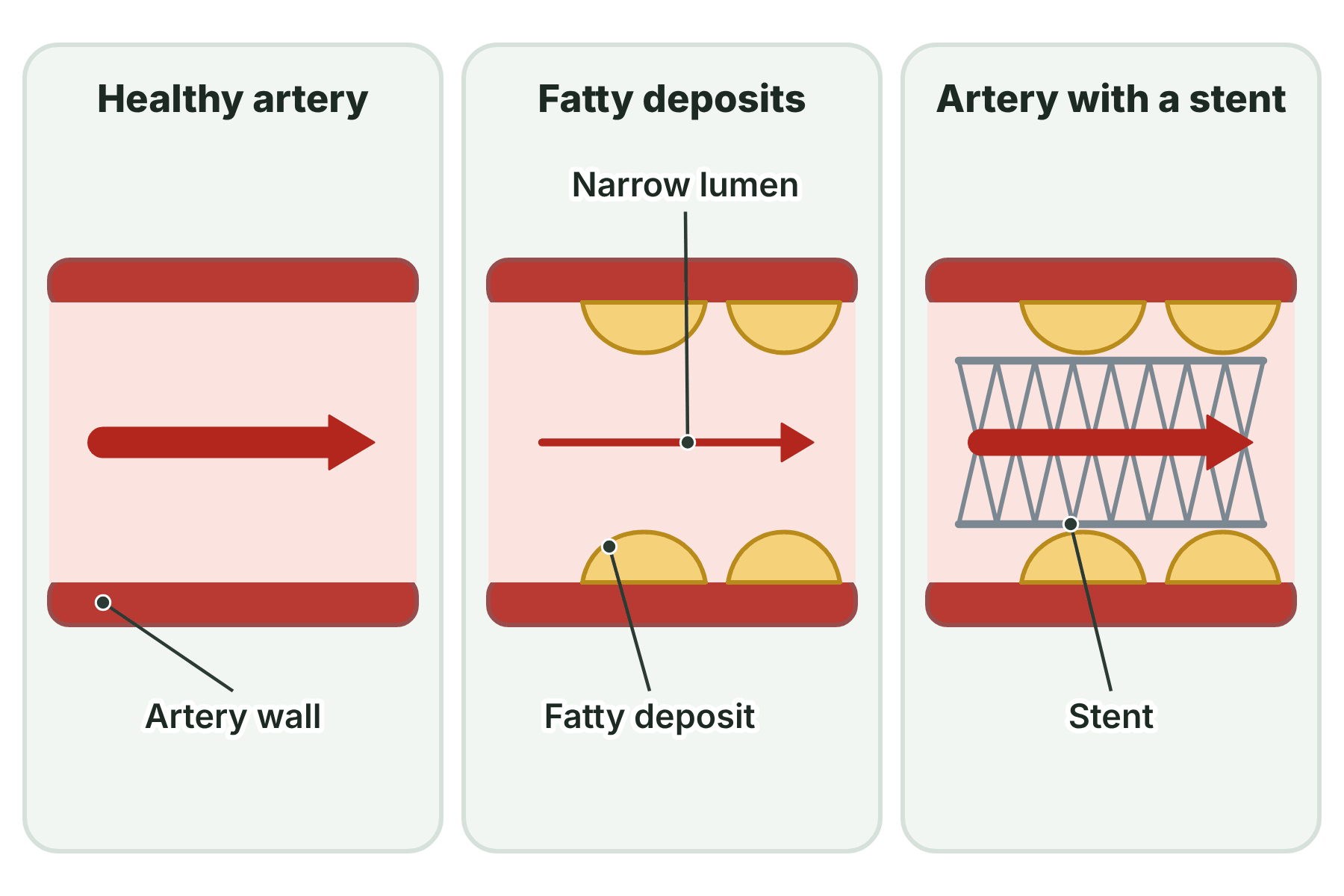
A stent holds a narrowed artery open so that blood can flow again.
Treating coronary heart disease
There are two main treatments for the arteries themselves.
-
Stents
A stent is a wire mesh tube that is pushed into the narrowed artery on a tiny balloon, then expanded to keep the artery open. Blood flows freely again, so the heart muscle gets oxygen. It needs surgery, and the artery can narrow again.
-
Statins
A statin is a drug that lowers the level of cholesterol in the blood. This slows down the rate at which fatty material is deposited in the arteries. It is taken regularly, and a few people have side effects such as muscle pain.
Faulty heart valves
Valves keep blood flowing the right way through the heart. In some people a valve stops working properly.
-
Valve does not open fully
The blood cannot flow through easily, so the heart has to work harder.
-
Valve leaks
Blood leaks backwards, so less blood is pumped out each time and the heart works harder.
-
Replacement valves
A faulty valve can be replaced with a biological valve, taken from an animal or a human donor, or with a mechanical valve, made from metal or plastic.
Heart failure
In heart failure the heart is too weak to pump enough blood.
-
Donor heart transplant
A healthy heart, or heart and lungs, from a donor can replace the diseased heart. The patient must take drugs for life so that the body does not reject the new heart, and there are not enough donors.
-
Artificial heart
A mechanical pump that does the work of the heart. It is occasionally used to keep a patient alive while they wait for a transplant, or to give the heart a rest while it recovers.
Drugs and mechanical devices compared
Drugs such as statins
- Easy to take, with no surgery
- Slow down the build-up of fatty deposits
- Have to be taken for a long time
- Can have side effects, and do not clear deposits that are already there
Devices such as stents and valves
- Work straight away
- Keep an artery open or replace a failing valve
- Need an operation, with risks of infection or bleeding
- A mechanical valve needs drugs to stop blood clotting, and a stent may narrow again
Evaluating a treatment
A patient has a heart valve that is leaking. Their doctor suggests a biological replacement valve instead of a mechanical one. Give one advantage and one disadvantage of a biological valve.
Show the solutionHide the solution
- 1 Think about what the valve is made of A biological valve is made of animal or human tissue. A mechanical valve is made of metal or plastic.
- 2 Give an advantage The body tolerates a biological valve better, so the patient usually does not need drugs to stop the blood clotting.
- 3 Give a disadvantage It does not last as long as a mechanical valve, so another operation may be needed.
AnswerAdvantage: the patient does not need to take blood-thinning drugs for life. Disadvantage: a biological valve wears out sooner, so it may need to be replaced again.
Case study
Why a heart transplant is not an easy answer
A heart transplant can give a new lease of life to a person with heart failure, but there are far fewer donor hearts than patients waiting. The new heart must also be matched to the patient, and the patient's immune system will try to attack it. To stop this rejection, patients take drugs for the rest of their lives, and these drugs make them more likely to catch infections. For these reasons, artificial hearts are sometimes used to keep people alive while they wait.
The exam skill
Every treatment for heart disease has benefits and risks, so a good answer always weighs both.
Coronary heart disease
Coronary heart disease
-
Cause
- fatty deposits narrow the coronary arteries
-
Effect
- less oxygen to the heart muscle
- chest pain
- heart attack
-
Drugs
- statins lower cholesterol
-
Devices
- stents
- replacement valves
- artificial hearts
-
Transplant
- donor heart
- shortage
- rejection drugs
Summary and exam focus
- In coronary heart disease, fatty deposits narrow the coronary arteries and reduce the oxygen reaching the heart muscle.
- Stents hold the arteries open, and statins lower cholesterol to slow the build-up of fatty material.
- Faulty valves can be replaced with biological or mechanical valves.
- In heart failure a donor heart, or a heart and lungs, may be transplanted.
- Artificial hearts keep patients alive while they wait for a transplant, or let the heart rest.
Exam focus
Evaluate the use of statins and stents to treat coronary heart disease. (6 marks) (6 marks)
A six-mark evaluation needs advantages and disadvantages of both treatments and a conclusion. Compare them: statins slow the problem with drugs, while a stent fixes a narrowing straight away but needs surgery.
Key terms
The words this lesson expects you to use. Each one is linked from the first place it appears above.
- Cardiovascular disease
- A disease of the heart or blood vessels.
- Non-communicable disease
- A disease that is not caused by a pathogen and cannot be passed from one person to another.
- Coronary heart disease
- A disease in which fatty deposits narrow the coronary arteries and reduce the blood flow to the heart muscle.
- Stent
- A wire mesh tube placed in an artery to hold it open.
- Statin
- A drug that lowers the level of cholesterol in the blood.
- Cholesterol
- A fatty substance in the blood that can build up in artery walls.
- Biological valve
- A replacement heart valve made from animal or human tissue.
- Mechanical valve
- A replacement heart valve made from metal or plastic.
- Transplant
- An operation that replaces a diseased organ with a healthy one from a donor.
You've finished the notes
Check your understanding
Test yourself while it is fresh. Start with the flashcards, then try the exam questions.
Something here looks wrong?
Tell us what and we will go and look. It goes to whoever writes these pages, nobody else, and we do not ask who you are — so there is nothing to sign and nothing comes back to you.