Exam questions · Biology · Evidence for Evolution and Classification
Antibiotic-resistant Bacteria
- 7 exam questions
- 24 marks
- 8 quick checks
-
1 State [1 mark]
Why can bacteria evolve rapidly?
Show answerHide answer
Model answer
They reproduce at a fast rate.
Mark scheme
- They reproduce at a fast rate — 1 mark
-
2 Explain [5 marks]
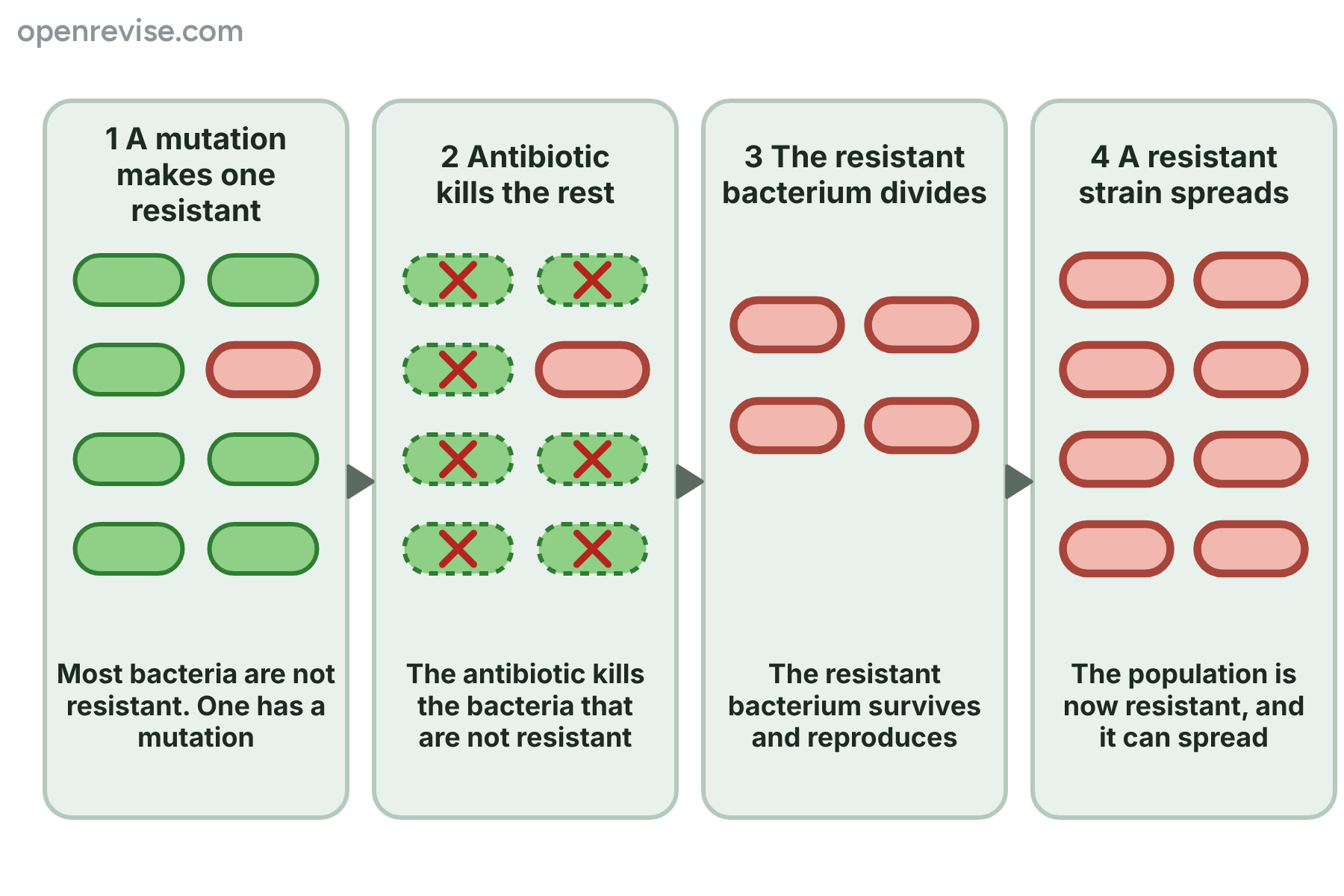
The diagram shows a population of bacteria exposed to an antibiotic. Explain how the diagram shows evolution by natural selection.
Show answerHide answer
Model answer
There is variation, as a mutation has made one bacterium resistant. The antibiotic acts as a selection pressure and kills the non-resistant bacteria. The resistant bacterium survives and reproduces, passing on the resistance allele. So the resistant strain becomes the whole population.
Mark scheme
- A mutation gives variation — 1 mark
- The antibiotic kills the non-resistant bacteria — 1 mark
- The resistant bacterium survives — 1 mark
- It reproduces and passes on the allele — 1 mark
- The resistant strain becomes more common — 1 mark
-
3 Calculate [3 marks]
A resistant bacterium divides once every 20 minutes. Calculate how many resistant bacteria there will be after 3 hours.
Show answerHide answer
Model answer
512 bacteria. 3 hours is 180 minutes, so there are \(180 \div 20 = 9\) divisions, and \(2^9 = 512\).
Mark scheme
- \(180 \div 20 = 9\) divisions — 1 mark
- \(2^9\) — 1 mark
- 512 — 1 mark
-
4 Explain [3 marks]
A patient with a bacterial infection stops taking antibiotics after three days, when they begin to feel better. Explain why this could lead to a resistant strain.
Show answerHide answer
Model answer
After three days not all the bacteria have been killed. The surviving bacteria are the ones that are most able to survive the antibiotic, and they may mutate. They reproduce, so the strain with resistance could become common and spread to other people.
Mark scheme
- Some bacteria are still alive — 1 mark
- Survivors are best able to withstand the antibiotic, and may mutate — 1 mark
- They reproduce and may form a resistant strain — 1 mark
-
5 Explain [3 marks]
A patient has a cold, which is caused by a virus, and asks the doctor for antibiotics. Explain why the doctor should not prescribe them.
Show answerHide answer
Model answer
Antibiotics do not kill viruses, so they will not cure the cold. Taking them would only expose the patient's own bacteria to the antibiotic, which selects any that are resistant. This helps to increase the number of resistant strains.
Mark scheme
- Antibiotics do not kill viruses — 1 mark
- They would expose bacteria to the antibiotic, selecting resistant ones — 1 mark
- This increases the development of resistant strains — 1 mark
-
6 Explain [3 marks]
Explain why the development of new antibiotics is unlikely to solve the problem of antibiotic resistance.
Show answerHide answer
Model answer
The development of new antibiotics is costly and slow. Bacteria reproduce at a fast rate, so resistant strains to the new antibiotics can appear quickly. New antibiotics are therefore unlikely to keep up with new resistant strains.
Mark scheme
- Development is costly and slow — 1 mark
- Bacteria reproduce quickly so resistance appears again — 1 mark
- New drugs unlikely to keep up with resistant strains — 1 mark
-
7 Evaluate [6 marks]
A government is deciding whether to ban the use of antibiotics on healthy farm animals. Evaluate the proposal.
Show answerHide answer
Model answer
Banning the use of antibiotics on healthy farm animals would reduce the chance that bacteria are exposed to antibiotics, so there would be less selection for resistant strains. Resistant strains from animals can spread to people in food or by contact, so the ban could reduce the spread. However, farmers use antibiotics to stop diseases spreading in crowded conditions, so without them more animals might become ill, and animal welfare and food production could suffer, and food costs might increase. Overall, since resistance is a serious threat to human health, the ban is likely to be justified, as long as farmers have other ways, such as better hygiene, to keep animals healthy.
Mark scheme
- Less exposure, so less selection for resistance — 1 mark
- Resistant strains can spread from animals to people — 1 mark
- Antibiotics prevent disease in crowded farms — 1 mark
- Animal welfare or food production could suffer — 1 mark
- Higher food costs or alternatives such as better hygiene — 1 mark
- A reasoned conclusion — 1 mark
Quick check
-
1
Why can bacteria evolve quickly?
Show answerHide answer
A: They reproduce at a fast rate
They reproduce at a fast rate, so there are many generations in a short time.
-
2
How do resistant strains of bacteria first arise?
Show answerHide answer
C: Mutations in the bacteria
Mutations produce new strains, some of which may be resistant.
-
3
What happens to resistant bacteria when an antibiotic is used?
Show answerHide answer
B: They survive and reproduce
They are not killed, so they survive and reproduce.
-
4
Which of these is resistant to antibiotics?
Show answerHide answer
D: MRSA
MRSA is resistant to antibiotics.
-
5
Why should patients complete their course of antibiotics?
Show answerHide answer
A: So that all bacteria are killed
So that all the bacteria are killed and none survive to mutate and form resistant strains.
-
6
Why are antibiotics not given for viral infections?
Show answerHide answer
C: They do not kill viruses
Antibiotics do not kill viruses, and using them would help to select resistant bacteria.
-
7
Why might the agricultural use of antibiotics be restricted?
Show answerHide answer
D: It increases the chance of resistant strains
It gives bacteria more opportunities to evolve resistance, which can spread to people.
-
8
Why are new antibiotics unlikely to solve resistance?
Show answerHide answer
B: They are slow to develop and resistance appears again
They are costly and slow to develop, and resistant strains can appear again quickly.