Biology · Evidence for Evolution and Classification
Antibiotic-resistant Bacteria
Natural selection is not just something that happened millions of years ago. It is happening in hospitals today. This lesson is for both Combined Science and separate Biology. It explains how bacteria evolve resistance to antibiotics, why MRSA is a problem, and what can be done to slow the spread of resistance.
Learning Objectives
- 1Explain how antibiotic-resistant strains of bacteria evolve by natural selection.
- 2Explain why bacteria can evolve rapidly, and why resistant strains spread.
- 3Describe how the rate of development of resistant strains can be reduced.
- 4Explain why the development of new antibiotics is unlikely to keep up with new resistant strains.
Retrieval practice
-
1
What is a mutation?
Show answerHide answer
A change in the base sequence of DNA.
-
2
What are antibiotics used for?
Show answerHide answer
To kill bacteria that cause disease inside the body.
-
3
Do antibiotics kill viruses?
Show answerHide answer
No. They only kill bacteria.
-
4
What is natural selection?
Show answerHide answer
The process in which individuals best suited to their environment survive and breed, passing on their alleles.
Evolution you can watch
Bacteria reproduce at a very fast rate, so a new generation can appear in as little as twenty minutes. That means evolution by natural selection can be seen in a few days, not millions of years. This is why resistance to antibiotics is evidence for the theory of evolution, and also why it is a serious problem for medicine.
How a resistant strain evolves
Use the same steps as in any example of natural selection.
-
1
Variation
Mutations of bacterial pathogens produce new strains. A mutation may make a strain resistant to an antibiotic.
-
2
Selection pressure
When the antibiotic is used, bacteria that are not resistant are killed.
-
3
Survival
Strains that are resistant are not killed. They survive.
-
4
Reproduction
The survivors reproduce, so the population of the resistant strain rises.
-
5
Spread
The resistant strain spreads, because people are not immune to it and there is no effective treatment.
Natural selection in bacteria
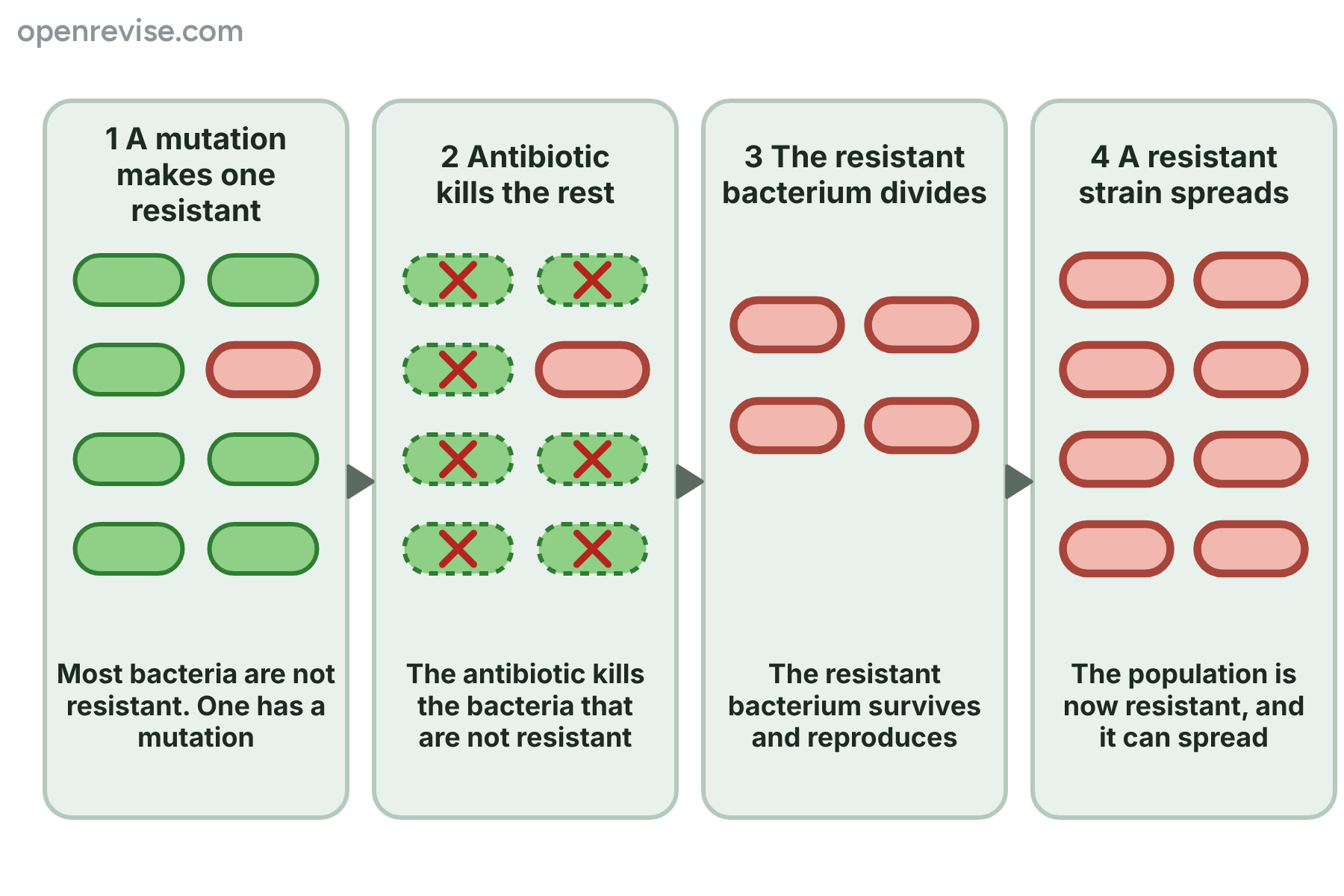
The antibiotic selects the resistant bacteria, which then reproduce.
Why bacteria evolve so quickly
Resistance can appear within a few years of a new antibiotic being used.
-
Fast reproduction
Bacteria can evolve rapidly because they reproduce at a fast rate. Some divide every 20 minutes, so one cell can make millions in a day.
-
Many individuals
A single infection may contain billions of bacteria, so even a rare mutation is likely to appear in at least one.
-
New strains
Mutations of bacterial pathogens produce new strains, which may differ in their response to antibiotics.
-
Passing on
Resistant bacteria pass the allele on to their offspring when they divide, and some can pass genes to other bacteria.
How fast does a resistant population grow?
One resistant bacterium divides every 30 minutes. If conditions stay the same, how many resistant bacteria will there be after 6 hours?
Show the solutionHide the solution
- 1 Find the number of divisions 6 hours is 360 minutes, and \(360 \div 30 = 12\) divisions
- 2 Each division doubles the number After 12 divisions the number is \(2^{12}\)
- 3 Calculate \(2^{12} = 4096\)
Answer4 096 bacteria
Case study
MRSA
MRSA, which stands for methicillin-resistant Staphylococcus aureus, is resistant to antibiotics. Staphylococcus aureus lives harmlessly on the skin of many people, but if it enters a wound it can cause serious infections. MRSA was first found in UK hospitals in 1961, soon after methicillin was introduced. Patients in hospital, who are ill and have wounds, are at greatest risk, so hospitals use strict hygiene and isolate infected patients.
Reducing the development of resistance
We cannot stop resistance appearing, but we can slow the rate at which it develops.
-
Appropriate prescribing
Doctors should not prescribe antibiotics inappropriately, such as for non-serious infections or for viral infections, which antibiotics cannot kill.
-
Finishing the course
Patients should complete their course of antibiotics, so all the bacteria are killed and none survive to mutate and form resistant strains.
-
Agriculture
The agricultural use of antibiotics should be restricted, because giving them to healthy animals gives bacteria more chances to evolve resistance.
-
Hygiene
Good hygiene, such as handwashing, reduces the spread of resistant strains.
The problem with new antibiotics
Scientists are always looking for new antibiotics, but it is a race that is hard to win.
-
Slow and costly
The development of new antibiotics is costly and slow, and can take about ten years or more to test.
-
Resistance appears again
Resistant strains to a new antibiotic can emerge within a few years of its use.
-
Not keeping up
New antibiotics are unlikely to keep up with the emergence of new resistant strains.
-
Little profit
Drug companies earn less from antibiotics, which are taken for a short time, than from drugs for long-term conditions.
Resistant and non-resistant bacteria
Non-resistant bacteria
- Killed by the antibiotic
- Survive only if the antibiotic is not present
- Their alleles become less common when the antibiotic is used
- Infections can be cured
Resistant bacteria
- Not killed by the antibiotic
- Survive and reproduce when the antibiotic is used
- Their alleles become more common
- Infections are hard to treat
The big idea
Every time an antibiotic is used, it selects the bacteria that can survive it, so careless use of antibiotics makes resistance more common.
Antibiotic resistance
Antibiotic resistance
-
Cause
- mutations in bacteria
- antibiotic kills non-resistant ones
-
Why fast
- bacteria reproduce at a fast rate
-
Spread
- people are not immune
- no effective treatment
-
MRSA
- resistant to antibiotics
-
Slowing it
- prescribe only when needed
- finish the course
- restrict farm use
-
New drugs
- costly and slow
- unlikely to keep up
Summary and exam focus
- Bacteria can evolve rapidly because they reproduce at a fast rate.
- Mutations of bacterial pathogens produce new strains, and some strains might be resistant to antibiotics.
- Resistant bacteria are not killed, so they survive and reproduce, and the population of the resistant strain rises.
- The resistant strain spreads because people are not immune to it and there is no effective treatment.
- Resistance can be slowed by not prescribing antibiotics inappropriately, by completing courses and by restricting agricultural use.
Exam focus
Explain how a population of bacteria can become resistant to an antibiotic. (5 marks) (5 marks)
Use the steps of natural selection in order and name the bacteria and the antibiotic in each step: mutation, antibiotic kills non-resistant bacteria, resistant survive and reproduce, so the resistant strain becomes more common. Do not say the bacteria "learn" or "adapt on purpose".
Key terms
The words this lesson expects you to use. Each one is linked from the first place it appears above.
- Antibiotic
- A drug that kills bacteria or stops them growing, without harming human cells.
- Resistant
- Not killed by an antibiotic.
- Strain
- A genetically different type of the same species of microorganism.
- Pathogen
- A microorganism that causes disease.
- MRSA
- A strain of bacteria that is resistant to many antibiotics.
- Mutation
- A change in the base sequence of DNA.
- Natural selection
- The process in which the best-suited individuals survive and breed.
- Immune
- Protected against a particular pathogen.
You've finished the notes
Check your understanding
Test yourself while it is fresh. Start with the flashcards, then try the exam questions.
Something here looks wrong?
Tell us what and we will go and look. It goes to whoever writes these pages, nobody else, and we do not ask who you are — so there is nothing to sign and nothing comes back to you.