Exam questions · Biology · Evidence for Evolution and Classification
Classification and the Linnaean System
- 7 exam questions
- 21 marks
- 8 quick checks
-
1 Name [2 marks]
Name the smallest and the largest groups in the Linnaean system of classification.
Show answerHide answer
Model answer
The smallest group is the species. The largest group is the kingdom.
Mark scheme
- Species is the smallest — 1 mark
- Kingdom is the largest — 1 mark
-
2 Give [3 marks]
Write the seven ranks of the Linnaean system in order, starting with the largest group.
Show answerHide answer
Model answer
Kingdom, phylum, class, order, family, genus, species.
Mark scheme
- Kingdom, phylum, class in order — 1 mark
- Order and family in order — 1 mark
- Genus and species in the right order — 1 mark
-
3 Explain [3 marks]
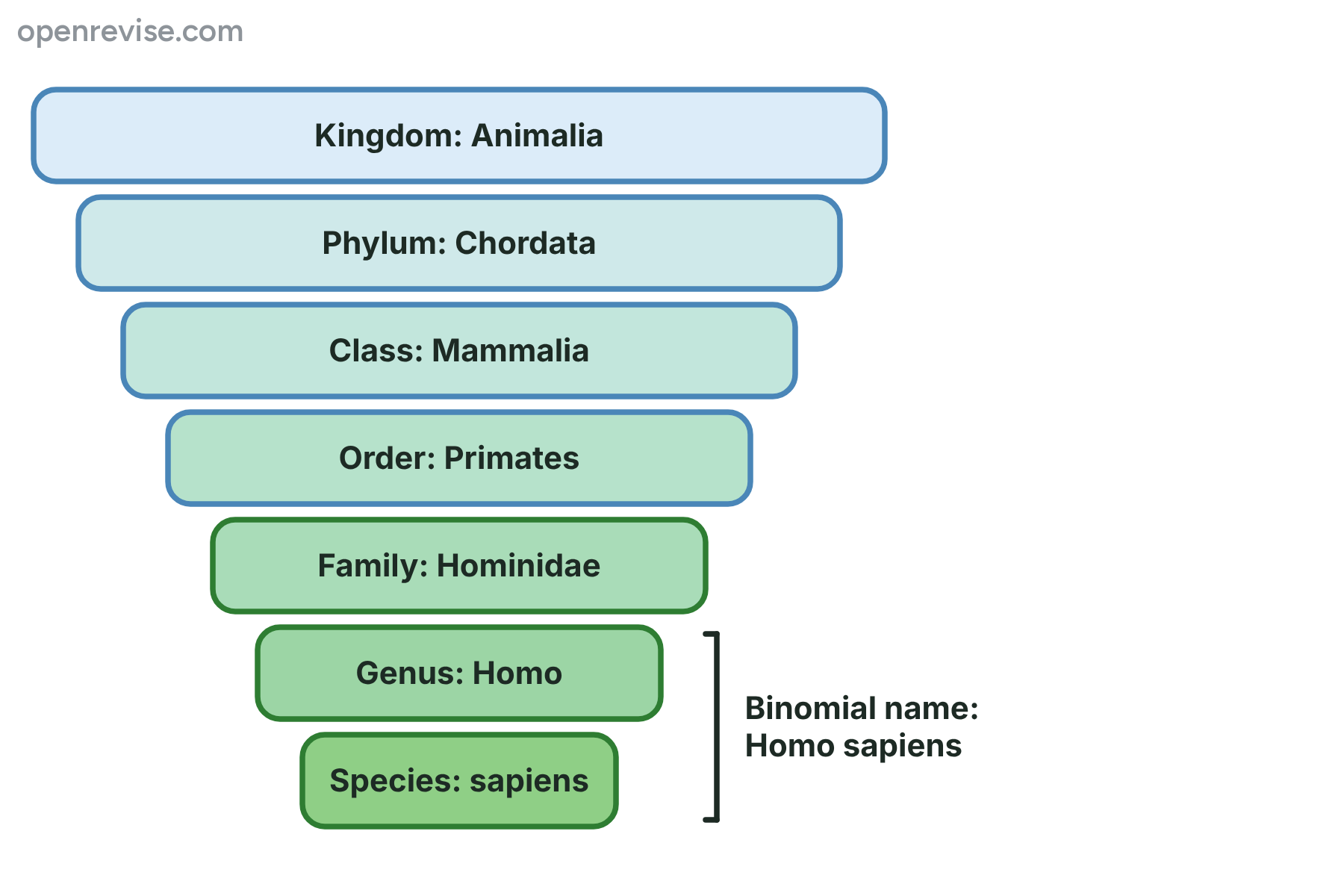
The diagram shows the classification of humans. Explain how the binomial name for humans is made up, and why the bars get narrower.
Show answerHide answer
Model answer
The binomial name has two parts, the genus followed by the species, so it is Homo sapiens. The bars get narrower because each group is divided into smaller groups, so there are fewer organisms in each rank down, and they have more characteristics in common.
Mark scheme
- Genus followed by species — 1 mark
- Homo sapiens — 1 mark
- Each rank has fewer organisms, which are more alike — 1 mark
-
4 Explain [3 marks]
The classification of four mammals is shown. Mammal W: Panthera leo. Mammal X: Panthera tigris. Mammal Y: Felis catus. Mammal Z: Canis lupus. Which two mammals are most closely related? Explain your answer.
Show answerHide answer
Model answer
Mammals W and X are most closely related. They are in the same genus, Panthera, which means that they share more ranks than any other pair. Y is in a different genus of the same family, and Z is in a different family.
Mark scheme
- W and X — 1 mark
- Same genus (Panthera) — 1 mark
- They share more groups than other pairs — 1 mark
-
5 Describe [3 marks]
Describe how organisms are named using the binomial system.
Show answerHide answer
Model answer
Each organism has a name of two parts. The first part is the genus, written with a capital letter, and the second part is the species, written with a lower case letter. The name is written in italics, or underlined if handwritten.
Mark scheme
- Two names — 1 mark
- Genus then species — 1 mark
- Capital letter for the genus and lower case for the species — 1 mark
-
6 Explain [3 marks]
Explain why scientists use scientific names for organisms rather than common names.
Show answerHide answer
Model answer
Common names are different in different countries and languages. The same common name may be used for more than one species. A scientific name is the same everywhere and identifies only one species.
Mark scheme
- Common names vary between countries — 1 mark
- A common name may refer to more than one species — 1 mark
- A scientific name is the same everywhere — 1 mark
-
7 Evaluate [4 marks]
Evaluate the Linnaean system of classification as a way of showing how closely organisms are related.
Show answerHide answer
Model answer
The system is useful because organisms in the same group share structures and characteristics, and the lower the rank they share, the more closely they are related. It is standard and used worldwide. However, it is based on structure, so organisms that look similar may be grouped together even if they are not closely related, and it cannot show how recently species diverged. New evidence has led to changes.
Mark scheme
- Groups organisms by shared characteristics — 1 mark
- Standard and used worldwide — 1 mark
- Based on structure, so may not show true ancestry — 1 mark
- Has been changed by new evidence — 1 mark
Quick check
-
1
Who developed the system of classification into kingdom, phylum, class, order, family, genus and species?
Show answerHide answer
C: Carl Linnaeus
Carl Linnaeus developed the system.
-
2
Which is the smallest group in the Linnaean system?
Show answerHide answer
B: Species
The species is the smallest group.
-
3
Which is the correct order of ranks from largest to smallest?
Show answerHide answer
D: Kingdom, phylum, class, order, family, genus, species
Kingdom, phylum, class, order, family, genus, species.
-
4
What does the binomial system use to name an organism?
Show answerHide answer
A: Its genus and species
Binomial means two names: the genus and the species.
-
5
Which is the correct way to write the scientific name of humans?
Show answerHide answer
C: Homo sapiens
The genus has a capital letter and the species has a lower case letter: Homo sapiens.
-
6
Two organisms are in the same genus. What does this show?
Show answerHide answer
B: They are very closely related
Organisms in the same genus are very closely related.
-
7
What is the Linnaean system mainly based on?
Show answerHide answer
D: Their structure and characteristics
Traditionally organisms were grouped by their structure and characteristics.
-
8
Why is a scientific name better than a common name?
Show answerHide answer
A: It is the same everywhere and names one species
It is the same all over the world and refers to one species.