Biology · Evidence for Evolution and Classification
Classification and the Linnaean System
There are millions of species on Earth, and biologists need a system to name and sort them. This lesson is for both Combined Science and separate Biology. It covers the Linnaean system of classification, the seven ranks from kingdom to species, and the binomial system of naming organisms.
Learning Objectives
- 1Describe the Linnaean system of classification, which groups living things by their structure and characteristics.
- 2Name the seven ranks from kingdom to species, and explain how the groups get smaller.
- 3Explain the binomial system of naming organisms with a genus and a species.
- 4Use given information to show understanding of the Linnaean system.
Retrieval practice
-
1
What is a species?
Show answerHide answer
A group of organisms that can interbreed to produce fertile offspring.
-
2
What is natural selection?
Show answerHide answer
The process in which individuals best suited to their environment survive and breed, passing on their alleles.
-
3
What is variation?
Show answerHide answer
Differences in the characteristics of individuals in a population.
-
4
Name two kingdoms of living things.
Show answerHide answer
For example animals and plants (also fungi and protists).
Sorting living things
Biologists have identified millions of species, and every one needs a name that scientists everywhere will understand. Traditionally living things have been classified into groups depending on their structure and characteristics, in a system developed by Carl Linnaeus, an eighteenth-century Swedish botanist. Because the groups are nested, one inside another, the system also shows how closely organisms resemble each other.
The Linnaean system
Linnaeus classified living things into seven ranks, from the largest group down to the smallest.
-
Kingdom
The largest group, such as animals or plants. All animals are in the animal kingdom.
-
Phylum, class and order
Each kingdom is divided into phyla, each phylum into classes and each class into orders. Each group is smaller and its members have more in common.
-
Family and genus
Each order is divided into families, and each family into genera, which are groups of very similar species.
-
Species
The smallest group, containing organisms that can breed together to produce fertile offspring.
The ranks of the Linnaean system
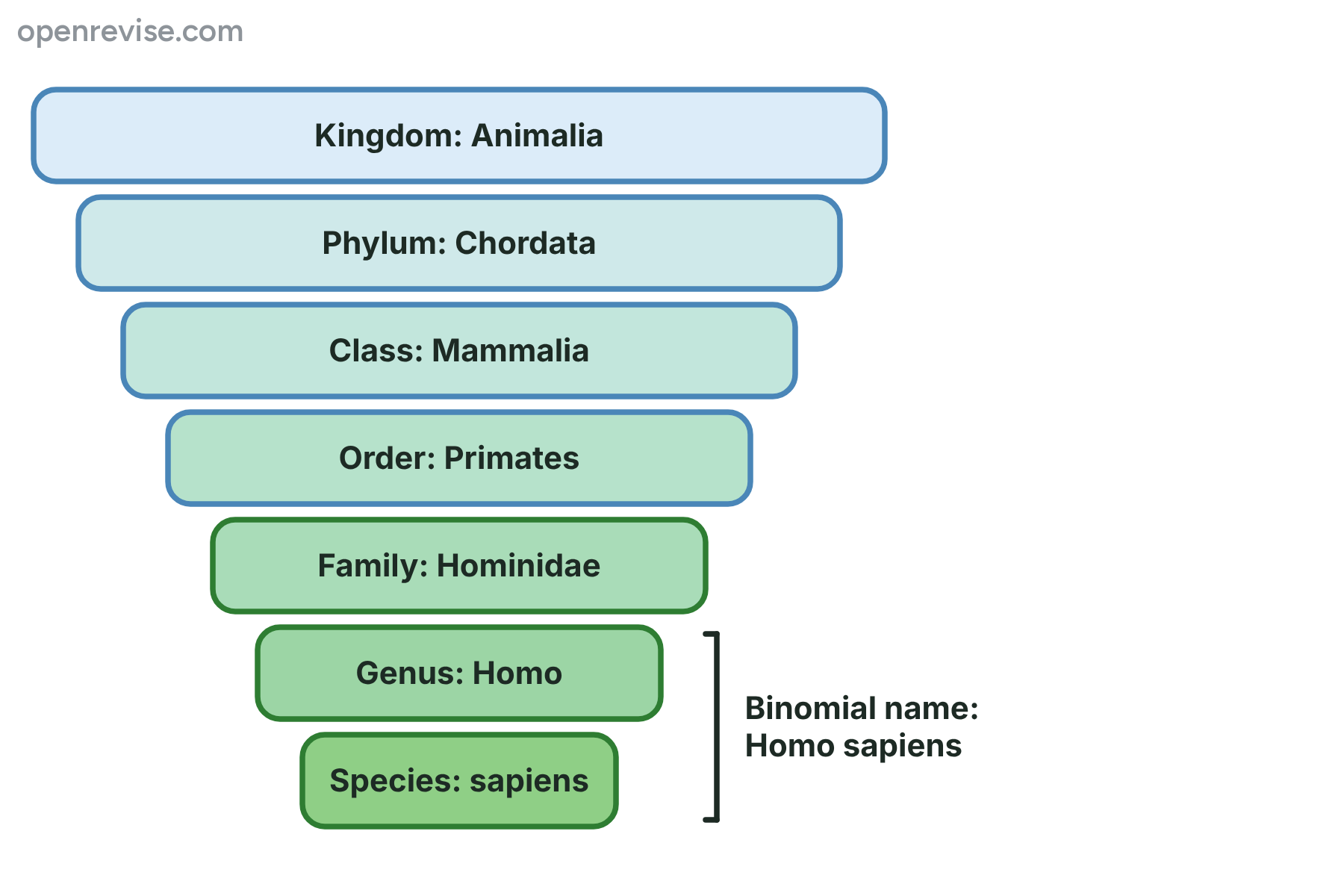
Each rank is smaller than the one above, so the organisms in it are more alike.
Remembering the order
The order matters, and examiners can ask for it in either direction.
-
1
Kingdom
The biggest group, so the least in common.
-
2
Phylum
The next group down.
-
3
Class
Includes animals such as mammals, birds and reptiles.
-
4
Order
Includes groups such as the primates and the carnivores.
-
5
Family
A group of closely related genera.
-
6
Genus
A group of closely related species. It is the first part of the species name.
-
7
Species
The smallest group. It is the second part of the name.
The binomial system
Linnaeus also gave scientists a standard way of naming each organism, called the binomial system.
-
Two names
Organisms are named by the binomial system of genus and species. Binomial means two names.
-
How it is written
The genus has a capital letter, and the species does not. Both are written in italics, or underlined if handwritten, as in Homo sapiens.
-
Same genus, close relatives
Lions (Panthera leo) and tigers (Panthera tigris) are in the same genus, so they are closely related.
-
Why use it
Common names vary between countries and may refer to more than one species. A scientific name is the same everywhere.
Using classification data
The table shows the classification of four animals. Which two animals are most closely related?
Show the solutionHide the solution
- 1 Lion Animalia, Chordata, Mammalia, Carnivora, Felidae, Panthera, leo
- 2 Tiger Animalia, Chordata, Mammalia, Carnivora, Felidae, Panthera, tigris
- 3 Domestic cat Animalia, Chordata, Mammalia, Carnivora, Felidae, Felis, catus
- 4 Wolf Animalia, Chordata, Mammalia, Carnivora, Canidae, Canis, lupus
- 5 Compare The lion and tiger share the same kingdom to genus (six ranks). The cat shares five ranks with them and the wolf shares four
AnswerThe lion and the tiger are the most closely related, because they share the most ranks, including the same genus, Panthera.
Features of the system
Strengths
- A standard way of naming and sorting organisms
- Scientists everywhere use the same name
- Shows how closely related organisms are
- Easy to add newly discovered species
Limits
- Based on structure, so may group organisms by appearance, not ancestry
- Cannot show how recently species diverged
- New evidence has led to changes in classification
- Some organisms are hard to place
Case study
Carl Linnaeus
Carl Linnaeus was a Swedish botanist who, in the 1730s and 1750s, set out a system for naming and classifying living things. He grouped organisms according to shared structures, for example classifying plants by the number of their reproductive parts. His book Systema Naturae went through many editions and ended up describing thousands of species. His two-part names are still used for every species today.
The big idea
The Linnaean system sorts organisms into groups inside groups, and every species has a two-part name made of its genus and species.
Linnaean classification
Linnaean classification
-
Ranks
- kingdom
- phylum
- class
- order
- family
- genus
- species
-
Groups
- each is smaller and more alike than the last
-
Binomial name
- genus then species
- Homo sapiens
-
Basis
- structure and characteristics
-
Use
- a standard name worldwide
- shows relatedness
Summary and exam focus
- Traditionally living things have been classified into groups depending on their structure and characteristics in a system developed by Carl Linnaeus.
- Linnaeus classified living things into kingdom, phylum, class, order, family, genus and species.
- Organisms are named by the binomial system of genus and species.
- Each group is smaller than the one above it, so the organisms in it have more in common.
- You should be able to use information given to show understanding of the Linnaean system.
Exam focus
The scientific name of the grey wolf is Canis lupus. State what is meant by a binomial name, and name the genus and species of the grey wolf. (3 marks) (3 marks)
Say that a binomial name has two parts, the genus first and the species second. Then name each: genus Canis (with a capital letter) and species lupus. Write the name carefully, because examiners look for the capital and the lower case.
Key terms
The words this lesson expects you to use. Each one is linked from the first place it appears above.
- Classification
- Sorting living things into groups according to their characteristics.
- Linnaean system
- A system that classifies living things into kingdom, phylum, class, order, family, genus and species.
- Kingdom
- The largest group in the Linnaean system, such as animals or plants.
- Genus
- A group of very similar species, and the first part of a binomial name.
- Species
- The smallest group in the system, and the second part of a binomial name.
- Binomial system
- Naming an organism using its genus and species.
- Taxonomy
- The science of naming and classifying living things.
- Carl Linnaeus
- The Swedish scientist who developed the system of classification and the binomial naming system.
You've finished the notes
Check your understanding
Test yourself while it is fresh. Start with the flashcards, then try the exam questions.
Something here looks wrong?
Tell us what and we will go and look. It goes to whoever writes these pages, nobody else, and we do not ask who you are — so there is nothing to sign and nothing comes back to you.